


Empire Gilded Light Fixture
An empire gilded light fixture brings French Neoclassical weight and metallic warmth into a room, offering grand illumination through traditional brass, bronze and crystal.

Empire Gilded Light Fixture
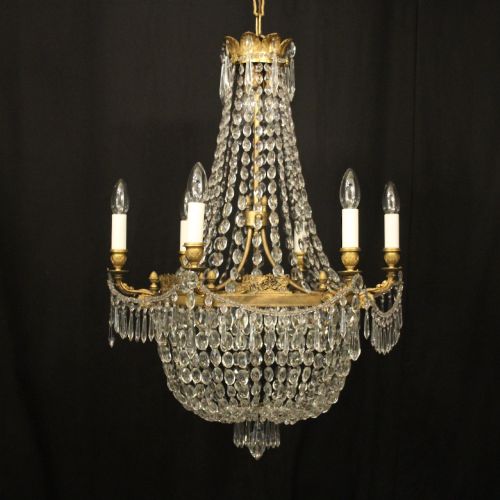
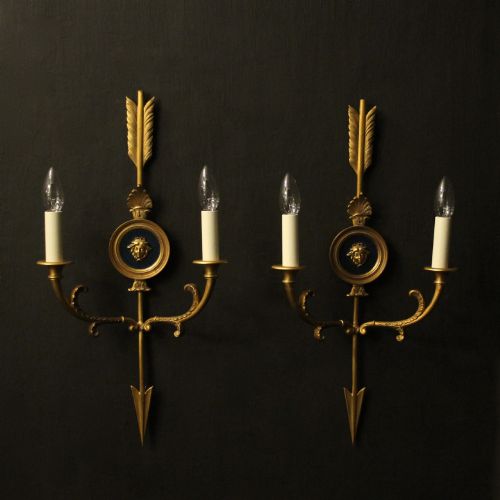
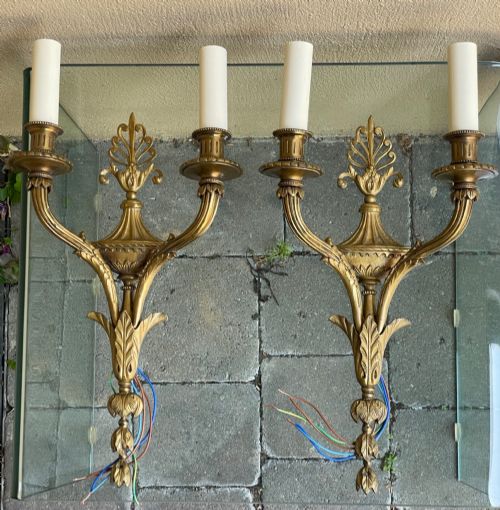
An empire gilded light fixture is defined by French Empire, Neoclassical and Rococo styling executed in brass, bronze and giltwood. These pieces range from multi-arm chandeliers to twin arm wall lights designed for interior illumination.
The versions most commonly met on this page date from the nineteenth century and the early decades of the twentieth century, including years such as 1900, 1910, 1920 and 1930. They originate predominantly from French traditions and take the form of chandeliers, wall sconces and ceiling lights.
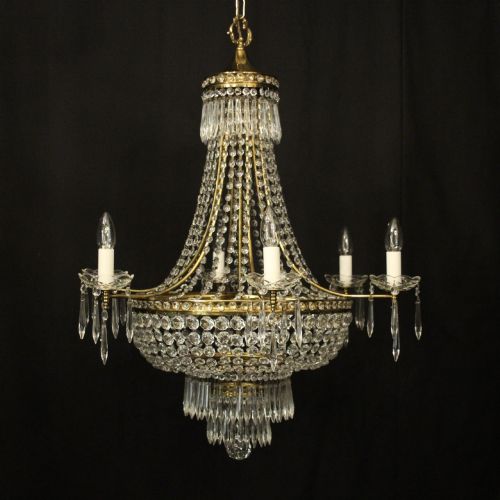
Buyers encounter substantial multi-light configurations alongside paired wall fixtures. These chandeliers often incorporate tent and waterfall structures or cut glass baskets suspended from metal frames.
Materials and construction methods
Makers utilised cast and patinated metals, forming structures primarily from gilded bronze, gilded brass and solid brass. These metallic bodies received gold leaf or gilt finishes to catch and reflect candlelight or early electric illumination.
Crystal glass and cut glass elements were integrated into larger designs, forming cascading waterfalls and tent formations beneath the main metal coronas. Giltwood was also employed for specific wall sconces, carved and gilded to match the metallic aesthetic.
The documented object types across these selections include multi-arm chandeliers, tent and waterfall designs, and paired wall sconces.
Judging quality and execution
Quality in these fixtures rests on the crispness of the metal casting and the depth of the gilding. Heavier bronze frames with sharply chiselled ornamentation stand apart from lighter brass or mixed metal alternatives.
The integration of crystal elements dictates the upper tier of the range. Uniformly cut glass components and complex multi-arm arrangements demonstrate superior workshop output compared to simpler single-tier configurations.
The Empire Gilded Light Fixture Glossary
- Empire
- A stylistic period drawing on ancient Roman, Greek and Egyptian motifs. It dictates the symmetrical, formal lines and classical ornamentation seen on these fixtures.
- Gilt Bronze
- Bronze metal that has been coated with a layer of gold. It provides a durable, rich metallic surface that resists tarnishing over decades.
- Tent and Waterfall
- A lighting configuration where strings of crystal beads form an upper tent shape above a cascading waterfall of glass drops. This arrangement disperses light across a wide angle.
- Wall Sconce
- A light fixture affixed directly to a vertical wall surface. These pieces usually feature twin arms or single candle branches matching larger ceiling chandeliers.
Empire Gilded Light Fixture: Frequently Asked Questions
How do I install an antique empire chandelier?
Professional electrical installation is necessary for these heavy metal and crystal fixtures. The internal wiring must support the weight and voltage requirements safely.
Weight distribution requires secure anchoring into ceiling joists rather than standard plasterboard. A licensed electrician ensures the fixture hangs level and meets modern safety standards.
What rooms suit an empire gilded light fixture?
Dining rooms, formal halls and high-ceilinged living spaces accommodate the scale and illumination of multi-arm chandeliers. Their metallic presence anchors traditional interior schemes.
Smaller spaces benefit from paired wall sconces which offer vertical symmetry and secondary lighting. These fixtures complement period properties and classical architectural details.
How do I clean gilded bronze and crystal?
Dusting requires a soft feather brush or dry microfiber cloth to prevent abrasion to the delicate gilt surface. Liquid cleaners can damage aged gilding if applied incorrectly.
Crystal drops may be removed individually and washed in warm soapy water before drying thoroughly. Metal components should remain untouched by harsh chemical solvents.
How do I identify a French empire lighting piece?
Key indicators include Neoclassical motifs such as laurel wreaths, urns and symmetrical architectural lines. The use of fire-gilded bronze provides a distinctive warm lustre.
Construction techniques from the nineteenth and early twentieth centuries reveal hand-cast metal components rather than modern stamped steel. France remains the primary source for these specific design characteristics.