
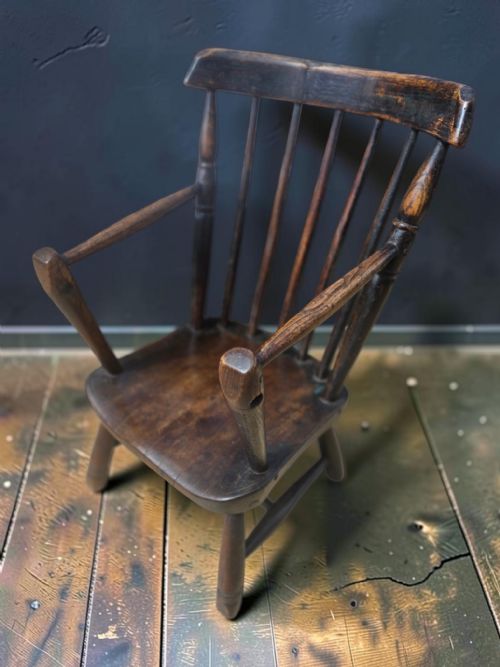
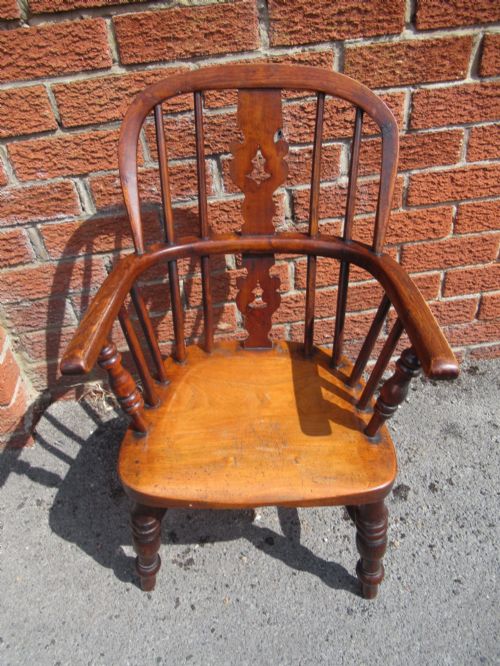


Elm Child Windsor Chair
An elm child windsor chair brings miniature vernacular craftsmanship into domestic spaces, offering sturdy seating designed for the smallest members of the household.
Elm Child Windsor Chair
An elm child windsor chair is a scaled-down version of adult country seating, constructed with a solid wooden seat into which the legs and back spindles are wedged directly. These small chairs survive from the eighteenth and nineteenth centuries, reflecting the domestic life and regional furniture-making traditions of Georgian, Regency, and Victorian England.
The pieces appearing on this page include armchairs, rocking chairs, high chairs, and stick-back or hoop-back variants. Elm seats feature frequently, often paired with ash, yew, beech, oak, or fruitwood for the bending parts, spindles, and legs.
Makers working within English regional vernacular styles produced these diminutive seats using traditional bodging and chair-making techniques. Each survivor demonstrates how local cabinet-makers adapted full-sized seating designs for children.
Materials and construction methods
Elm provides the solid, resilient seat board, chosen for its interlocking grain that resists splitting when legs and spindles are driven in. Country makers combined this durable timber with ash, yew, beech, or fruitwood for bent bow backs, steam-bent arms, and slender turned spindles.
Construction relies on through-wedged tenons and socket joints, where turned legs and back pillars fit into bored holes in the shaped seat. This method creates a rigid frame without metal fixings, allowing the timber components to move naturally with changes in humidity.
Listings feature elm combined with ash, yew, beech, oak, and fruitwood across Georgian, Regency, and Victorian periods.
Judging quality and proportion
Quality rests upon the harmony of miniature proportions and the selection of figured timbers. Superior examples maintain the structural elegance of adult Windsors while scaling down every component with balanced precision.
The choice of secondary woods also signals distinction, particularly where yew or fruitwood is used alongside elm for visual contrast and grain patterning. Retention of original surface finishes and structural integrity without excessive replacement parts elevates an example further.
The Elm Child Windsor Chair Glossary
- Windsor chair
- A chair built with a solid wooden seat into which the legs and back uprights are fitted directly. This form relies on a heavy plank seat rather than a hollowed frame.
- Crinoline stretcher
- A bent metal or wooden-hooped brace connecting the legs of a chair to provide rigidity. It curves horizontally beneath the seat, often seen on eighteenth-century regional seating.
- Hoop back
- A continuous steam-bent rail forming the back and arms of a chair in a single curved sweep. This technique requires straight-grained timber capable of severe bending.
- Stick back
- A chair back constructed from plain turned spindles rather than a solid carved splat. These vertical members support the top rail and distribute weight evenly.
- Vernacular furniture
- Domestic items made by local tradesmen using regional materials and traditional methods rather than adhering to metropolitan fashion. These pieces serve practical household functions.
Elm Child Windsor Chair: Frequently Asked Questions
How were these chairs used historically?
These small seats served young children during meals, seated at low tables or raised via high chair frames. They functioned as everyday items in domestic nurseries and farmhouses across generations.
Families relied on sturdy wooden construction to withstand daily use by infants and toddlers. Their survival indicates they held a valued place within the home.
How do I date an elm child windsor chair?
Dating relies on examining the turning style of the legs, the shaping of the seat, and how the back spindles connect. Earlier examples often display crinoline stretchers and deeper sculpted elm seats.
Changes in wood species combinations and joinery techniques also help place a chair within the Georgian, Regency, or Victorian eras. Comparative study of regional vernacular styles narrows down the period of production.
Are these chairs suitable for daily use?
These pieces possess robust construction due to traditional wedged joints and dense elm seats. They remain structurally sound for gentle domestic interaction when handled with care.
Many collectors prefer to use them as decorative display items rather than active seating. Placing them out of direct sunlight helps protect the historic wood surfaces.
What wood combinations are typical?
Elm provides the primary material for the thick carved seat board in almost all examples. Makers frequently paired this with ash or yew for the back spindles and bent bows.
Beech, oak, and fruitwood also appear in the legs and underframing. This multi-wood construction reflects the local timber availability of regional workshops.