
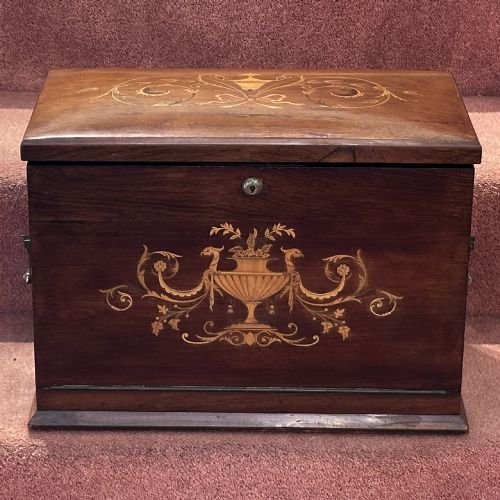

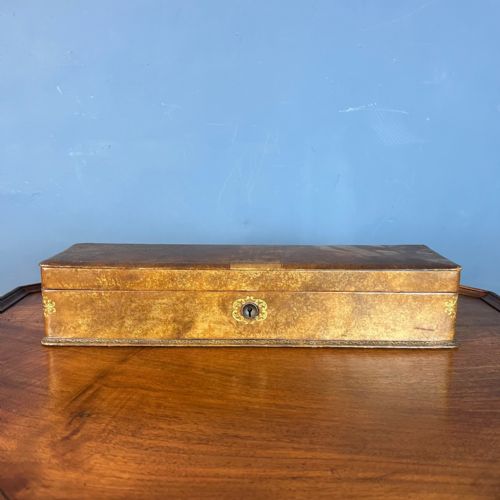


Edwardian Writing Desk Box
When you search for an Edwardian writing desk box, you find compact desk accessories and stationery cabinets designed for correspondence.
How they were made
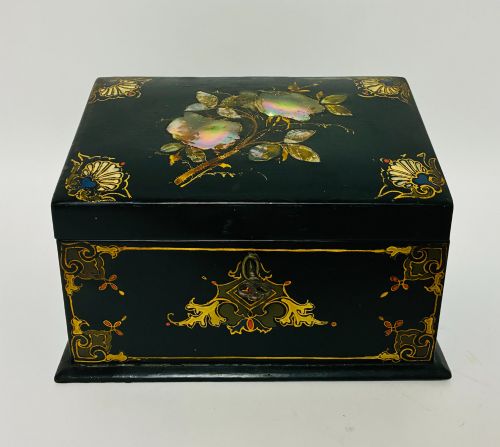
Cabinet makers constructed these pieces using dense hardwoods such as mahogany, oak, walnut, and cedar, frequently applying burr walnut or satinwood veneers for decorative effect. Some boxes incorporate marquetry, boxwood cross-banding, or reeded decoration.
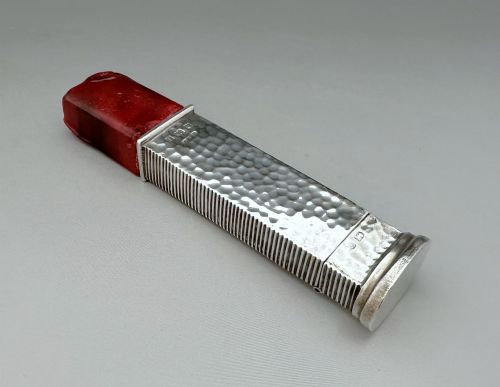
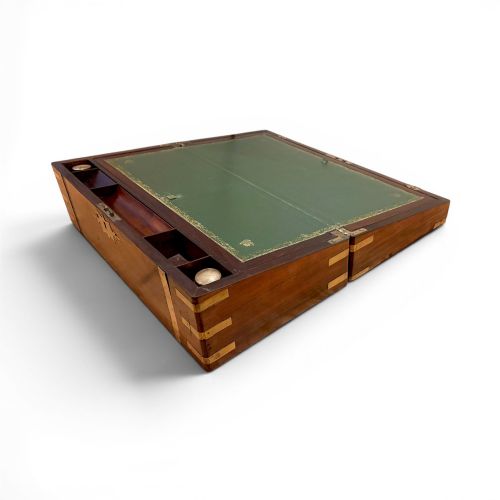
Metalwork played a structural and decorative role, with brass bindings, corners, and mounts reinforcing the wooden carcases. Interiors often featured tooled leather, glass inkwells, and silver-plated or sterling silver mounts for stamp boxes and vesta cases.
What varies in quality
The distinction between tiers rests upon the choice of timber and the precision of the joinery and internal fittings. Plain oak utility pieces sit at one end, while burr walnut and coromandel boxes with intricate marquetry and secret drawers represent a higher grade of manufacture.
Fittings also dictate standard, where fitted glass inkwells with silver collars, working keys, and nuanced internal compartments elevate a piece above standard stationery storage.
The materials recorded across these pieces span oak, mahogany, burr walnut, coromandel, brass, glass, and leather.
The Edwardian Writing Desk Box Glossary
- Writing slope
- A desk box featuring a sloping lid that opens to reveal a writing surface and internal compartments for pens and paper. These items fold flat for storage or travel.
- Stationery cabinet
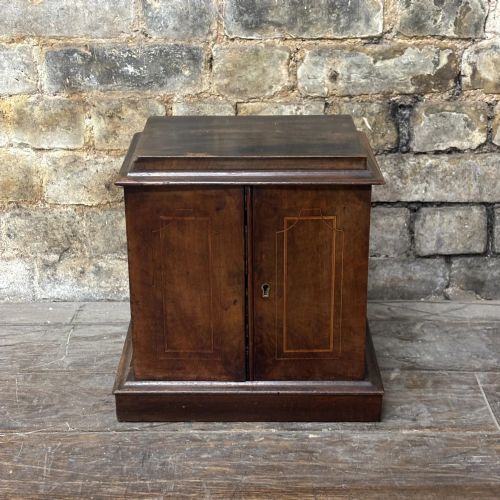
- An upright desktop box with a fall-front or door, designed to hold envelopes, writing paper, and documents in vertical pigeonholes.
- Campaign
- A descriptor for portable furniture and boxes built with recessed brass handles and reinforced corners for military transport.
- Marquetry
- The art of applying pieces of veneer to a structure to form decorative patterns and pictures. It appears frequently on Edwardian cabinet lids.
- Vesta
- A small pocket box or case designed to hold safety matches. These often appear alongside sealing wax combos in desk sets.
Edwardian Writing Desk Box: Frequently Asked Questions
What is the difference between a writing slope and a stationery cabinet?
A writing slope opens to provide an angled surface specifically for handwriting letters, folding down to enclose paper and ink within the body of the box.
Conversely, a stationery cabinet remains upright on the desk, offering vertical slots and shelves to organise loose paper, envelopes, and correspondence without serving as a writing desk itself.
How do I identify an Edwardian piece from a Victorian one?
Edwardian pieces generally date from the early twentieth century and lean towards lighter mahogany timbers, delicate marquetry, and simpler satinwood banding.
Victorian examples often utilise darker, heavier woods like burr walnut, rosewood, or massive oak, frequently featuring substantial brass bindings and campaign-style hardware.
What are secret drawers used for?
Secret drawers provide a concealed space within a writing slope or box to store private letters, valuables, or money away from casual view.
They usually require the removal of standard stationery partitions or the manipulation of hidden spring mechanisms to reveal the compartment.
Were these boxes meant for travel?
Certain forms, such as campaign writing slopes built from mahogany or camphor wood with brass corners, were engineered for transport by officers and travellers.
Other items, like stationery cabinets and heavy oak inkstands, were strictly stationary desk accessories meant to remain permanently in a study or drawing room.