

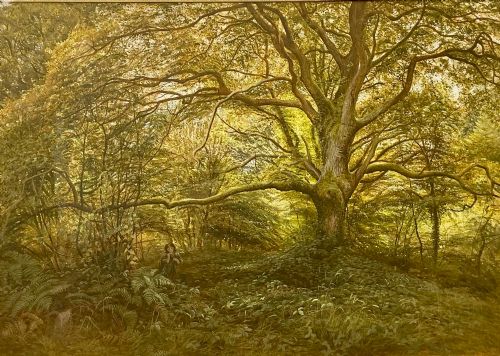


Edwardian Woodland Scene Art
Edwardian woodland scene art captures quiet forest paths and bluebell woods through the brush of early twentieth-century painters.
Edwardian Woodland Scene Art
When you search for edwardian woodland scene art, you encounter pastoral landscapes and forest views created during the Edwardian period and neighbouring decades. These paintings record quiet British and Irish countryside scenes through the eyes of period artists.
The pieces on this page mostly take the form of watercolour paintings and oil paintings on canvas or paper. They capture subjects ranging from cattle watering to bluebell woods and snowy winter landscapes.
Most works reflect the dominant painting styles of the era, including British Impressionism and Victorian Naturalism. They offer a direct window into how early twentieth-century painters interpreted the natural world.
How they were made
Artists painted these woodland scenes using oil paint or watercolour pigment applied to canvas, paper or wood panels. Many works received protection behind glass within traditional frames.
Makers often applied gilt to frames to complement the warm tones of the oils and watercolours within. Brushwork ranges from the fine detail of Victorian realism to the looser strokes of Impressionism.
Several artists painted bluebells specifically in spring, ensuring the woodland floor remains perpetually violet.
What varies in quality
Quality in these woodland paintings rests on the surety of the artist's hand and the atmospheric depth of the scene. Stronger works capture the play of light through trees with distinct brushwork and balanced composition.
The condition of the paper, canvas and original pigments also shapes the piece. Works that retain their fresh colour without heavy fading or surface damage stand higher in the range.
William H Myers·Bonomi Edward Warren·Alfred Grey·Rowland Henry Hill·Charles James Adams·George Graham·Edward H Holder·George F Wetherbee·Charles Edward Wilson·Lester Sutcliffe·George Neil
The Edwardian Woodland Scene Art Glossary
- Watercolour pigment
- Colour mixed with water-soluble binders, applied to paper to create transparent washes of tone.
- Impressionism
- A style of painting that focuses on capturing light and atmosphere rather than exact botanical or architectural detail.
- Gilt
- A thin layer of gold or gold-coloured material applied to the wooden frame surrounding the painting.
- Provenance
- The documented history of a painting's ownership and origin over time.
Edwardian Woodland Scene Art: Frequently Asked Questions
What subjects appear in these woodland scenes?
The works depict trees, forest paths, bluebell woods and river landscapes. Animals such as cattle often feature near water.
Artists drew inspiration from the British and Irish countryside during the early twentieth century.
Are these paintings signed by artists?
Many examples bear signatures from the painters who created them. These inscriptions help attribute the works to specific historical figures.
Signatures usually sit discreetly in the corner of the canvas or paper.
How should I hang watercolour art?
Watercolours require protection from direct sunlight to prevent the pigments from fading over time. Glazing with glass helps shield the paper from environmental moisture.
Keep them on interior walls away from direct heat sources.
What periods do these paintings span?
The listings encompass works from the Victorian era through the Edwardian period and into the 1930s and 1940s. This broad range reflects shifting artistic styles.
Different pieces show elements of realism, pastoral observation and early impressionistic techniques.