

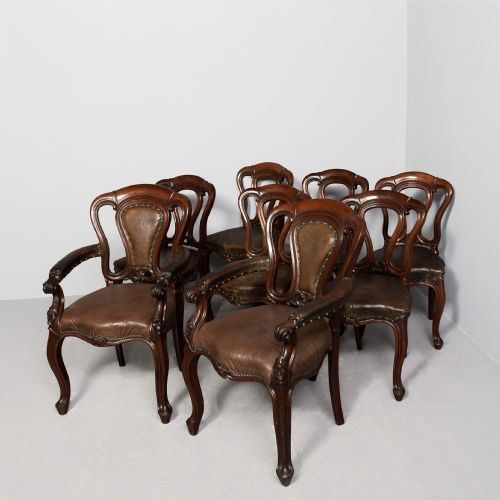
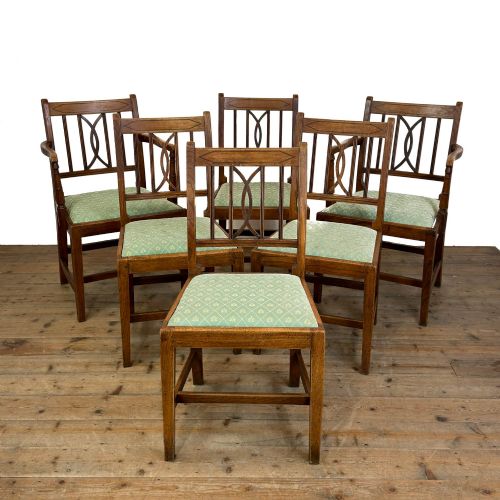
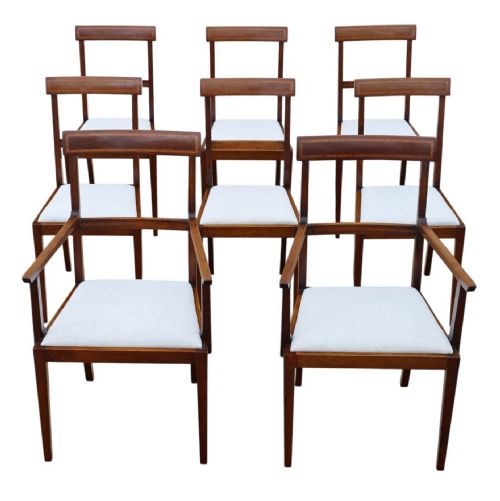


Edwardian Upholstered Armchair Set
An edwardian upholstered armchair set brings coordinated seating to a room, offering matching frames and textiles spanning the early twentieth century.
Edwardian Upholstered Armchair Set
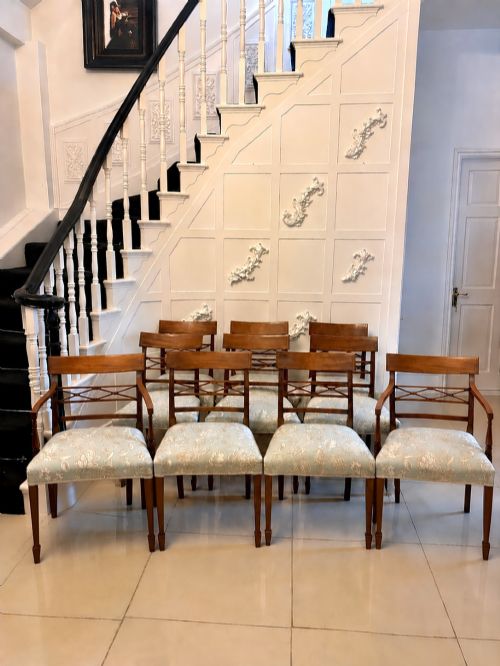
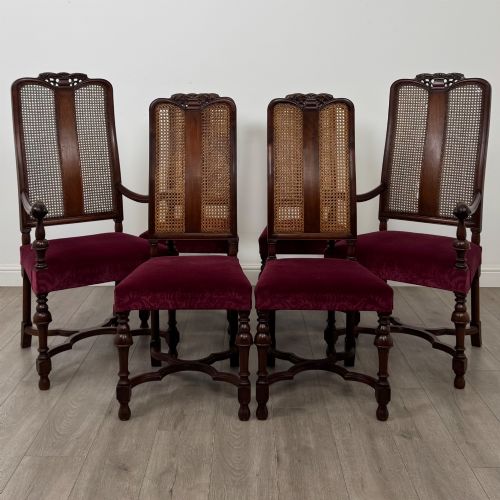
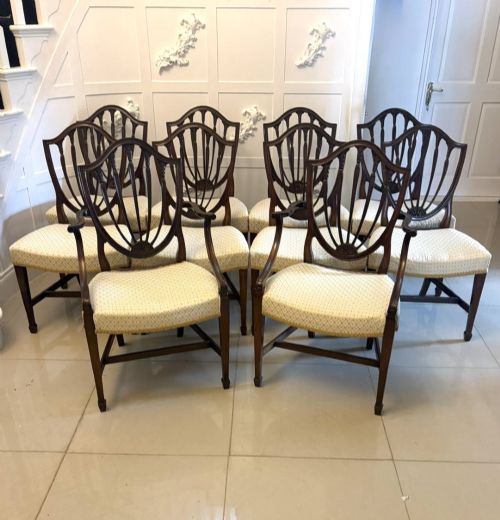
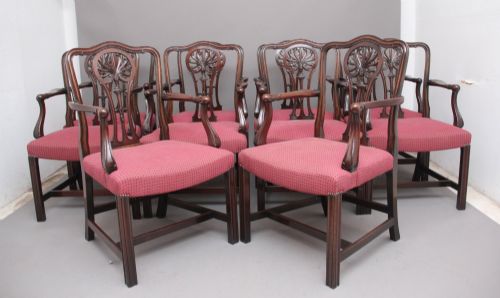
An edwardian upholstered armchair set comprises matched seating arrangements, most frequently encountered as parlour suites, salon suites, or paired sofa and armchair combinations. These groupings include multi-piece sets featuring a settee alongside matching armchairs, or larger dining chair collections incorporating carver armchairs.
The evidence shows production spreading across the Edwardian era into the early twentieth century, alongside Victorian pieces and revival styles such as Georgian, Queen Anne, and Arts and Crafts. Frames appear in mahogany, walnut, oak, and maple, carrying upholstery in fabric, velvet, leather, and damask.
Buyers encounter everything from intimate pairs of his and her lounge seats to extensive salon suites and large sets of dining chairs with carvers. Matching sets coordinate timber frames with uniform textile coverings across settees, armchairs, and side chairs.
Materials and construction methods
Cabinetmakers constructed the underlying frames predominantly in solid mahogany, walnut, oak, and maple. Timber components frequently incorporated carved details, boxwood inlay, and shield backs, whilst some models utilised brass fittings and ball and claw feet.
Upholstery techniques involved durable padding finished with textile coverings including velvet, damask, leather, and standard fabric. Buttonback detailing and drop-in seats appeared regularly across parlour suites and dining chair sets.
One recorded suite carries a direct historical connection to Winston Churchill via Harry Warren House.
Distinctions in craftsmanship and finish
Quality rests in the precision of the timber framing and the execution of carved ornaments or inlaid decoration. Pieces exhibiting refined proportions, tight joinery, and superior cabinet timbers distinguish themselves from simpler vernacular items.
The standard of upholstery work and the selection of covering materials mark further differences across suites. Original or sympathetic textiles paired with robust internal padding elevate the execution of a matched set.
Maple and Co·Alfred Allen of Birmingham·Howard and Sons·James Shoolbread
The Edwardian Upholstered Armchair Set Glossary
- Carver armchair
- A dining chair featuring armrests, traditionally placed at the head of a dining table or matched within a larger chair set.
- Parlour suite
- A coordinated group of seating furniture, typically comprising a settee and matching armchairs designed for a formal reception room.
- Inlay
- A decorative technique where contrasting timbers or materials are inserted into recessed portions of the primary wood surface.
- Shield back
- A chair back design shaped in the outline of a heraldic shield, popularised during the eighteenth century and revived later.
- Buttonback
- An upholstery style where depressions are formed in the padding by buttons pulled tight and secured to the frame.
Edwardian Upholstered Armchair Set: Frequently Asked Questions
What pieces comprise an edwardian upholstered armchair set?
These groupings generally consist of a settee paired with matching armchairs, or larger salon suites featuring several seats.
Listings also record matching pairs of lounge seats and extensive dining sets that incorporate carver armchairs.
Where were these suites used originally?
Such seating collections furnished formal reception rooms, parlours, drawing rooms, and libraries in period homes.
Pairs of chairs often served in bedrooms or private sitting rooms as companion seats.
How do I care for the upholstery?
Protect delicate textiles such as velvet, damask, and standard fabric from direct sunlight to prevent fading and fibre degradation.
Regular light vacuuming removes dust from crevices, whilst leather components benefit from appropriate conditioning treatments.
How can I identify Edwardian revival styles?
Revival pieces incorporate earlier design vocabularies like Queen Anne, Chippendale, or Georgian styles onto early twentieth-century frames.
Construction traits and timber characteristics usually betray the actual manufacturing period despite the historic stylistic influence.