
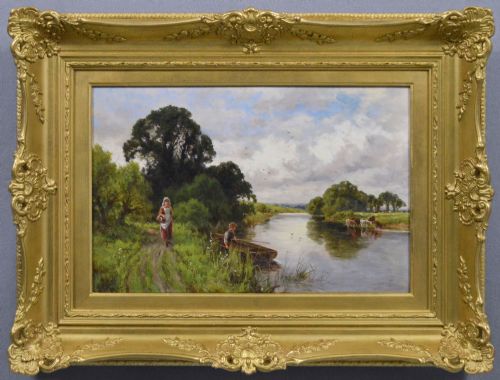


Edwardian Thames Scene
These edwardian thames scene works capture the bustling waters and quiet banks of the capital's river during a golden era of British art.
Edwardian Thames Scene
An edwardian thames scene brings the historic river life of London and its surrounding reaches into a room through the mediums of oil and watercolour. These artworks record the maritime traffic, bridges, and waterside villages that defined the waterway at the turn of the twentieth century.
Most pieces encountered on this page date from around 1900, spanning the late Victorian and Edwardian periods up to the nineteen-twenties. The subjects range from bustling commercial pools with barges and shipping to quiet pastoral riverbanks with figures fishing at dusk.
Collectors seek these works for their atmospheric depiction of British waterways and their connection to recognised maritime and landscape painters of the era. The compositions often feature notable landmarks such as St Paul's Cathedral, Windsor Castle, and Tower Bridge.
Materials and Techniques
Artists captured these river views using oil paint on canvas or watercolour paint on paper, often housed within giltwood frames. Oil on canvas allowed for rich, textured depictions of shipping and water, while watercolour suited the luminous, misty light of the Thames.
Painters utilised both studio techniques and plein air observations to record the changing light and atmospheric conditions along the river. The application of pigment ranges from delicate washes of colour to thick, confident brushstrokes.
Several canvases record the heavy river traffic of barges when horses still hauled goods along the mudbanks.
Distinctions in Quality
The strength of a composition and the artist's command of light and atmosphere dictate the standing of an individual piece. Works that capture the specific movement of water and the dense atmosphere of the London pool demonstrate superior skill.
The handling of architectural detail alongside the fluidity of the river determines the finesse of the painting. Finer works maintain a balance between topographical accuracy and the poetic mood of the waterway.
Henry H Parker·Edward Henry Eugene Fletcher·Walter Duncan·Frank W Scarborough·Henry Sykes·EW Haslehurst·Frank Wasley·Herbert John Finn·R Allan
The Edwardian Thames Scene Glossary
- Watercolour paint
- A medium consisting of pigment suspended in a water-soluble vehicle, used extensively on paper for luminous landscape and marine views.
- Oil on canvas
- Pigment mixed with an oil binder applied to a stretched cloth support, allowing for deep colour saturation and textured brushwork.
- Giltwood
- Wood that has been treated with a thin layer of gold leaf or gilt, commonly found on the period frames enclosing these paintings.
- Maritime
- Pertaining to the sea or river navigation, describing works focused on ships, barges, and port activity.
Edwardian Thames Scene: Frequently Asked Questions
What periods do these Thames paintings cover?
The works primarily date from the Edwardian era around 1900, with some examples extending from the late Victorian period through to the nineteen-twenties.
This span captures a transitional time in British art when artists moved between traditional pastoral views and industrial maritime scenes.
Which mediums are most common for river scenes?
Artists working on these subjects utilised oil paint on canvas and watercolour paint on paper.
Watercolours offered a fluid medium for atmospheric mists, while oils provided depth for depictions of shipping and commercial river traffic.
How do these artworks depict London landmarks?
Painters incorporated recognizable sights such as Tower Bridge, St Paul's Cathedral, and Windsor Castle to ground their compositions in specific geography.
These landmarks help historians and collectors date the views and understand the changing architecture of the Thames.
Where should an Edwardian river painting be hung?
These works suit traditional reception rooms or studies where their historic subject matter and gilt frames can be appreciated in measured light.
Direct sunlight should be avoided to protect both the paper or canvas and the original pigments from fading over time.