
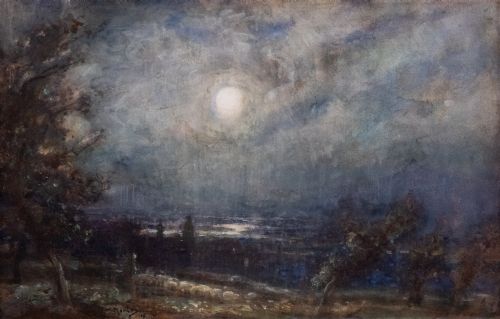


Grey Atmospheric Watercolour
A grey atmospheric watercolour captures misty light and damp air using restrained tones.
Grey Atmospheric Watercolour
A grey atmospheric watercolour presents a subdued palette focusing on damp air, mist, and muted light across landscapes and rivers. These paintings often depict coastal scenes, marine views, and historic bridges rendered with soft tonal transitions.
The selections available here stem from the nineteenth century through the mid twentieth century, encompassing Victorian Impressionism, Edwardian periods, and twentieth century British school movements. Such pieces bring quiet subtlety to domestic and institutional walls alike.
Materials and methods
These works utilise watercolour pigment and gouache applied directly to paper, often protected beneath glass. Artists built up transparent washes to suggest moisture in the atmosphere, reserving gouache for opaque highlights on water or stone.
The physical support relies consistently on paper, demanding careful control of water content by the painter to achieve the characteristic hazy, overcast diffusion seen in these marine and landscape subjects.
The listings span the nineteenth century through the nineteen sixties, employing paper, watercolour pigment, gouache, and glass.
Judging the work
Quality rests on the economy of brushwork and the artist's ability to suggest vast damp spaces without overworking the pigment. Superior examples demonstrate confident handling where minimal washes convey deep atmospheric perspective.
The strength of the composition and the precision of topographical detail separate accomplished pieces from routine topographical recording. Stronger works balance technical restraint with a tangible sense of place and weather.
Thomas William Morley·Robert Leslie Howey·Frank Wasley·William A. Macdonald·Frederick William Jackson·Fred Lawson·Herbert John Finn·Walter Duncan
The Grey Atmospheric Watercolour Glossary
- Watercolour pigment
- Finely ground colour suspended in a water-soluble binder. This medium allows transparent layers to be built up gradually.
- Gouache
- An opaque water-based paint often used alongside watercolour to add solid highlights. It contains a white pigment admixture to increase opacity.
- Impressionism
- A style prioritising the visual impression of a moment, focusing on light and atmosphere rather than minute detail. British practitioners adapted this approach to local weather and mist.
- Topographical
- Representing specific places accurately. These watercolours often record named locations such as Windsor Castle or Westminster Bridge.
Grey Atmospheric Watercolour: Frequently Asked Questions
How should I frame a watercolour?
Watercolours require framing behind glass with a mount that keeps the paper from touching the glazing surface. This prevents moisture damage and preserves the pigment over time.
Keep these works away from direct sunlight to avoid fading the delicate washes and paper supports.
What subjects appear in these paintings?
The primary subjects include marine views, coastal fishing boats, river scenes along the Thames, and rural northern landscapes. Coastal villages and historic bridges recur frequently.
Artists focused heavily on overcast skies, morning mists, and winter conditions to explore tonal grey palettes.
How do I identify the period?
Period identification relies on artist signatures, framing styles, and stylistic markers associated with Edwardian or mid twentieth century British art. Subject matter and costume details in figures also offer clues.
Consulting recorded dates for known artists provides the most reliable guide to a piece's creation era.
Are gouache and watercolour different?
Watercolour relies on transparent washes where the white of the paper provides luminosity. Gouache includes an added white pigment that makes the paint opaque.
Many artists combined both mediums within a single sheet to create contrast between hazy distances and sharp highlights.