



Edwardian Sugar and Cream
These edwardian sugar and cream sets and related tea services bring refined tableside service from the early twentieth century into modern homes.
Edwardian Sugar and Cream
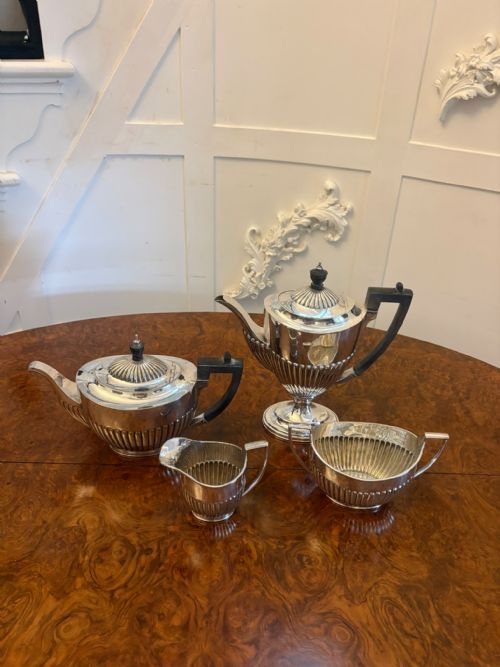
An edwardian sugar and cream set comprises matching vessels for serving sugar and milk, frequently appearing within larger tea and coffee sets or strawberry services from the nineteen hundreds.
The evidence shows forms ranging from three, four, and six piece tea sets to strawberry dishes, jug and bowl sets, and boxed services.
Makers produced these wares predominantly in silver plate and EPNS, alongside sterling silver and salt glaze stoneware.
How they were made
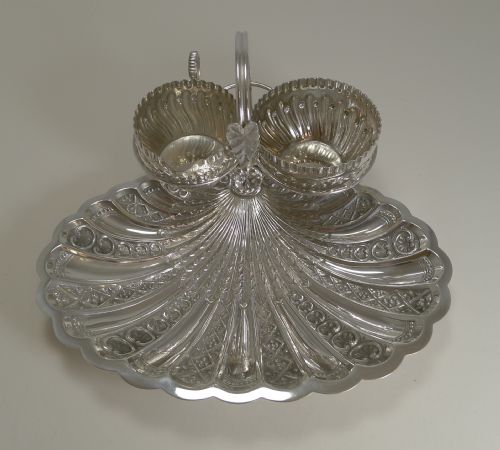
Silversmiths utilised sterling silver and silver plate over base metals, applying detailed techniques such as ornate grapevine ornamentation.
Potters shaped stoneware and salt glaze ceramics, while other pieces incorporated ebonised wood and ebony handles or knobs.
Many better sets came housed in original fitted cases designed specifically to protect the service.
Materials recorded across the archive include silver plate, sterling silver, stoneware, salt glaze, ebonised wood, and ebony.
What varies in quality
The standard of a set rests upon the weight of the metal, the crispness of decorative detailing like grapevine motifs, and whether the service remains complete in its original fitted case.
Larger four, five, and six piece settings demand greater craftsmanship than simple three piece configurations or individual cream jugs.
Maker attribution to established firms like Walker & Hall, Roberts and Belk, or Harry Atkin elevates the standing of a service.
Walker & Hall·Roberts and Belk·Harry Atkin·Doulton Lambeth
The Edwardian Sugar and Cream Glossary
- EPNS
- Electroplated Nickel Silver. This denotes a base metal core coated with a thin layer of silver.
- Salt Glaze
- A ceramic finish. It creates a distinctive textured surface by throwing salt into the kiln during firing.
- Sterling Silver
- A standard alloy of silver. It contains ninety-two point five percent silver by mass.
- Strawberry Dish
- A specialised serving vessel. It typically accompanies fruit and cream sets from the period.
Edwardian Sugar and Cream: Frequently Asked Questions
What pieces belong in a standard set?
A standard set includes vessels for serving sugar and cream, frequently accompanied by a teapot, hot water kettle, or matching tray depending on whether it is a three, four, or six piece service.
Some configurations also incorporate specialised serving pieces such as strawberry dishes or sugar sifters housed in fitted boxes.
How do I care for silver plated tea ware?
Silver plated items require gentle cleaning with a soft cloth and dedicated silver polish to maintain the finish without wearing through the plated layer to the base metal underneath.
Storing pieces away from damp environments prevents tarnishing and protects any ebonised wood or ebony components from drying out.
Are these sets made of solid silver?
The majority of pieces recorded in the evidence utilise silver plate or EPNS rather than solid silver, though hallmarked sterling silver boxed services do occur.
Makers stamped silver plated items to indicate the plating method, whereas sterling pieces feature official assay office hallmarks indicating purity and date.
What styles define edwardian tea services?
Edwardian tea services draw upon traditional forms while incorporating flowing Art Nouveau decorative elements such as organic grapevine detailing.
These designs bridge late nineteenth century Victorian tastes and the cleaner lines of the twentieth century.