
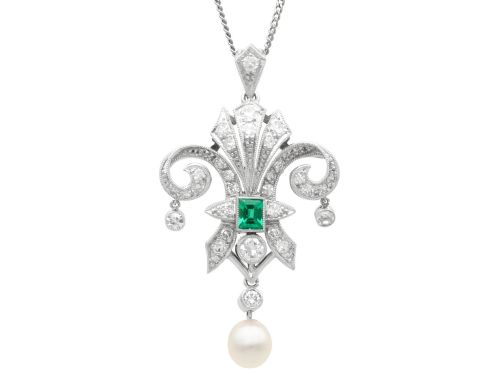
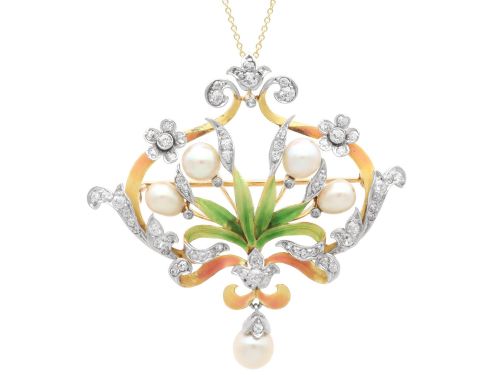
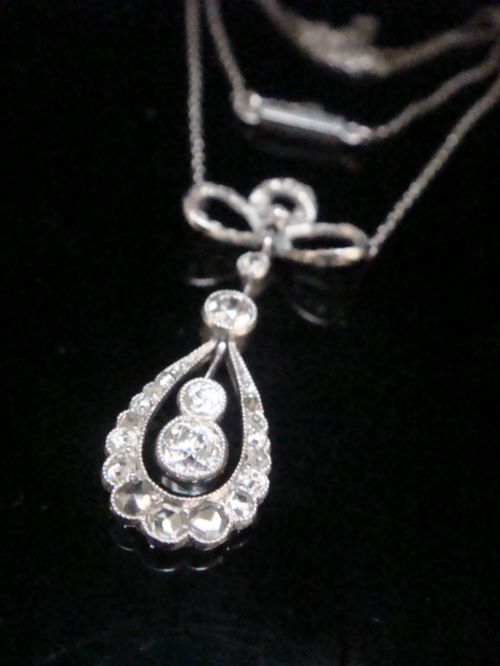


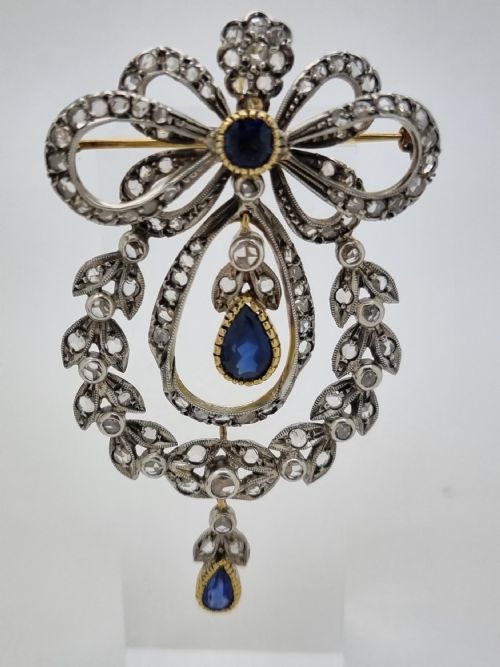

Edwardian Style Diamond Pendant
An edwardian style diamond pendant brings together delicate platinum work and bright stones, offering the refined elegance collectors seek in early twentieth-century jewellery.
Edwardian Style Diamond Pendant
When you search for an edwardian style diamond pendant, you find delicate necklaces, convertible brooch pendants, and drop designs that capture the lightness of the period. The pieces on this page draw principally from the Edwardian era, alongside related nineteenth and twentieth-century periods such as Victorian, Art Deco, and the 1920s to the 1950s.
Most examples combine diamonds with precious metals like platinum and gold, occasionally incorporating sapphires, emeralds, pearls, opals, or citrines. Forms range from bows and halo settings to butterfly motifs and lockets, reflecting the diverse stylistic output of these decades.
How they were made
Goldsmiths and jewellers utilised platinum and high-carat white and yellow gold to construct lightweight yet strong mountings for the stones. Platinum became the metal of choice during the Edwardian period because its strength allowed for intricate, lace-like wirework without heavy metal settings.
Diamonds were hand-set alongside coloured gemstones such as sapphires, emeralds, and natural pearls. Techniques combined fine millegrain edges with openwork frames to maximise the passage of light through each stone.
Some butterfly pendants manage to flutter through the decades without ever losing their original pin.
What varies in quality
Quality rests upon the fineness of the metalwork and the harmony of the stones. Finer pieces demonstrate precise piercing and delicate millegrain work that remains crisp under magnification.
The choice and matching of gems also set examples apart, where well-proportioned diamonds and cleanly saturated coloured stones elevate the overall balance of the design.
The Edwardian Style Diamond Pendant Glossary
- Millegrain
- A decorative technique featuring a row of tiny raised metal beads along the edges of a setting. This softens the transition between the metal and the stone.
- Platinum
- A dense, durable white metal that gained widespread use in fine jewellery during the Edwardian era. Its strength permits exceptionally fine settings.
- Halo pendant
- A centre gemstone surrounded by a ring of smaller accent stones. This arrangement enhances the visual presence of the primary gem.
- Convertible brooch
- A piece of jewellery designed to function as both a pendant and a brooch. This versatility allowed wearers to pin it to clothing or suspend it from a chain.
Edwardian Style Diamond Pendant: Frequently Asked Questions
How do I wear a pendant brooch?
Many Edwardian and Victorian pieces feature a hidden bail alongside a pin fastening on the reverse. This allows you to thread a chain through the back or remove the chain to wear the piece pinned to a lapel.
When wearing the piece as a pendant, ensure the pin catch is securely closed so it does not snag on clothing during daily wear.
What defines Edwardian jewellery style?
Edwardian jewellery is characterised by light, airy motifs such as garlands, bows, and lace patterns. Jewellers favoured platinum and white gold to create the illusion of metal dissolving into a web of diamonds.
This aesthetic contrasted sharply with the heavier designs of the preceding Victorian era, embracing grace and refinement above all else.
Are these pieces made of platinum?
Many pieces from this period utilise platinum, often combined with yellow or white gold. Platinum became prominent in fine workshops around the turn of the twentieth century due to its exceptional tensile strength.
This metal allowed makers to construct ultra-thin settings that securely held diamonds while appearing almost invisible.
Can I check the period of a pendant?
Dating relies on examining the construction methods, metal combinations, and stone cuts used by the maker. Edwardian work typically pairs platinum-topped gold with old-cut diamonds and delicate openwork frames.
Comparing these structural details against known stylistic eras helps clarify whether a piece originates from the Edwardian years or later decades like the 1920s.