


Edwardian Standing Corner Unit
An Edwardian standing corner unit turns wasted room space into a showcase for glass and timber.
Edwardian Standing Corner Unit
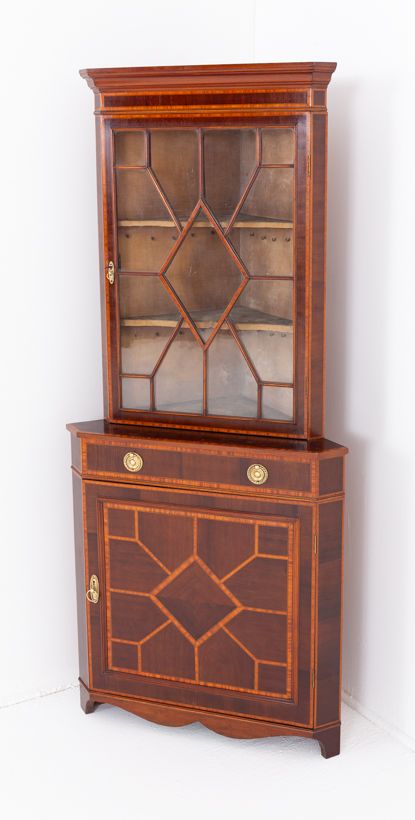
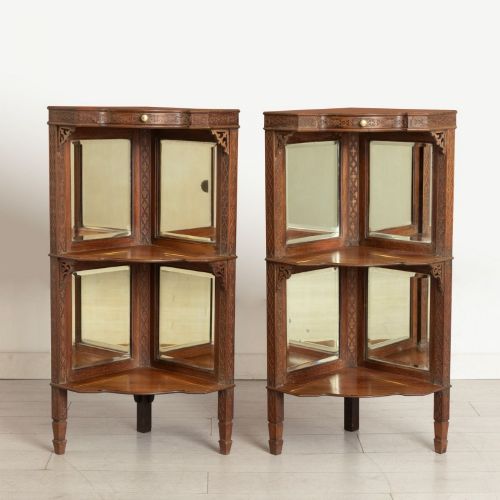
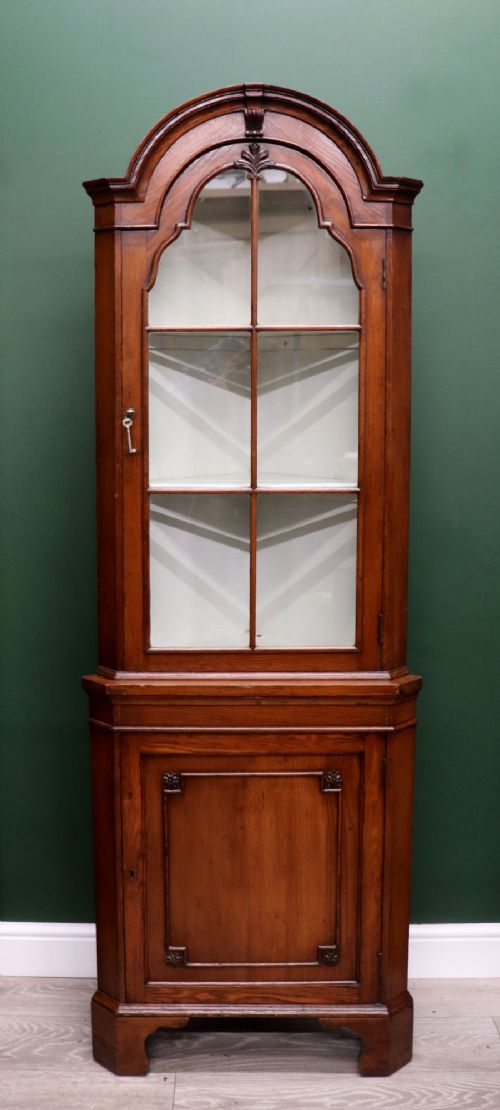
When you examine an Edwardian standing corner unit, you encounter tall display furniture built specifically to fill the awkward angles of a room. The selection here brings together pieces spanning the Edwardian era, Victorian period, and early twentieth century, showing how cabinet makers utilised neglected angles.
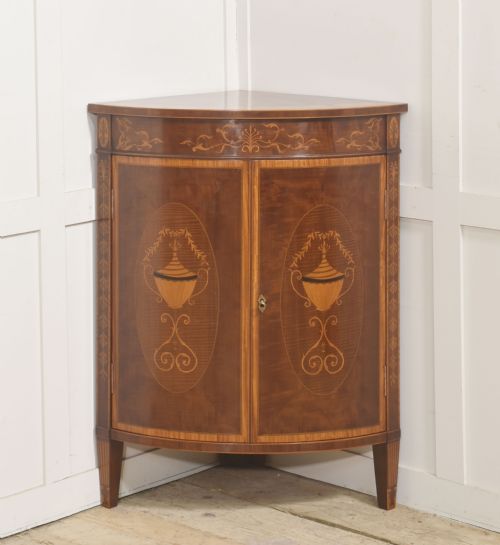
Makers drew heavily on earlier design vocabularies, producing Sheraton Revival, Georgian style, and Queen Anne revival interpretations alongside simpler Edwardian forms. You will find both single-piece standing cupboards and two-part constructions that separate for transport.
Materials and construction
Timber selection dictated the character of these cabinets, with solid mahogany and walnut providing the primary structural carcase. Cabinet makers applied satinwood, boxwood, and marquetry inlay to door panels and friezes, creating sharp geometric or floral motifs against the darker background wood.
Glazing bars divided glass panels into smaller panes on display doors, while brass hardware such as hinges, escutcheons, and keyplates secured the openings. Open tier versions utilised turned or barley twist columns to support successive shelves rising towards the ceiling.
The listings show standing corner units predominantly from the Edwardian period and late nineteenth century, alongside walnut whatnot stands.
Determinants of quality
Quality rests in the precision of the cabinet work, particularly how tightly the back panels fit into the wall corner and how smoothly doors seat within their frames. Superior pieces exhibit finer marquetry inlay, selecting contrasting woods with deliberate grain direction rather than simple painted decoration.
The choice of timber thickness and secondary woods inside drawers or carcases separates standard workshop production from high-end output by makers like Edwards & Roberts. Better examples integrate complex serpentine shaped fronts and balanced proportions that elevate a functional storage item into a notable display piece.
Edwards & Roberts
The Edwardian Standing Corner Unit Glossary
- Sheraton Revival
- A late nineteenth and early twentieth century style drawing inspiration from the lighter neoclassical designs of Thomas Sheraton. It relies on symmetrical proportions, tapered legs, and delicate marquetry.
- Marquetry
- Decorative patterns formed by fitting together thin veneers of various wood types, ivory, or brass into a timber surface. This technique created elaborate floral or ribbon motifs on cabinet doors.
- Whatnot
- A freestanding piece of furniture consisting of multiple open shelves supported by pillars, used for displaying ornaments. These tiered stands appear frequently alongside enclosed corner cupboards in the evidence.
- Serpentine front
- A curved furniture front featuring a convex central section flanked by two concave curves. This shaping requires advanced woodworking skill and indicates a higher grade of cabinet making.
- Glazed door
- A door fitted with glass panels to allow visibility into the interior cabinet space. It protects displayed objects from dust while keeping them in plain sight.
Edwardian Standing Corner Unit: Frequently Asked Questions
Where should I place a corner unit?
These units fit directly into ninety-degree room angles, making use of space that standard rectangular furniture leaves empty. They anchor corners in dining rooms, hallways, or drawing rooms without obstructing walkways.
Position them away from direct heat sources to protect the timber veneers and polish from drying out or splitting.
How do I distinguish Edwardian from Victorian cabinets?
Edwardian pieces tend to display lighter mahogany and satinwood timber with more restrained Sheraton Revival influences. Victorian versions frequently utilise darker burr walnut and heavier proportions with elaborate turning.
Examining the internal construction timber and hardware style often clarifies the transition between the late nineteenth century and the early nineteen hundreds.
Can I store heavy books inside?
Enclosed standing cupboards with sturdy wooden shelves handle heavier volumes and household items securely. Open tier whatnot versions suit lighter decorative objects and porcelain collections rather than dense library storage.
Check the shelf supports and timber thickness before loading any antique cabinet with heavy weight.
What is a two-part corner cabinet?
A two-part corner cabinet splits horizontally into an upper display section and a lower cupboard base. This construction method helped transport tall furniture through narrow hallways and stairwells during the Edwardian period.
The sections stack together securely to create a double-height display unit.