


Edwardian Salon Armchairs
Edwardian salon armchairs bring refined formal seating to a drawing room, combining slender timber frames with decorative marquetry and traditional upholstery.
Edwardian Salon Armchairs
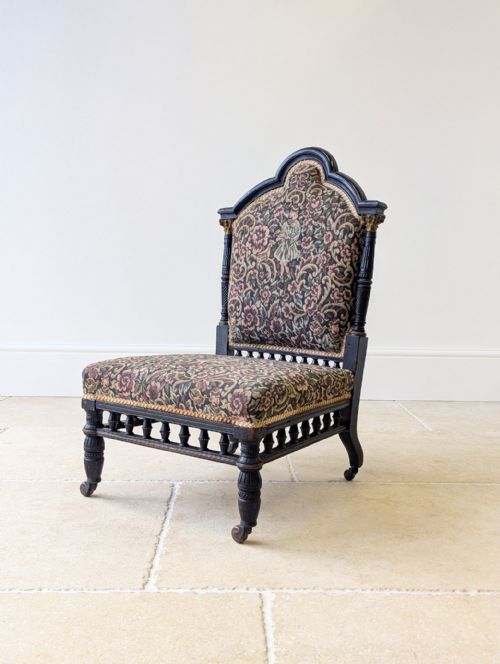
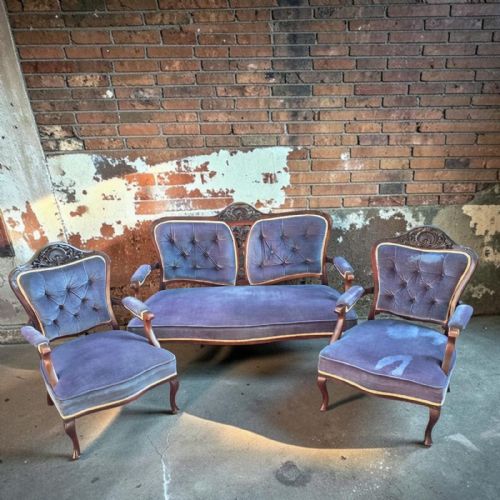
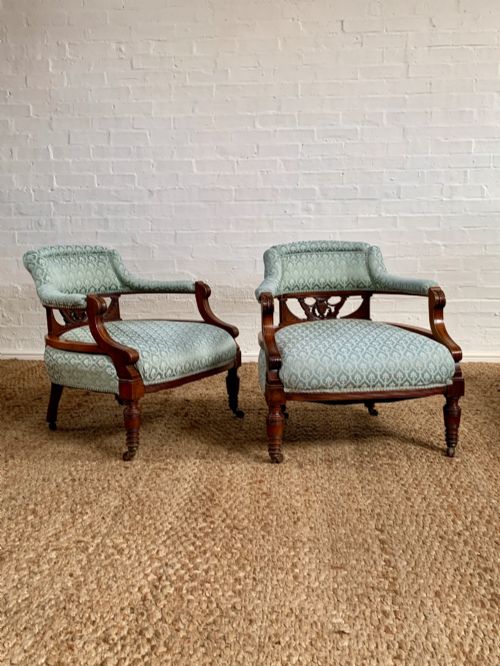
Edwardian salon armchairs occupy a distinct place in late nineteenth and early twentieth century domestic interiors, designed primarily for reception rooms rather than heavy daily use. The pieces found here span the Edwardian era and Victorian periods, often taking the form of tub chairs, open armchairs, or matching suites that include settees.
Makers of the period favoured lighter proportions than their Victorian predecessors, producing occasional chairs and salon seating that relied on mahogany, walnut, and rosewood frames. Buyers searching for edwardian salon armchairs will frequently encounter inlaid decoration, stringing, and marquetry reflecting neoclassical or art nouveau influences alongside simpler carved timber designs.
Materials and Construction
Frames are predominantly constructed from solid mahogany, walnut, or satinwood, often shaped with curved arms, cabriole legs, or barley twist turnings. Artisans integrated decorative stringing and marquetry into the timber surfaces, embedding contrasting veneers to form floral or geometric motifs.
Upholstery relies on traditional stuffing techniques secured within fabric, velvet, damask, or buttoned silk, sometimes complemented by woven cane panels in bergère formats. Brass castors and decorative tacks frequently complete the assembly of these structural elements.
Several chairs include diminutive child-sized versions built with the exact same marquetry and cabriole legs as the full-scale parlour suites.
Gradations of Craft
The standard of an armchair rests upon the precision of its timber joinery and the complexity of its inlaid details. Pieces with finely cut marquetry, balanced proportions, and robust structural framing stand apart from simpler vernacular examples.
The integrity of the original upholstery platform and the retention of matching suites or pairs elevate the standing of individual chairs within the broader selection.
Howard and Sons
The Edwardian Salon Armchairs Glossary
- Bergère
- An upholstered armchair with an enclosed cane back and sides, supported by a wooden frame. This style gained popularity for its lighter appearance in formal reception spaces.
- Marquetry
- Decorative woodwork where small pieces of veneer are fitted into a ground material to form intricate patterns. Craftsmen utilised contrasting timbers like satinwood and mahogany to achieve visual depth.
- Stringing
- Thin inlay lines of contrasting wood set into grooves on furniture surfaces. This technique outlines panels and legs on Edwardian pieces.
- Tub Chair
- An armchair with a rounded back that curves continuously into the arms. The enclosed shape provides a compact seating option for parlours and bedrooms.
- Cabriole Leg
- A furniture leg featuring a double curve, bending outward at the knee and inward at the ankle. This form draws inspiration from ancient Chinese furniture designs.
Edwardian Salon Armchairs: Frequently Asked Questions
How were salon armchairs originally used?
These chairs furnished formal drawing rooms and parlours where guests gathered for conversation and entertainment. Their lighter construction allowed servants or residents to reposition them easily around the room.
They served as occasional seating rather than heavy fireside lounging chairs, reflecting the polite social rituals of the period.
How do I distinguish Edwardian from Victorian chairs?
Edwardian frames generally exhibit lighter proportions, brighter mahogany tones, and restrained neoclassical inlays or stringing. Victorian equivalents often rely on heavier dark timbers, deeper carving, and more imposing button-backed upholstery.
Overlaps occur around the turn of the century, where transitional pieces blend Victorian robustness with Edwardian refinement.
Can I use these chairs in a modern room?
Their compact dimensions and slender wooden frames make them suitable as accent seating in contemporary living spaces or bedrooms. They integrate well against plain walls where their inlaid details and shaped arms remain visible.
Pairing them with modern textiles can bridge historical timber work with current interior schemes.
What is a salon suite?
A matching set comprising a settee and multiple armchairs or occasional chairs designed to furnish a reception room uniformly. These suites ensured aesthetic harmony across all seating elements within a formal interior.
Surviving sets sometimes include ladies and gentlemen's chairs featuring differing back heights designed to accommodate period attire.