


Edwardian Ruby Diamond Brooch
An Edwardian ruby diamond brooch combines fiery red stones with sparkling gems, offering refined elegance from the early twentieth century.
Edwardian Ruby Diamond Brooch
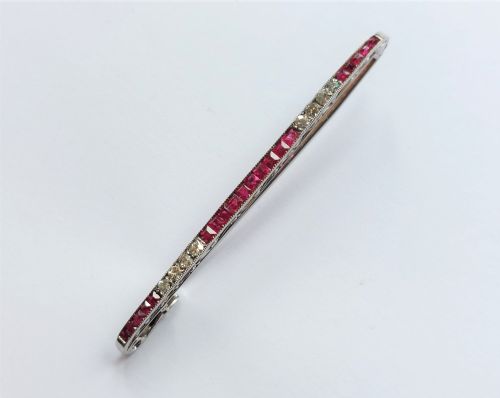
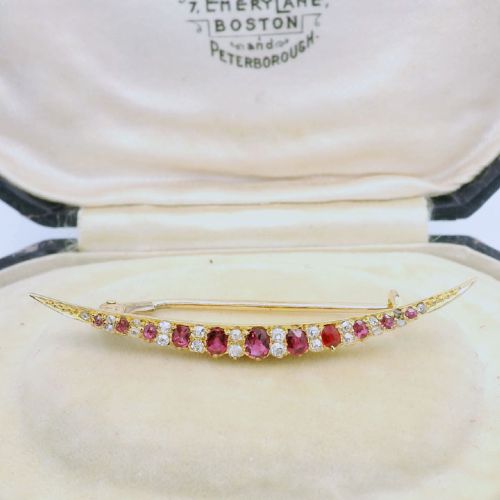
An Edwardian ruby diamond brooch is a wearable ornament typically set with precious red stones and diamonds mounted in gold, silver, or platinum. When buyers search for an Edwardian ruby diamond brooch, they encounter delicate crescent shapes, floral motifs, bar brooches, and figurative designs such as insects and birds.
The pieces appearing on this page span the Edwardian era, late Victorian period, and early Art Deco years, alongside occasional nineteenth-century examples. The most common format met here is the crescent or bar brooch utilising 15ct gold, 9ct gold, or platinum-topped gold settings.
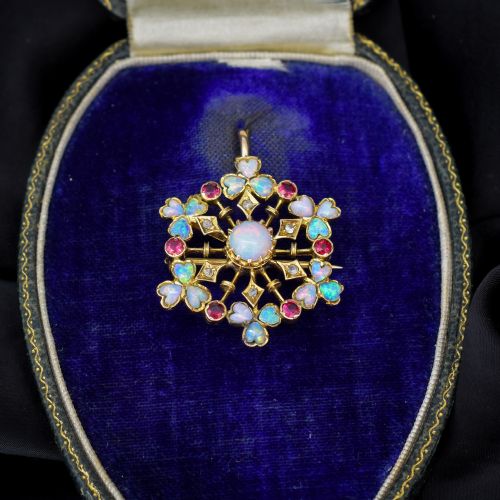
Makers of the period favoured light, airy frameworks inspired by garlands and natural forms, often combining old-cut diamonds with natural rubies. These jewels frequently double as pendants, offering versatile ways to wear antique gemstone pieces today.
Materials and construction methods
Goldsmiths constructed these brooches using combinations of yellow gold, rose gold, silver, and platinum. Silver or platinum was frequently layered over gold on the face of the jewel to enhance the brilliance of the diamonds while the gold provided structural strength at the back.
Gemstones were hand-set using claw, grain, or collet techniques suited to rose-cut and old-mine or old-european cut diamonds paired with natural rubies. Structural forms like crescent frames and slender bar pins relied on soldered wirework and chased metal details.
Listings feature pieces from the Edwardian, Victorian, and early Art Deco periods, utilising rubies, diamonds, sapphires, emeralds, pearls, and enamel.
Factors determining quality
Quality in these jewels rests upon the proportion and harmony of the design, whether it is a symmetrical crescent or a naturalistic floral spray. Finer examples display meticulous stone matching and secure, precise setting work that holds each ruby and diamond without obscuring the metalwork.
The choice of alloys, such as higher-carat golds combined with platinum or silver facings, elevates the piece. Superior craftsmanship shows in the refinement of the pin mechanism and the delicacy of openwork frames.
The Edwardian Ruby Diamond Brooch Glossary
- Old-cut diamond
- A hand-faceted diamond cut before modern brilliant standards, typically featuring a small table and high crown that produces a soft, candlelit sparkle.
- Crescent brooch
- A curved, crescent-moon shaped pin popular during the late nineteenth and early twentieth centuries, frequently set in graduated rows of gems.
- Bar brooch
- A slender horizontal pin featuring gemstones clustered centrally or spaced along a linear metal bar.
- Pendant brooch
- A convertible piece of jewellery fitted with a hidden loop or bail so it can be worn pinned to clothing or suspended from a chain.
- Belle Epoque
- A stylistic period spanning the late Victorian and Edwardian eras characterised by garland motifs, platinum settings, and light, graceful designs.
Edwardian Ruby Diamond Brooch: Frequently Asked Questions
How do I wear an antique brooch?
These pieces can be pinned to lapels, silk scarves, or hatbands using the original pin and C-clasp or trombone fastening.
Many designs also include a fold-down loop allowing them to be hung from a chain as a pendant.
Are these brooches made with natural rubies?
The stones found in these period pieces include natural rubies alongside old-cut diamonds and occasionally pearls or emeralds.
Settings reflect the materials of the late nineteenth and early twentieth centuries, primarily gold, silver, and platinum.
How do I distinguish Edwardian pieces from Victorian ones?
Edwardian jewels often utilise platinum or silver-topped gold to create lighter, lace-like mountings with diamonds and rubies.
Victorian pieces from the preceding decades tend to feature heavier yellow or rose gold settings and distinct motifs like crescent or floral clusters.
Can a brooch be converted into a necklace?
Pendant-brooch hybrid pieces already feature integrated loops for chain suspension without altering the original antique structure.
Brooches without loops should be worn as pins to preserve their historical integrity.