

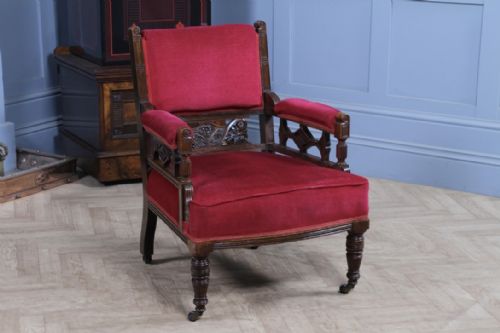


Edwardian Parlor Chairs
Edwardian parlor chairs are refined timber seating built for reception rooms, and collectors seek them for their inlaid detail and light frames.
Edwardian Parlor Chairs
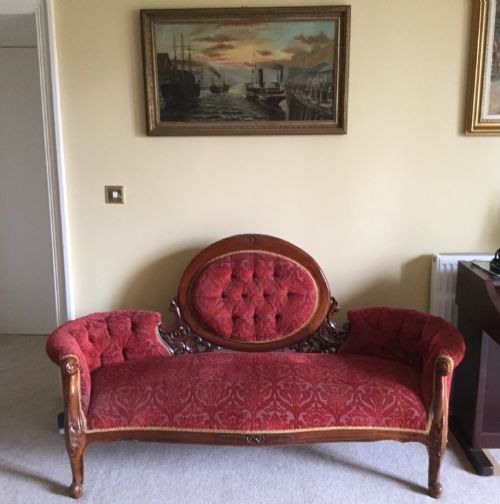
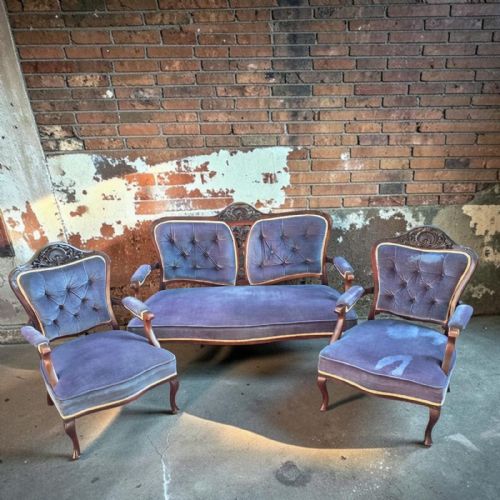
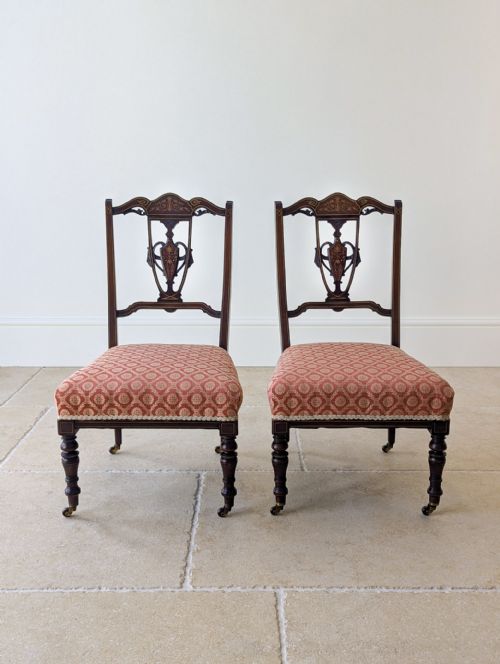
Edwardian parlor chairs bring lighter timber frames and delicate proportions to reception rooms, moving away from heavier nineteenth-century seating. When searching for edwardian parlor chairs, buyers frequently encounter single occasional chairs, paired salon seats, and complete matched suites designed for formal entertaining.
The material record spans the late nineteenth and early twentieth centuries, blending Edwardian production with earlier Victorian influences. Walnut, mahogany, and rosewood appear consistently alongside satinwood and beech, often configured as armchairs, corner chairs, and side chairs.
Makers of the period drew heavily on Sheraton Revival designs while occasionally touching upon Arts and Crafts and Art Nouveau aesthetics. These diverse stylistic currents ensure that each grouping offers a distinct silhouette tailored to formal domestic spaces.
How They Were Made
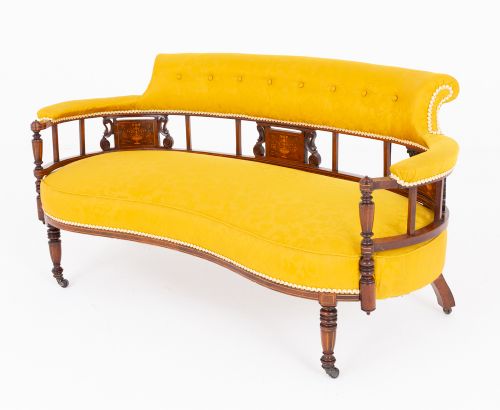
Craftsmen utilised dense timbers such as mahogany, walnut, and rosewood for the structural frames, applying intricate marquetry and fine stringing in contrasting woods. Satinwood and beech also served as primary and secondary woods, shaped into cabriole or straight tapering legs.
Upholstery formed a central part of the construction, utilising sprung bases, deep pile brocade, velvet, and patterned fabric coverings. Brass elements appeared selectively as castors or structural accents on larger salon suites and settees.
Listings for edwardian parlor chairs span from eighteen-eighty through nineteen-ten, recording substantial use of mahogany, rosewood, and walnut.
What Varies in Quality
The refinement of the timber inlay and marquetry sets the standard for superior examples, distinguishing simple commercial production from master cabinetwork. Crisp carving on walnut and mahogany frames demonstrates greater artisan time and material selection.
The integrity of the original upholstery platform and the precision of the joinery determine the overall distinction of a piece. Suites and pairs that retain their matching frames and cohesive fabric treatments command greater consideration among purists.
Jenks and Wood
The Edwardian Parlor Chairs Glossary
- Sheraton Revival
- A late nineteenth and early twentieth-century style imitating the neoclassical furniture designs of Thomas Sheraton. It relies on light satinwood and mahogany veneers with delicate floral inlay.
- Marquetry
- Decorative patterns formed by small pieces of wood veneer fitted into a primary timber ground. Craftsmen utilise this technique to render floral or geometric motifs across chair backs.
- Salon Suite
- A matched grouping of seating comprising a settee and multiple chairs intended for a drawing room. These suites share identical wood types, inlay patterns, and upholstery schemes.
- Cabriole Leg
- A furniture leg that curves outward at the knee and tapers inward toward the foot. This classical form appears frequently on Victorian and Edwardian chairs.
- Occasional Chair
- A light, movable chair designed to be placed around a room as needed rather than kept in a fixed position. They often feature open backs and inlaid details.
Edwardian Parlor Chairs: Frequently Asked Questions
How do I identify Edwardian parlor chairs?
Edwardian parlor chairs are identified by their lighter frames, delicate proportions, and use of mahogany or rosewood. They frequently incorporate inlaid stringing and marquetry motifs rather than heavy carved ornamentation.
They date from the opening decades of the twentieth century, often reflecting a revival of eighteenth-century neoclassical styles popularized by Sheraton.
Were these chairs used in dining rooms?
These pieces were primarily intended for formal reception rooms, drawing rooms, and ladies' parlours where guests were entertained. Their lighter construction made them easy to move around for conversation.
While some robust examples served secondary dining functions, their delicate inlaid backs and upholstered arms suited them better for sitting rooms.
How should I care for upholstered salon chairs?
Care for the timber frames by applying quality beeswax occasionally to nourish the mahogany, walnut, or rosewood surface. Keep them away from direct sunlight to prevent fading on the fabric and wood veneer.
Vacuum upholstered surfaces gently with a soft brush attachment to protect delicate textiles such as velvet and brocade from dust accumulation.
What is the difference between Victorian and Edwardian chairs?
Victorian chairs generally feature heavier, darker timber frames with deep button-backed upholstery and robust carving. They lean toward denser proportions and elaborate Victorian Rococo Revival forms.
Edwardian chairs lighten these silhouettes significantly, introducing brighter satinwood highlights, inlaid marquetry, and slender legs derived from Sheraton Revival aesthetics.