
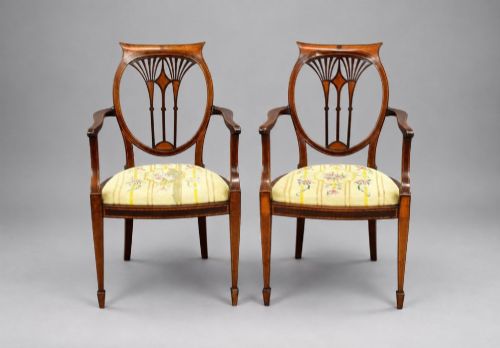
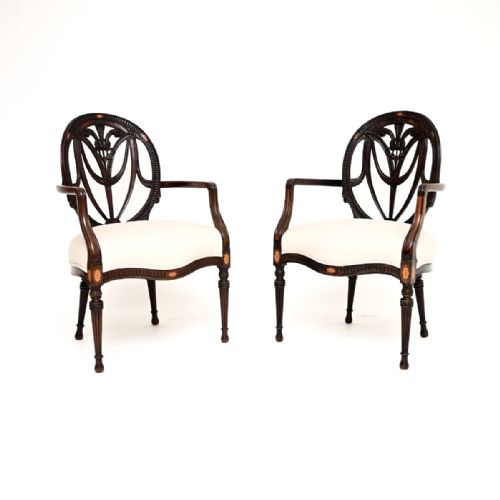
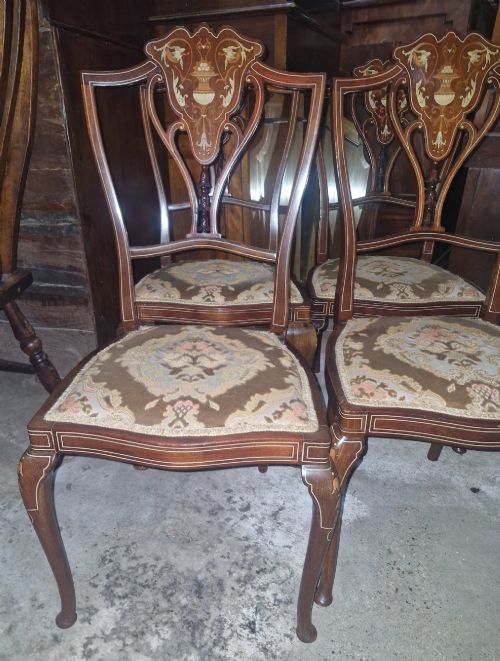
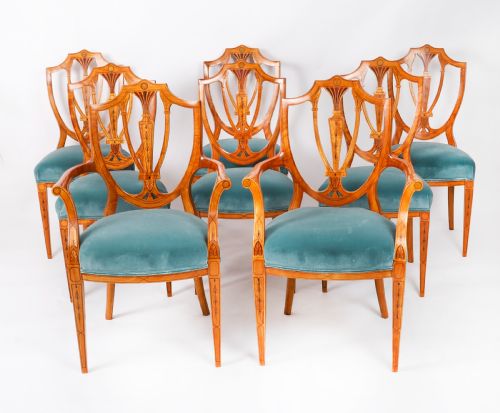
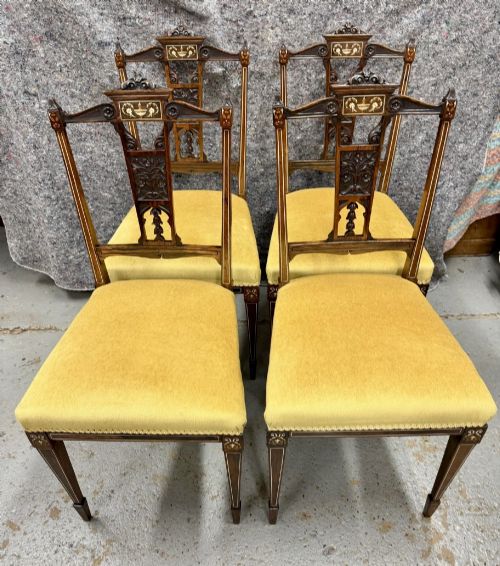
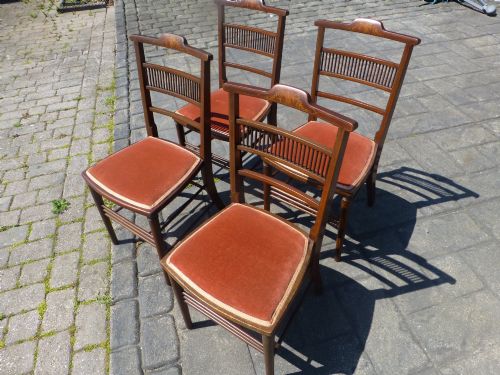


Edwardian Marquetry Dining Chairs
Edwardian marquetry dining chairs bring formal botanical detail and rich mahogany frames to the dining room, offering a refined seat for traditional interiors.
Edwardian Marquetry Dining Chairs
Edwardian marquetry dining chairs combine the light framing of the early twentieth century with intricate wood inlay, frequently appearing alongside sets of side chairs and occasional armchairs.
Most examples found on this page date from the Edwardian period or the late nineteenth century, spanning Sheraton Revival and Art Nouveau influences applied to standard dining furniture.
The primary forms include set configurations of four or six chairs, alongside pairs of carvers and salon chairs intended for both dining and drawing room use.
How they were made
Makers constructed the primary frames using mahogany, walnut, and rosewood, providing a dark structural base for intricate lighter detailing.
Satinwood, boxwood, and general wood inlay formed the contrasting marquetry motifs, set flush into the timber surfaces of backs and splats.
Upholstered elements rely on traditional fabric and velvet coverings, secured over padded seats within the frame.
Periods represented span from the late Victorian era through the Edwardian period.
What varies in quality
The precision of the wood inlay defines the upper tier of pieces, where contrasting boxwood and satinwood form sharp, detailed botanical patterns rather than simple linear banding.
Timber selection governs the depth of the finish, with rich rosewood and figured mahogany providing a denser grain and heavier structural presence than secondary woods.
Cowtan & Sons·Shoolbred
The Edwardian Marquetry Dining Chairs Glossary
- Marquetry
- Decorative patterns formed by fitting together thin veneers of different woods onto a structural panel. This technique creates pictorial or symmetrical designs across the chair back.
- Carver
- An armchair designed with open sides to accommodate formal dining attire. These often match a larger set of smaller side chairs.
- Shieldback
- A chair back shaped like an inverted shield, popularised in the eighteenth century and revived during later periods. The curved top rail flows directly into the stiles.
- Satinwood
- A lustrous yellow timber imported from tropical regions, used extensively for contrasting inlay work. Its pale colour highlights delicate floral and ribbon motifs.
Edwardian Marquetry Dining Chairs: Frequently Asked Questions
Are these chairs suitable for daily dining?
These seating options handle regular daily use provided the joints remain tight and the upholstered pads offer adequate support. Many retain sturdy hardwood frames built for practical dining rooms.
Care should be taken to protect antique wood finishes from moisture and direct sunlight during everyday meals.
How do I spot a Sheraton Revival piece?
Sheraton Revival pieces display neoclassical motifs such as bellflowers, urns, and satinwood banding on mahogany or rosewood frames. The overall proportions remain light and straight-legged.
This style emerged strongly in late Victorian and Edwardian workshops looking back to eighteenth-century elegance.
What is the difference between an armchair and a carver?
The terms are often used interchangeably for armchairs positioned at the heads of a dining table. Traditionally, carvers offered slightly wider seats to accommodate formal clothing.
On this page, both terms describe seated furniture with integrated arm supports matching a set of side chairs.
How should I care for the inlaid wood?
Maintain the surface with a quality beeswax and a soft cloth to nourish the timber without building up heavy chemical residues. Avoid excess moisture, which can loosen delicate boxwood or satinwood veneers.
Keeping the chairs away from direct heat sources prevents the wood from drying and cracking over time.