



Edwardian Mahogany Kidney Desk
An edwardian mahogany kidney desk offers a sweeping curved workspace that combines practical writing utility with elegant decorative presence.
Edwardian Mahogany Kidney Desk
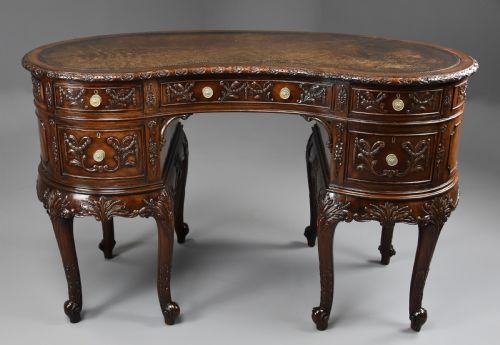
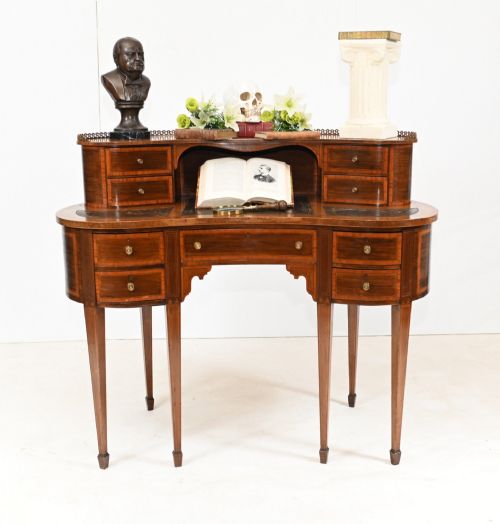
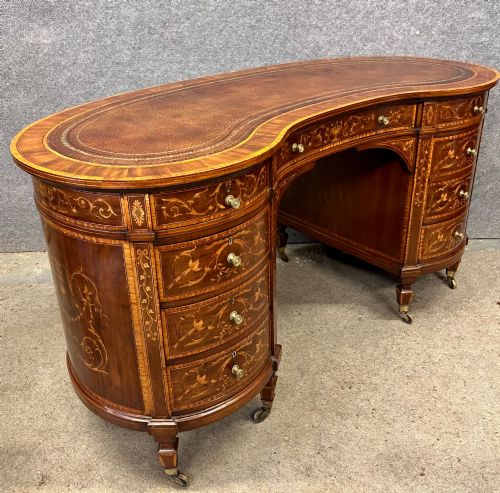
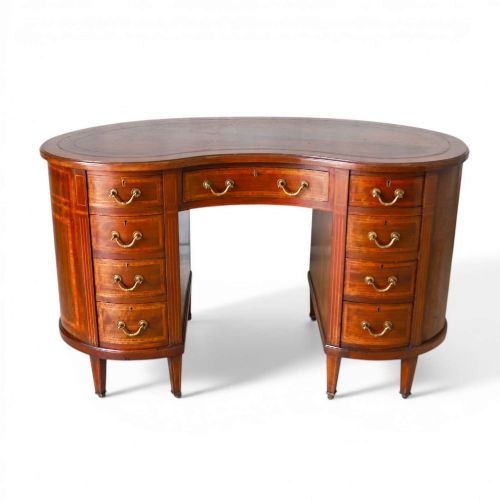
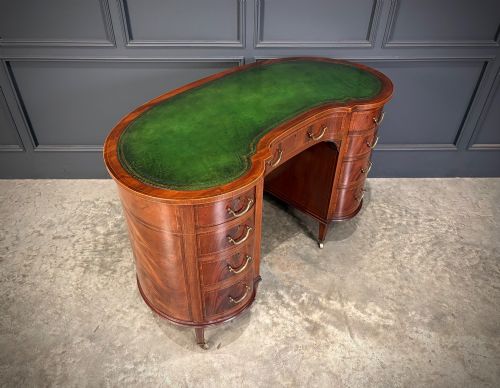
The edwardian mahogany kidney desk is defined by its distinctive curved outline, designed to wrap gently around the user while providing a dedicated writing surface. Most examples encountered here date from the Edwardian period and the late Victorian era, spanning into the early twentieth century.
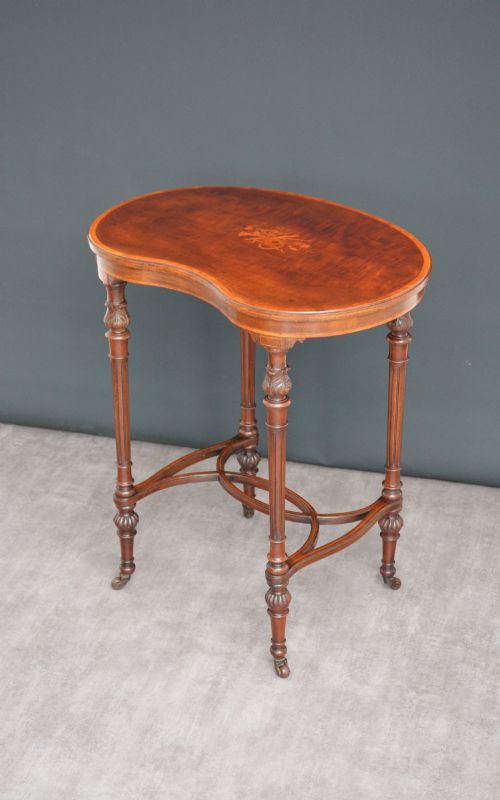
Beyond standard writing desks, the forms include freestanding library tables, dressing tables, and occasional side tables sharing the signature kidney shape. These pieces draw heavily on Sheraton Revival and French Revival design vocabularies, often incorporating intricate marquetry and fine stringing.
How they were made
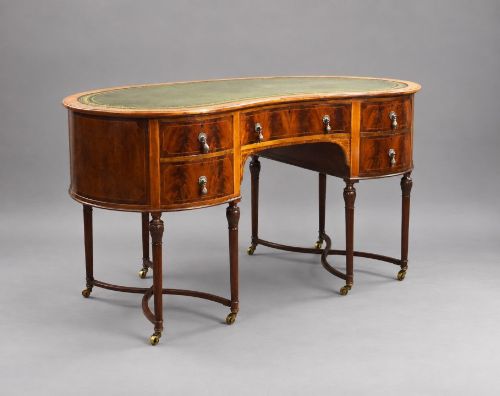
Construction relies primarily on solid mahogany and flame mahogany veneers, selected for rich grain patterns and deep warm tones. Artisans shaped these timbers to the tight curves of the kidney form using specialised bending and joining techniques.
Surface decoration frequently incorporates boxwood and satinwood inlay, creating delicate classical motifs and contrasting borders. Many retain original inset leather writing surfaces, bordered by subtle gold tooling.
Edwardian Mahogany Kidney Desk Retail Price Guide 2026
Typical asking prices for edwardian mahogany kidney desk among the pieces listed under this phrase on Sellingantiques today, from the lower quarter to the upper quarter. They describe what is for sale here now, not the wider market.
Some desks are small enough to serve as lamp tables or wine tables, proving the kidney shape was built for versatility as well as writing.
What varies in quality
Quality rests upon the crispness of the inlay work and the choice of timber figure, such as highly figured flame mahogany veneers. Pieces bearing the marks of established makers command attention for their superior cabinetmaking and refined proportions.
The sophistication of the internal drawer construction and the integrity of the curved framing further distinguish finer examples from standard production. Preservation of original brass hardware and untouched leather inserts adds significantly to the character of a piece.
Wolfe & Hollander·Shapland & Petter·Edwards & Roberts
The Edwardian Mahogany Kidney Desk Glossary
- Kidney desk
- A writing table shaped with a concave front curve, allowing the user to sit nestled into the centre. This distinctive form became particularly popular during the late Victorian and Edwardian periods.
- Flame mahogany
- A veneer cut from the fork of the mahogany tree where the branch meets the trunk. It creates a striking, rippled flame-like pattern across the surface of the desk.
- Marquetry
- The art of applying pieces of veneer to a structure to form decorative patterns and pictures. Makers utilised different coloured woods such as boxwood and satinwood to achieve tonal contrast.
- Sheraton Revival
- A late nineteenth and early twentieth century design movement that reinterpreted the lighter, neoclassical styles of Thomas Sheraton. These pieces often feature delicate legs and restrained inlay.
- Stringing
- Thin lines of contrasting wood inlaid into channels cut into the primary surface. This linear detail frequently outlines the drawers and top edges of Edwardian furniture.
Edwardian Mahogany Kidney Desk: Frequently Asked Questions
How were these desks used originally?
These desks served as elegant correspondence tables in drawing rooms, boudoirs, or studies. Their freestanding capability allowed them to sit centrally within a room rather than pushed against a wall.
The curved front provided easy access to writing materials while maintaining a compact footprint suited to lighter domestic tasks.
How do I identify a Sheraton Revival piece?
Sheraton Revival pieces draw inspiration from eighteenth-century neoclassical designs, characterised by slender tapered legs and delicate marquetry. They frequently employ mahogany solids paired with lighter contrasting wood inlays.
Look for classical motifs, symmetrical arrangements, and an overall sense of lightness in the proportions compared to heavier Victorian furniture.
Can I use a kidney desk as a dressing table?
Many examples share the exact form of dressing tables, equipped with the same curved outline and drawer configurations. The surface area accommodates grooming essentials just as readily as writing materials.
Historical usage often overlapped depending on the room the furniture occupied, making them adaptable for modern living spaces.