
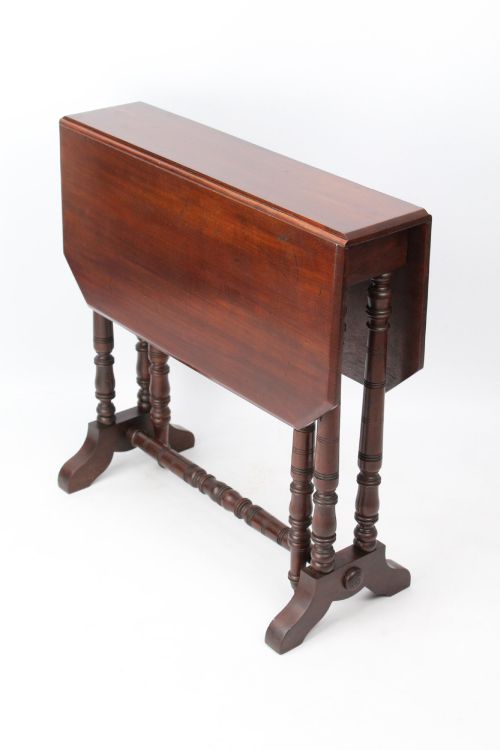

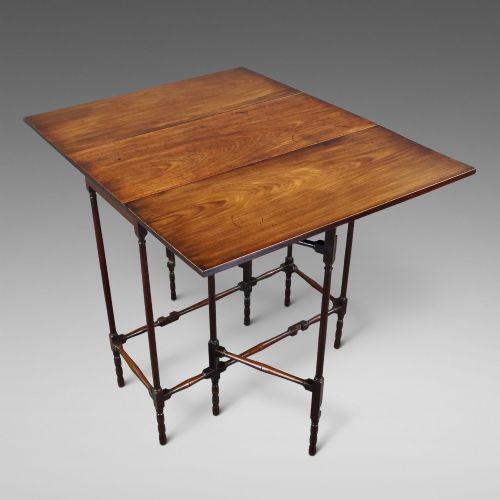


Edwardian Mahogany Gateleg Table
An edwardian mahogany gateleg table is a versatile folding piece designed to save space whilst offering a generous surface when opened.
Edwardian Mahogany Gateleg Table
When searching for an edwardian mahogany gateleg table, you encounter practical folding furniture predominantly made during the Edwardian period, alongside related Victorian and early twentieth-century examples. These pieces function as occasional tables, drop-leaf dining tables, and compact coffee tables that fold down neatly against a wall when not in use.
The most common form on this page is the Sutherland table, a slender variant with drop leaves supported by swinging gate legs. You will also find spider leg tables and triangular gateleg designs constructed in solid or ebonised mahogany.
Materials and construction
Makers utilised mahogany as the primary timber, occasionally selecting solid mahogany or applying ebonising for a dark finish. Decorative details frequently include satinwood inlay, boxwood, and satinwood crossbanding.
Structural integrity relies on hinged drop leaves and pivoting gate legs that swing out to support the extended flaps. Brass hardware often secures joints and movements across these folding tables.
Some tiny spider leg tables are so narrow when folded they resemble slender wooden gates resting quietly against the wall.
Distinctions in quality
The standard of timber selection and inlay work sets finer pieces apart from standard utility items. Subtle additions such as crossbanded borders, canted corners, and delicate spider legs indicate superior cabinet-making.
Construction robustness in the folding mechanism and gate action determines everyday utility and longevity. Well-fitted hinges and smooth drop leaves reflect attentive workshop execution.
The Edwardian Mahogany Gateleg Table Glossary
- Gateleg table
- A table with hinged leaves supported by legs that swing outward like gates. This design allows the surface area to expand or contract easily.
- Sutherland table
- A narrow style of drop-leaf table with particularly slender legs and leaves that drop almost vertically. It was patented in the nineteenth century and remains highly popular.
- Spider leg table
- A gateleg table featuring exceptionally thin turned legs that create a delicate profile. These are common on smaller occasional and tea tables.
- Satinwood inlay
- Contrasting yellowish timber set into the mahogany surface in decorative patterns. It provides visual enrichment to the top and borders.
- Crossbanding
- A strip of veneer laid across the grain of the primary wood around the perimeter of a table top. This technique frames the central panel.
Edwardian Mahogany Gateleg Table: Frequently Asked Questions
How do I use a gateleg table daily?
Keep the leaves dropped against the sides for compact placement in a hallway or living room. Raise the flaps and swing out the supporting legs whenever you need extra surface space for dining or writing.
Ensure you lower the leaves gently and avoid placing excessive weight on the unsupported edges of the extended flaps.
What is a Sutherland table?
A Sutherland table is a specific type of drop-leaf table characterised by a very narrow central fixed top and particularly wide leaves. When folded down, the leaves hang almost vertically, making the footprint remarkably small.
This form was designed for tight spaces in Victorian and Edwardian homes where furniture needed to move aside quickly.
How do I date an Edwardian table?
Look for characteristic Edwardian design markers such as satinwood inlay, lighter proportions, and ebonised finishes combined with turnery styles of the period. Date ranges often span the late nineteenth century through to the 1920s.
Compare the construction methods and wood patination with standard pieces recorded from the era to confirm the manufacturing window.
Can these tables seat guests for dinner?
Larger gateleg and drop-leaf dining tables are built to accommodate multiple diners when fully opened out. Models designed as dining tables extend to seat four, eight, or ten people depending on their original scale.
Smaller occasional and Sutherland versions are best suited for tea, display, or side use rather than formal meals.