


Edwardian Leather Flask
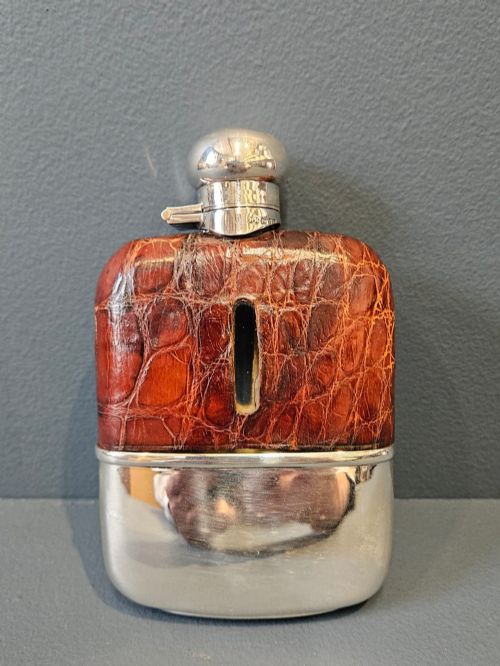
An edwardian leather flask is a portable drinking vessel designed for travel, field sports and outdoor leisure, combining glass, metal and hide.
Edwardian Leather Flask
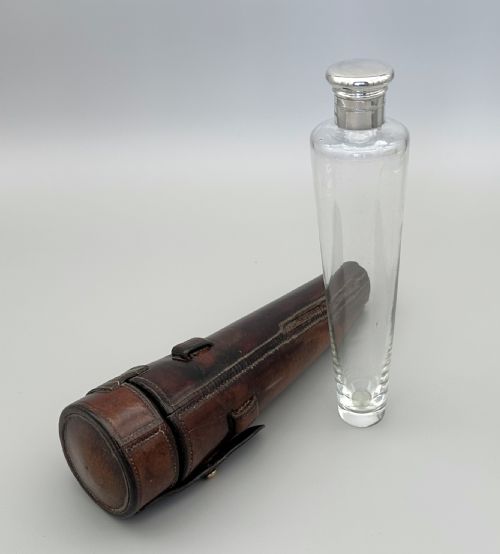
An edwardian leather flask takes several distinct forms, most commonly appearing as a curved hip flask or a saddle flask housed in its own fitted case. These items emerge from periods spanning the early twentieth century, including the Edwardian era, George V reign and Art Deco years.
The materials recorded across these pieces combine clear glass bottles with leather, crocodile skin, sterling silver or silver plate. Some examples feature a collapsible cup attached to the base, while others take the form of desk flasks or campaign decanters intended for travel.
The versions most frequently met on this page are silver-mounted or leather-covered hip flasks dating from the nineteen-hundreds to the nineteen-thirties. They reflect the portable drinking habits of the period, often designed to slip into a pocket or mount onto a horse.
Materials and Construction
Makers formed the core vessel from moulded glass to hold spirits safely without imparting taste. This glass bottle was then wrapped partially or fully in leather or crocodile skin to provide grip and protection during travel.
Silver or silver-plated mounts reinforced the neck and cap, frequently incorporating hinged lids and secure screw mechanisms to prevent spills. Hallmarks stamped into the metal components record the assay office and date of production, linking the piece to silversmiths active in Sheffield and other manufacturing centres.
Object forms recorded in the archive include hip flasks, saddle flasks, desk bottles, barware and campaign decanters.
Judging Quality
The distinction between standard utility items and superior examples lies in the weight of the metal and the precision of the leatherwork. Heavier gauges of sterling silver and finely stitched crocodile skin elevate a piece well above simple silver-plated variants.
Completeness also dictates standing, particularly where original fitted leather cases, matching cups or intact hallmarked lids remain with the bottle. The integration of mechanical elements, such as a smoothly operating collapsible cup, demonstrates the skill of the original maker.
Hukin & Heath·James Dixon
The Edwardian Leather Flask Glossary
- Saddle flask
- A drinking bottle shaped with a captive base or fitted leather case designed to slide into a leather holster on a horse saddle. These pieces served riders during hunting and cross-country travel.
- Hip flask
- A curved pocket container made to follow the contour of the body for discreet carriage. They typically feature a captive screw cap to prevent loss of the stopper.
- Campaign decanter
- A portable glass bottle housed in a protective leather case intended for officers on the move. Such items belong to a broader tradition of travel equipment from the Edwardian period.
- Silver plate
- A layer of silver fused to a base metal core such as copper or Britannia metal. This technique offered the visual appeal of solid silver at a lower production cost.
- Collapsible cup
- A drinking vessel formed from telescoping metal segments that collapse into a compact base cap. This clever addition provided an immediate cup without adding bulk to the flask.
Edwardian Leather Flask: Frequently Asked Questions
What is an edwardian leather flask?
An edwardian leather flask is a portable drinking vessel constructed from glass, metal and leather or crocodile skin. These pieces were manufactured for travel, hunting and outdoor pursuits during the early twentieth century.
They range from pocket hip flasks to larger saddle flasks and desk bottles, combining practical utility with period craftsmanship.
How do I date an edwardian leather flask?
Dating relies heavily on silver hallmarks stamped onto the mounts, which indicate the year of manufacture and assay office. Stylistic cues such as George V or Art Deco details also help place pieces into the nineteen-twenties or thirties.
Items lacking hallmarks are generally dated through overall construction, materials and comparative examples from the Edwardian era.
Were these flasks made for hunting?
Many examples, particularly saddle flasks, were specifically engineered for mounted field sports and hunting excursions. Their shaped leather cases allowed them to be secured directly to a saddle.
Other variations, such as curved hip flasks, were designed for everyday travel and outdoor leisure rather than equestrian use.
How should I clean the leather?
Leather and crocodile skin coverings require gentle treatment using specialist leather balms to maintain flexibility and prevent drying out. Moisture should be kept away from stitched seams and metal mounts during cleaning.
Silver components can be polished carefully with a soft cloth, taking care not to stain the surrounding hide.