




Edwardian Hepplewhite Dining Chairs
Edwardian hepplewhite dining chairs bring neoclassical shield backs and figured mahogany into the dining room with lighter proportions.
Edwardian Hepplewhite Dining Chairs
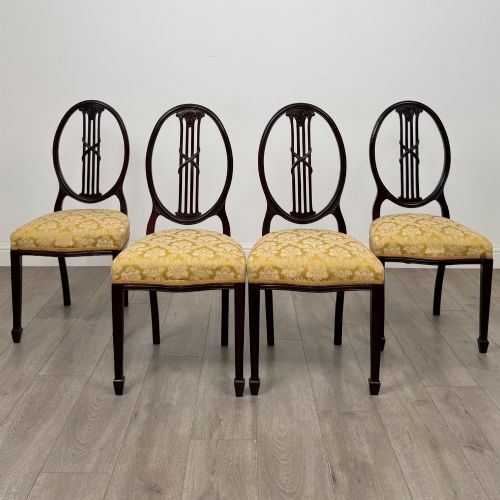
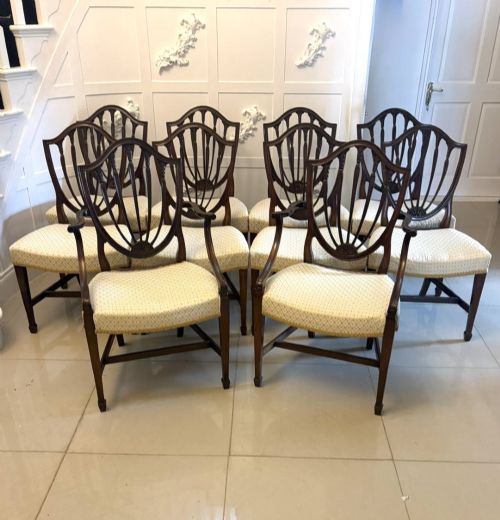
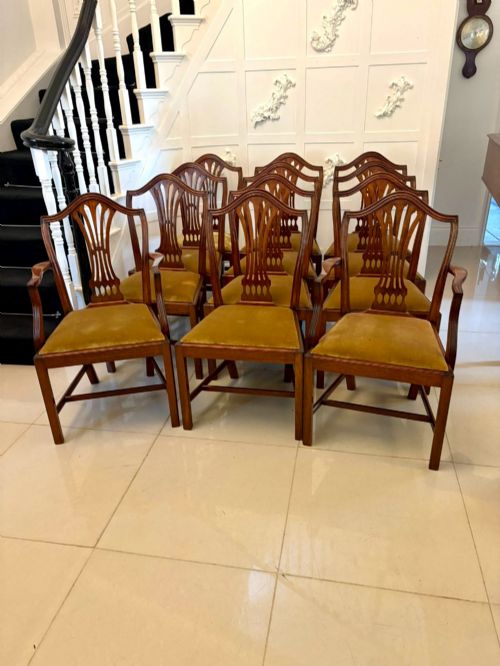
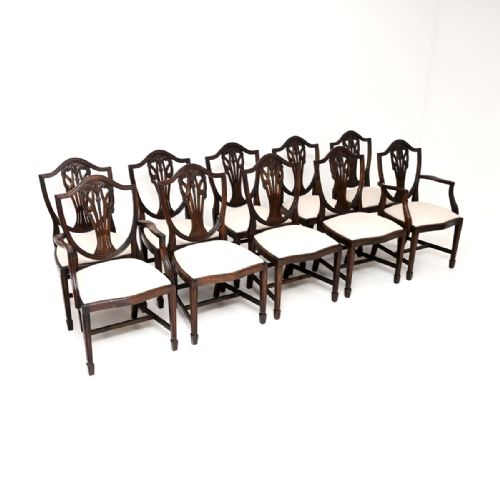
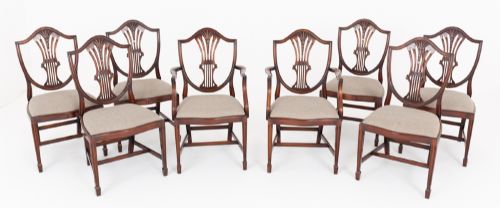
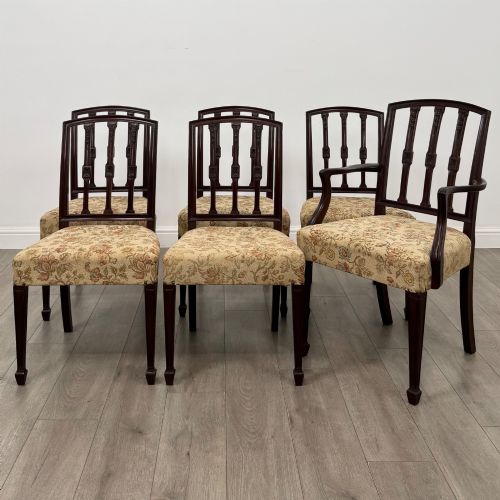
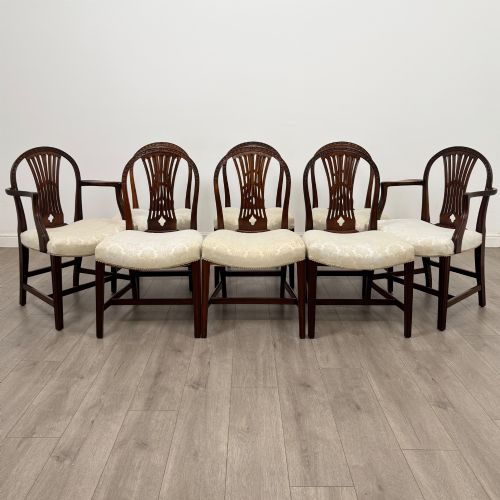
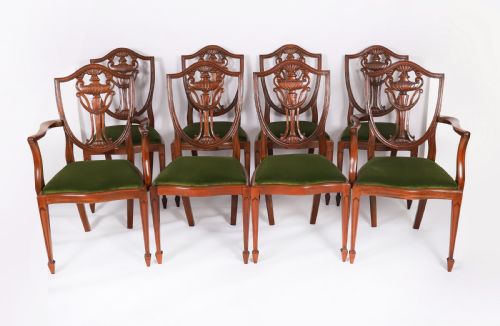
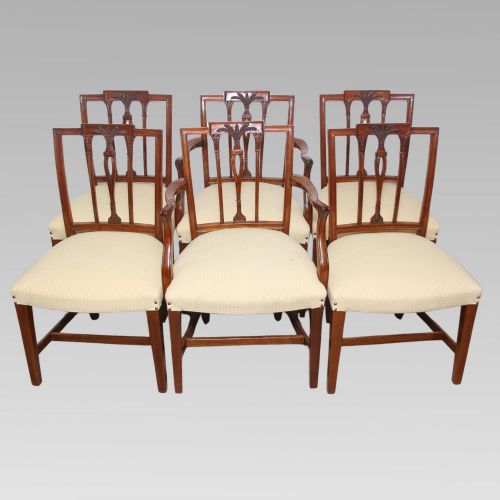
Edwardian hepplewhite dining chairs are revived neoclassical seating forms that draw directly upon eighteenth-century patterns while utilising the timbers and construction methods of the early twentieth century. Buyers encounter these pieces most frequently configured in sets ranging from four to twelve, often incorporating a pair of matching armchairs or carvers alongside single side chairs.
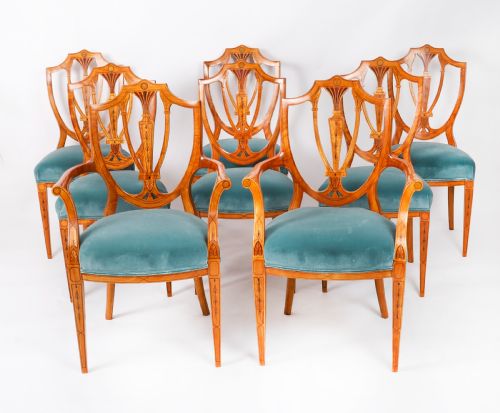
The dominant material visible across these listings is mahogany, complemented by occasional examples in satinwood, maple, and walnut. The characteristic shield back shape defines the visual profile, supported by straight tapered legs or spade feet that distinguish the revival output from heavier Victorian prototypes.
Materials and construction
Cabinetmakers constructed these chairs primarily using solid and veneered mahogany, sometimes enriched with contrasting satinwood stringing or delicate inlay work. The timber frames rely on mortise and tenon joints to secure the upright stiles to the seat rails and carved splats.
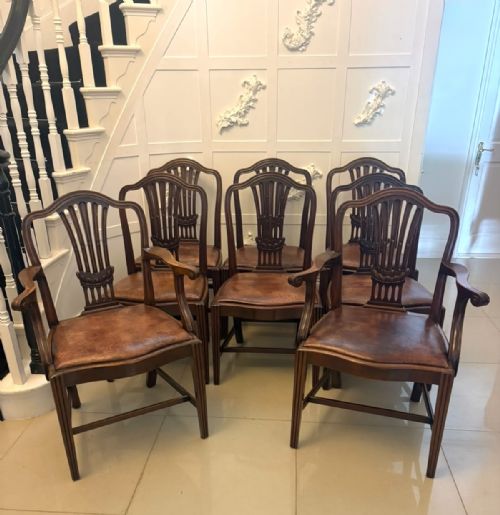
Seat pads are upholstered over traditional webbed and stuffed foundations, utilising materials such as leather, velvet, and various woven fabrics. Carved details on the shield backs and splats are shaped directly from the wood rather than applied in composition.
The archive and current stock demonstrate a strong preference for sets of eight chairs, frequently combining six side chairs with two matching carvers.
Quality differences
The standard of carving across the pierced splats separates basic production from superior examples, with finer sets displaying crisp drapery, bell husks, and feather motifs without softening of the edges. Timber selection dictates visual depth, where richly figured mahogany grain and uniform colour elevate the presence of the suite.
Originality of the set composition and the retention of matching carvers influence desirability, particularly when larger quantities survive intact. Upholstery choices and the preservation of original leather or textile coverings also mark the distinction between commercial output and workshop pieces of higher ambition.
Maple & Co·Cowtan & Sons
The Edwardian Hepplewhite Dining Chairs Glossary
- Shield back
- A chair back shaped like an inverted shield, characteristic of Hepplewhite designs. This form supports open-work splats often carved with drapery, urns, or feathers.
- Carver
- An armchair designed to match a set of single dining chairs, traditionally placed at the heads of the table. These incorporate sweeping open arms attached to the seat rails.
- Satinwood
- A pale, hard exotic timber utilised for its golden sheen and smooth grain. Makers employed it for contrasting stringing, banding, and complete decorative surfaces.
- Splat
- The vertical wooden element positioned centrally in the chair back. In these designs, it takes a pierced, urn-like or shield-linked form tapering toward the seat.
- Spade foot
- A rectangular foot that tapers downward toward the base, finishing square. This foot style terminates many of the straight legs seen on Edwardian revival seating.
Edwardian Hepplewhite Dining Chairs: Frequently Asked Questions
How many chairs come in a typical set?
Sets commonly appear in groupings of four, six, eight, ten, or twelve chairs to accommodate varying dining table lengths. Many larger suites include a designated pair of matching carvers alongside the single side chairs.
Buyers looking to furnish larger rooms find that sets exceeding eight chairs frequently retain their original uniformity in timber and carving detail.
Are these chairs comfortable for daily dining?
The supportive upright posture encouraged by the shield back and solid wood frame suits formal dining environments. Traditional stuffed seats provide a firm sitting foundation rather than deep modern cushioning.
Original seat heights and proportions reflect early twentieth-century dining customs, which differ slightly from contemporary seating dimensions.
How do I distinguish Edwardian revivals from eighteenth-century originals?
Edwardian pieces display the characteristic machine-milled precision, timber seasoning techniques, and secondary woods typical of the early 1900s. Subtle variations in the crispness of the carved splats and the colour of the mahogany finish identify the later revival period.
Examination of the underside reveals construction marks and screw types consistent with twentieth-century workshop practices rather than eighteenth-century joinery.
What wood types are most common?
Mahogany serves as the primary timber across the vast majority of these listings, chosen for its durability and rich dark grain. Occasional variations feature satinwood, maple, or walnut used for contrasting inlay and decorative banding.
The wood surfaces are frequently polished to a mellow sheen that highlights the natural figuring of the mahogany shield backs.