
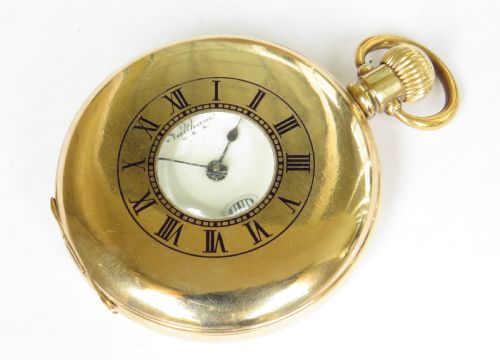


Edwardian Half Hunter Watch
An edwardian half hunter watch brings pocket timekeeping with a protective front window, combining daily utility with fine period craftsmanship.
Edwardian Half Hunter Watch
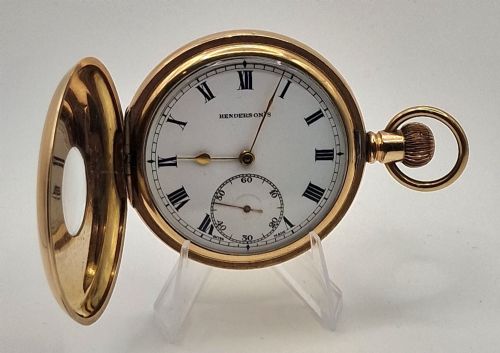
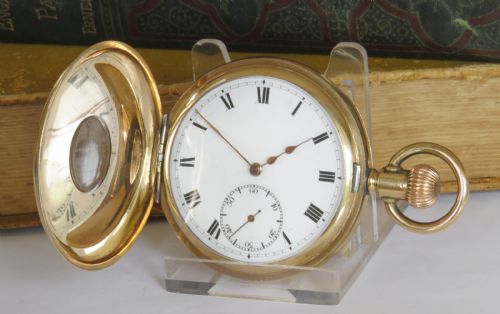
The edwardian half hunter watch is a pocket timekeeper distinguished by a metal outer case featuring a glass-covered centre aperture to read the hands without opening the cover. When you search for this phrase, you find watches originating primarily from the early twentieth century alongside adjacent interwar and late nineteenth-century examples.
The versions most commonly met on this page span silver, sterling silver, gold, gold filled, and gold plated metal cases. They frequently house mechanical movements signed by makers such as Hamilton & Inches, Limit Revue, Waltham, Cyma, JW Benson, Baume & Co, and Pimco.
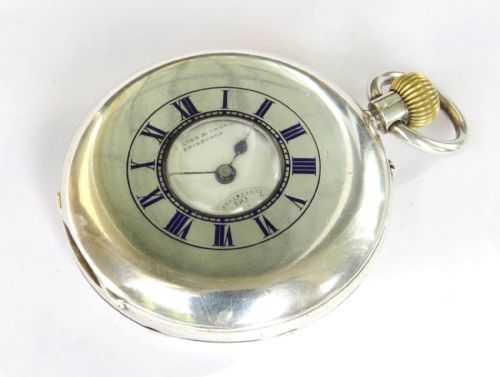
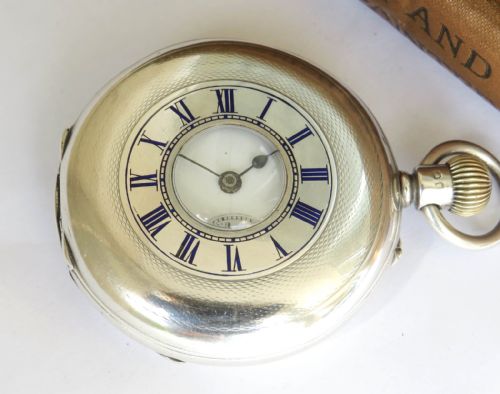
These pieces survive in forms ranging from plain polished silver outer cases to those adorned with enamel chapter rings around the glass aperture. They represent a distinct era of portable horology where pocket watches remained an essential personal accessory.
How they were made
Cases are formed from precious metals like silver and gold, as well as durable alternatives including gold filled and gold plated brass. Enamel is frequently applied to the outer case to create contrasting marker rings or numerals around the central glass viewing window.
Internal movements rely on traditional mechanical watchmaking techniques, housing geared wheel trains and jewelled pivots. These delicate components are housed securely within protective metal case constructions designed to withstand daily pocket wear.
This site's listings span the nineteenth century, Edwardian era, and interwar period, featuring silver, gold, brass, and enamel materials.
What varies in quality
The distinction between standard examples and the finest pieces often rests upon the reputation of the maker and the precision of the movement. Signed mechanisms from established watchmakers command greater interest than unsigned or generic alternatives.
Case materials also dictate the tier of the piece, with solid silver and gold housings representing superior manufacture compared to plated or filled metal variants. The crispness of enamelling on the outer case further elevates the overall standard.
Hamilton & Inches·Limit Revue·Waltham·Cyma·JW Benson·Baume & Co·Pimco·Eastern Watch Case Co Criterion
The Edwardian Half Hunter Watch Glossary
- Half hunter
- A pocket watch featuring a protective outer cover with a glass window in the centre allowing the time to be read without opening the case. This design protects the delicate crystal beneath while offering immediate visibility.
- Hunter
- A pocket watch with a full metal spring-loaded outer cover that must be completely opened to view the hands and dial. It differs from the half hunter by lacking a central viewing aperture.
- Gold filled
- A manufacturing method where a layer of solid gold is mechanically bonded to a base metal core. This provides the appearance and durability of solid gold at a different weight and cost.
- Enamel
- A glassy substance fused to metal under high heat to create decorative coloured surfaces. On these watches, it typically forms crisp black numerals around the viewing window.
Edwardian Half Hunter Watch: Frequently Asked Questions
How do I read the time on it?
You read the time through the glass aperture on the outer case, which usually displays an enamel chapter ring corresponding to the watch hands beneath. For setting the time or viewing the full dial, the spring-loaded cover opens via the crown.
The outer markers guide your eye to the hands even when the case is fully closed. It was designed for busy owners who required rapid time checks on the move.
Are these watches mechanical?
Yes, these pocket watches rely entirely on traditional mechanical movements powered by a mainspring that you wind by hand via the crown. They contain intricate gear trains and escapements rather than electronic components.
Many incorporate jewelled bearings to reduce friction within the moving parts. Regular winding keeps the balance wheel oscillating and the hands moving across the face.
What metals were used for the cases?
The cases are constructed from a variety of materials including solid silver, sterling silver, and solid gold. You will also encounter gold filled and gold plated metal variants.
Precious metal cases often bear hallmarks indicating their assay office and standard of purity. These materials determined the initial cost and status of the timepiece.