
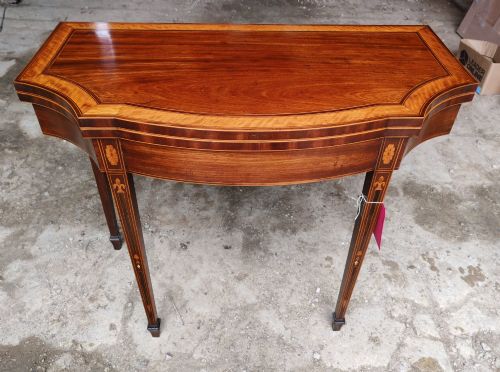
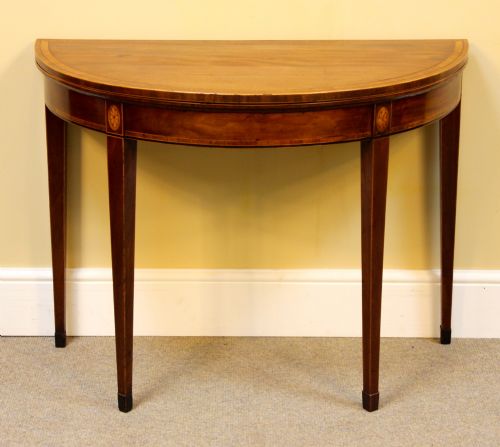


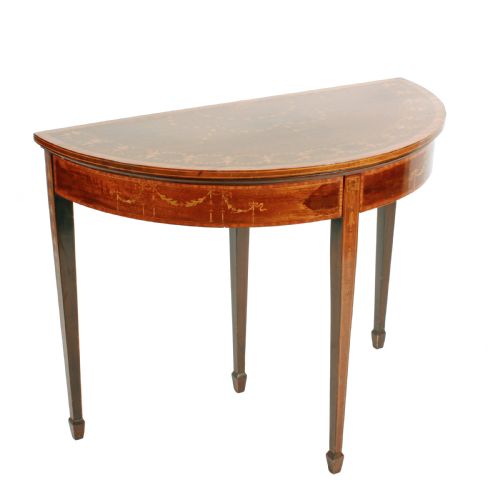

Edwardian Foldover Table
These edwardian foldover table pieces are adaptable surfaces that open to reveal dual-purpose spaces for cards, writing, or tea.
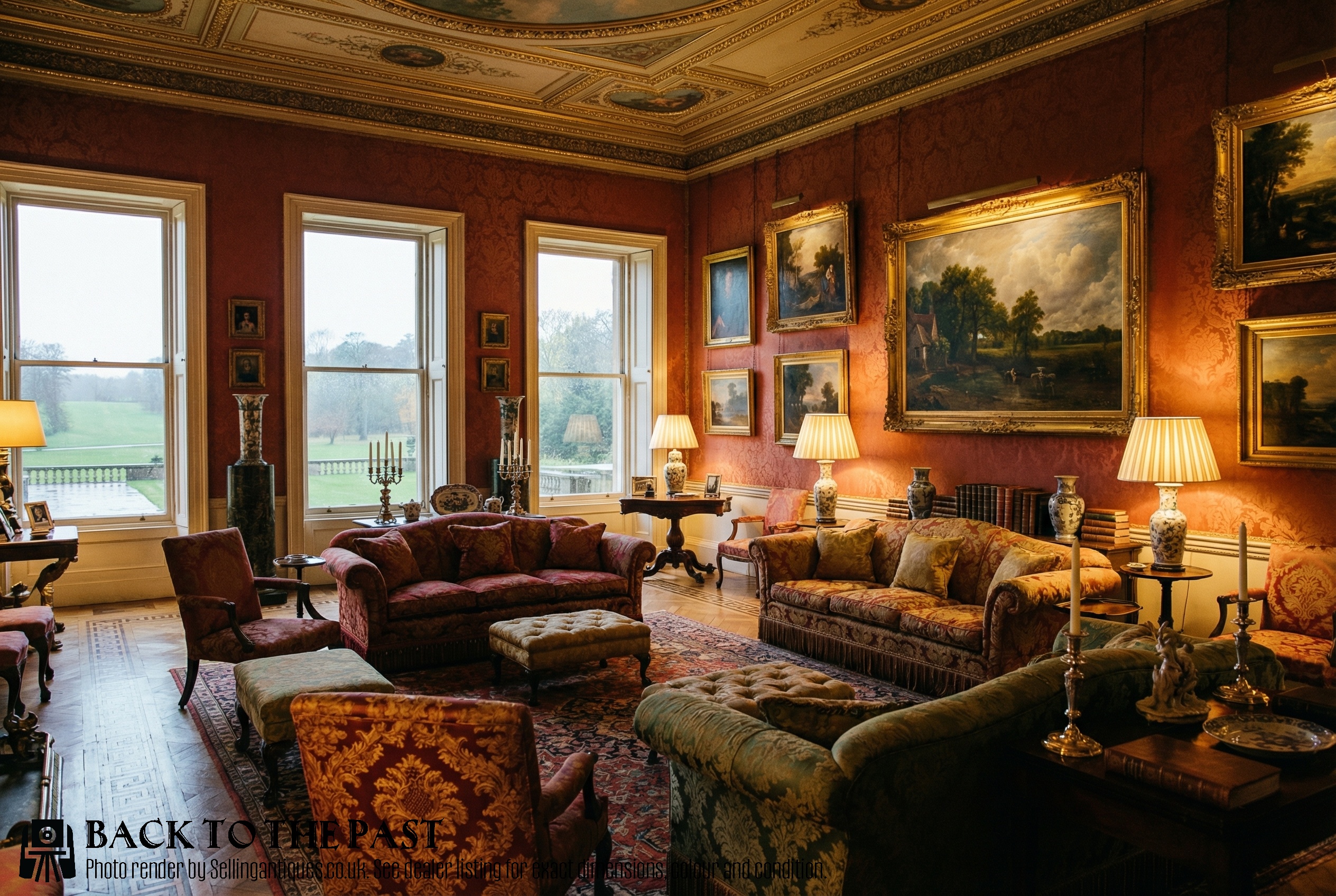
Edwardian Foldover Table
The most common examples you will meet here date from the Edwardian period or adopt earlier revivals, constructed primarily in mahogany and satinwood. These tables function equally well as console surfaces against a wall or pulled into the centre of a room for entertaining.
How they were made
Makers utilised solid timbers and selected veneers such as mahogany, walnut, and satinwood, frequently applying intricate boxwood and marquetry inlay to the top surfaces. The folding mechanisms rely on clever hinging, sometimes paired with pivoting rear legs that swing out to support the expanded leaf.
Surfaces were traditionally finished with French polish to protect the timber while accentuating the natural grain and contrast of inlaid borders. Brass fittings and hardware frequently appeared on campaign-style or drawer-equipped variations.
Object forms range from standard card and tea tables to specialised campaign writing desks and chess-playing surfaces.
What varies in quality
Quality rests heavily on the crispness of the cabinetwork and the precision of the timber matching across the fold. Superior examples display seamless grain continuity when the leaf is opened, alongside tight, clean joints in the folding mechanism.
The sophistication of the decoration also sets pieces apart, ranging from simple polished mahogany borders to elaborate satinwood marquetry and fine stringing. Heavier, more stable timber frames separate durable everyday items from lighter, purely decorative interpretations.
Edwards and Roberts·Gillows
The Edwardian Foldover Table Glossary
- Demi-lune
- A half-moon shape commonly used for the top and base of console and card tables. This profile allows the piece to sit flush against a wall when closed.
- Marquetry
- The art of applying decorative pieces of veneer to a structure to form intricate designs or pictures. It often incorporates contrasting woods like boxwood and satinwood.
- Campaign style
- Furniture designed to be easily dismantled and transported, typically featuring recessed brass handles and corner brackets. This functional aesthetic influenced certain writing and folding tables.
- Serpentine
- A curved line or edge that bends inward and outward in a continuous wave. You will see this profile frequently on the front aprons and tops of tea and card tables.
- Stringing
- Thin lines of contrasting wood inlay used to outline the edges of tabletops and drawers. It provides a sharp visual border to panels of mahogany or satinwood.
Edwardian Foldover Table: Frequently Asked Questions
What is a foldover table used for?
These tables served primarily as multi-functional furniture for the home, acting as compact console surfaces when closed and expanding to accommodate card games, writing, or tea when opened.
Their dual nature made them particularly useful in smaller drawing rooms where space-saving adaptability was essential for entertaining guests.
How do I tell an Edwardian piece from a Georgian one?
Edwardian interpretations often display lighter satinwood marquetry and revival styles inspired by earlier eras, whilst Georgian pieces generally rely on heavier solid mahogany construction and simpler, more restrained lines.
Examining the secondary timbers underneath and the style of the internal hinges also helps clarify the actual period of manufacture.
Where should I place a demi-lune table?
A demi-lune or half-moon table is designed to sit flat against a wall as a console or pier table when the top is folded down. When guests arrive, the top unfolds to form a full circle or square for activities.
This placement keeps the room feeling open while ensuring the table remains ready for immediate use.
How do I care for inlaid wood surfaces?
Protect antique polished wood by keeping tables away from direct sunlight and maintaining a stable indoor humidity to prevent the delicate veneer and stringing from lifting.
Dust regularly with a dry cloth and occasionally apply a gentle wax polish suited to historic furniture to maintain the lustre.