





Edwardian Drinks Credenza
An Edwardian drinks credenza brings refined hospitality to a room, offering clever storage for bottles and glassware within polished timber cabinetry.
Edwardian Drinks Credenza
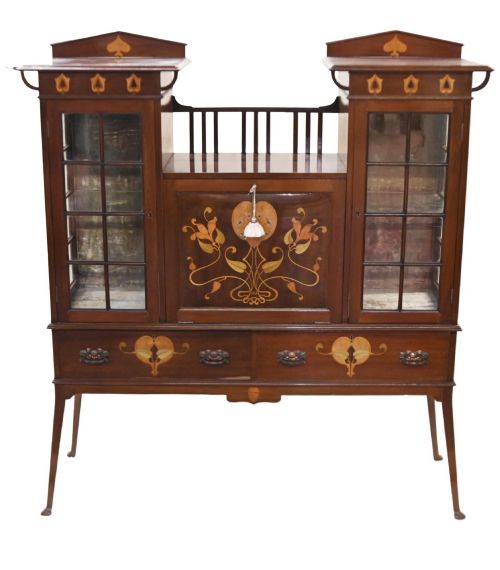
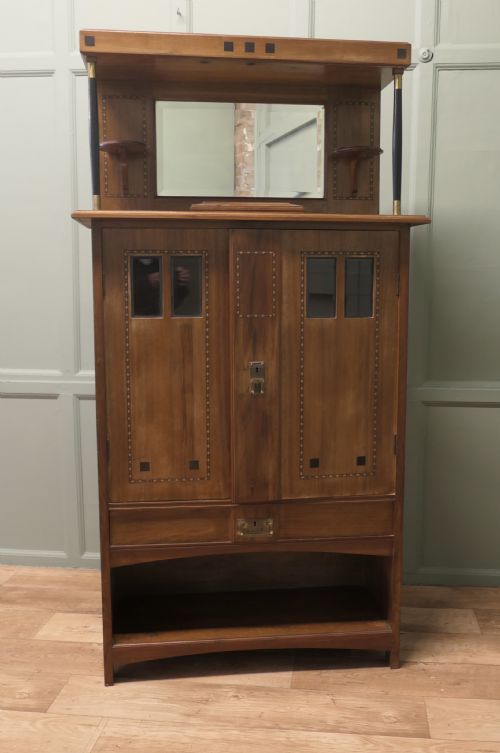
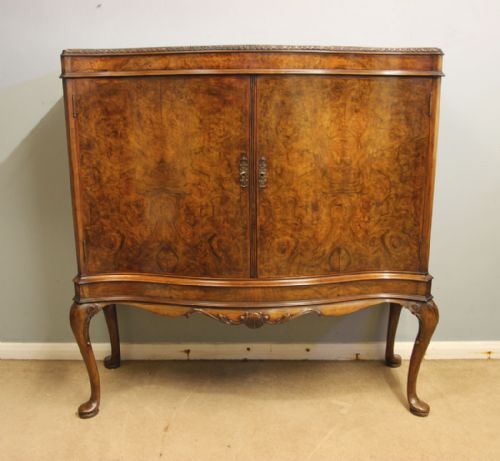
When you search for an Edwardian drinks credenza, you are looking for sophisticated entertaining furniture designed to house bottles, decanters and glassware. The pieces encountered here span the Edwardian era alongside adjacent periods, featuring forms such as side cabinets, cocktail cabinets and demi lune sideboards.
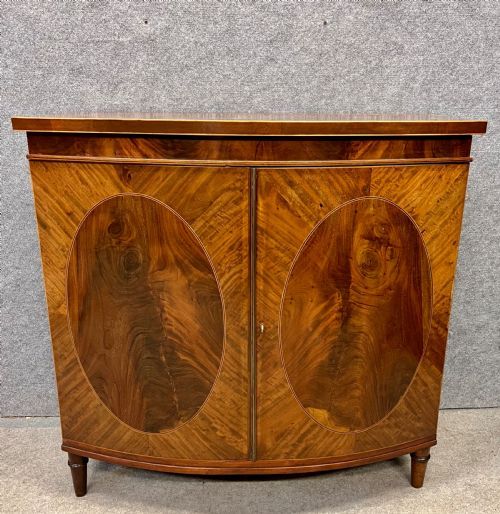
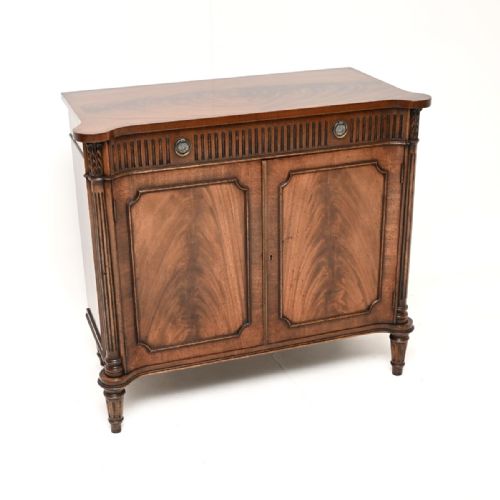
Makers of the era utilised diverse stylistic influences, ranging from Queen Anne revival and Georgian proportions to Secessionist lines and French revival details. You will frequently find semicircular demi lune profiles, bow fronts and serpentine shapes that elevate a simple storage unit into a striking architectural feature.
The selection includes low sideboards and tall display cabinets equipped for beverage storage, often distinguished by glazed doors or drop-down cocktail flaps. These variations reflect how Edwardian households adapted traditional dining room furniture for modern social habits.
Materials and construction
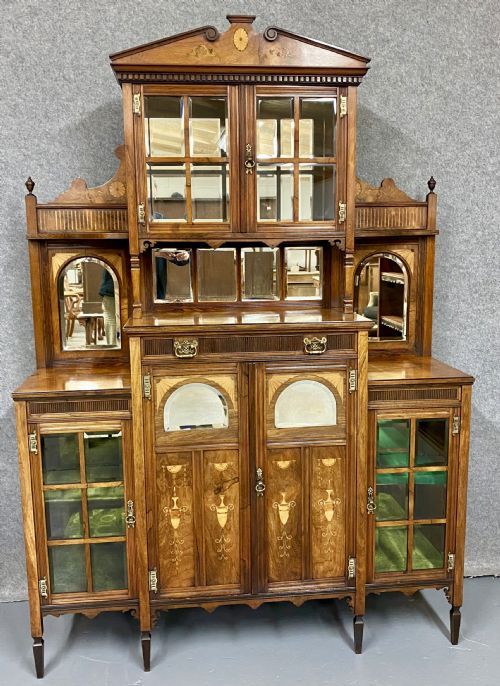
Cabinetmakers relied on substantial timbers like mahogany, walnut and burr walnut, frequently applying contrasting satinwood inlay or marquetry to accentuate the curved fronts. Brass fittings, including key escutcheons and handles, provide functional accents against the dark wood surfaces.
Interiors often incorporate mirrored glass panels to reflect light behind glassware collections, while polished wood surfaces demonstrate traditional joinery techniques suited to curved and serpentine carcases.
Edwardian Drinks Credenza Retail Price Guide 2026
Typical asking prices for edwardian drinks credenza among the pieces listed under this phrase on Sellingantiques today, from the lower quarter to the upper quarter. They describe what is for sale here now, not the wider market.
Mirrored glass panels inside these cabinets were cleverly added to make a modest collection of sherry glasses look twice as abundant.
Assessing craftsmanship and finish
Superior examples distinguish themselves through the precision of their marquetry inlay and the choice of highly figured veneers like burr walnut or satinwood. The harmony of proportions, particularly on complex demi lune or serpentine shapes, separates exceptional workshop production from standard utility pieces.
The integration of interior mirror glass, well-fitted shelving and original brass hardware contributes to a cohesive design that holds its decorative integrity over time.
The Edwardian Drinks Credenza Glossary
- Demi lune
- A half-moon shape characteristic of side cabinets and console tables designed to sit flush against a wall.
- Marquetry
- Decorative patterns formed by inserting pieces of contrasting veneer into a wood foundation to create pictorial or geometric designs.
- Serpentine
- A gently undulating shape featuring a convex centre flanked by concave curves, often seen on cabinet fronts.
- Secessionist
- A stylistic movement rejecting historicism in favour of geometric simplification and clean linear forms.
- Burr walnut
- Timber taken from a tree growth that produces intricate, swirling grain patterns highly prized for cabinet veneers.
Edwardian Drinks Credenza: Frequently Asked Questions
What is an Edwardian drinks credenza?
An Edwardian drinks credenza is a specialised cabinet designed for storing and serving beverages, combining functional shelving with decorative woodwork.
These pieces typically incorporate enclosed compartments for bottles and glassware, often styled with inlaid veneers or curved fronts.
How were these cabinets used?
They served as dedicated hospitality stations in dining rooms and drawing rooms during the Edwardian period and beyond.
Hosts used them to keep decanters, glasses and bottles close at hand during social gatherings and formal dinners.
What woods are commonly found?
Mahogany and walnut form the primary structure of these cabinets, frequently enhanced by burr walnut or satinwood inlay.
Brass hardware and mirror glass are also standard materials integrated into the overall design.
How do I date an Edwardian cabinet?
Dating relies on stylistic clues such as the presence of Edwardian marquetry, specific revival influences like Queen Anne style, or Secessionist geometry.
Construction methods and timber selection further help place a piece within the late nineteenth or early twentieth century.