

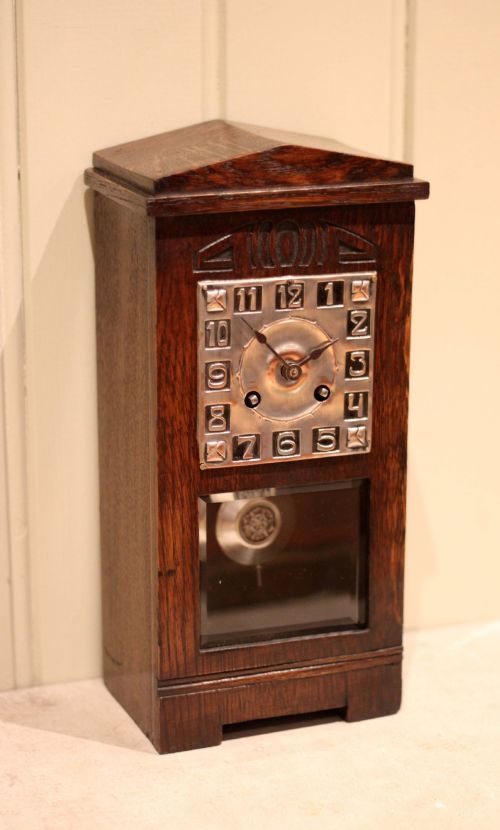
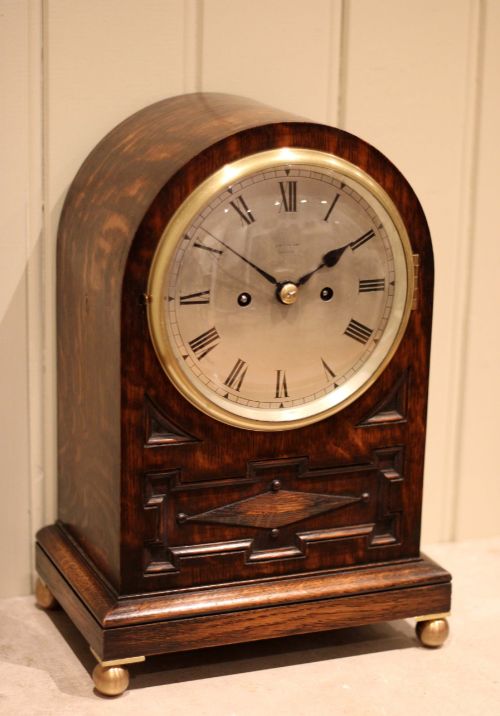
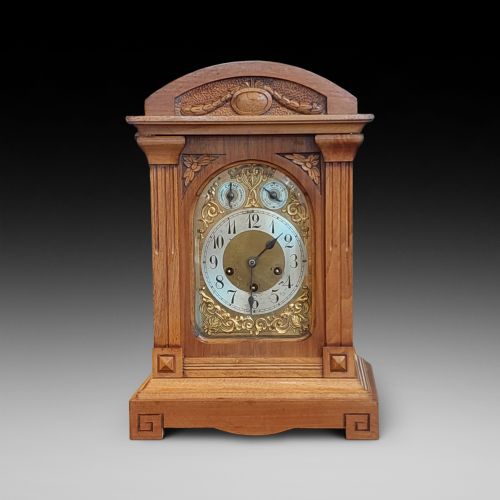

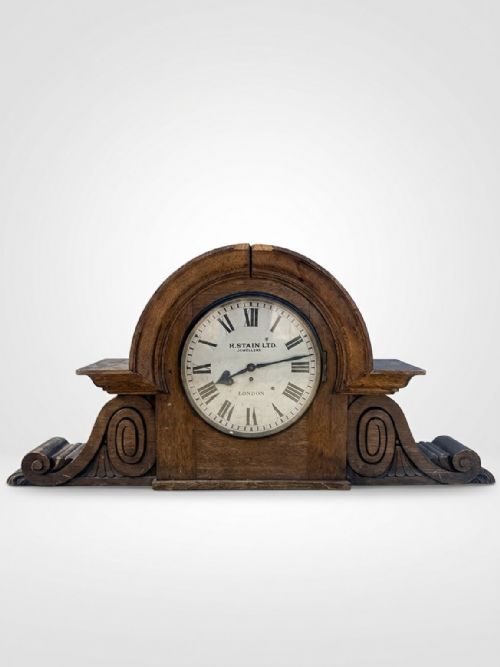
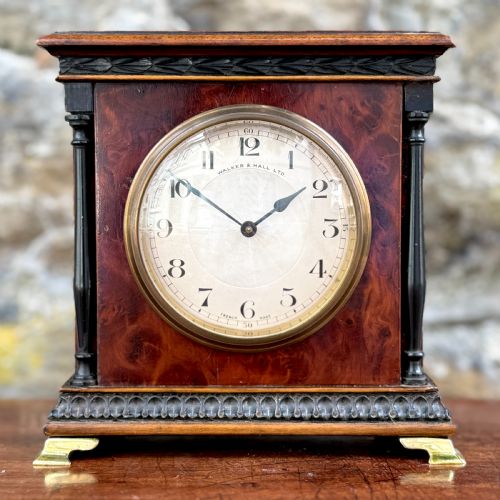


Edwardian Carved Mantel Clock
An edwardian carved mantel clock brings architectural presence and mechanical precision into a room, offering both reliable timekeeping and period design.
Edwardian Carved Mantel Clock
An edwardian carved mantel clock is a domestic timepiece designed to sit on a fireplace mantel or shelf, combining functional horology with decorative woodworking. You encounter styles ranging from plain architectural oak cases to elaborate Art Nouveau inlays and Black Forest carvings.
Most examples on this page date from the Edwardian era and around nineteen hundred, utilising cabinet woods such as oak and mahogany. They appear in forms from simple arched bracket clocks to large boardroom models featuring Westminster chimes and brass faces.
How they were made
Cabinetmakers constructed the cases primarily using solid oak, mahogany, and walnut, often applying hand carving and geometric or floral inlay work. Metal components such as brass, steel, and glass form the bezels, dials, and protective face covers.
Internal movements rely on mechanical gear trains driven by springs or fusee chains, with enamel dials carrying the numerals. Makers fitted these chassis into wooden housings styled to reflect Victorian, Arts and Crafts, or Art Nouveau tastes.
Edwardian Carved Mantel Clock Retail Price Guide 2026
Typical asking prices for edwardian carved mantel clock among the pieces listed under this phrase on Sellingantiques today, from the lower quarter to the upper quarter. They describe what is for sale here now, not the wider market.
Some heavier bracket clocks doubled as domestic security systems, waking the household with deep, resonant quarter-strikes.
What varies in quality
The distinction between ordinary and superior pieces rests on the depth of hand carving and the complexity of the internal movement. Clocks featuring fusee mechanisms or specialised quarter-striking chimes represent a higher standard of horological engineering than standard time-only spring-driven models.
Case construction also dictates value, with well-figured timbers, crisp architectural mouldings, and intact brass ornamentation setting finer examples apart from plainer production models.
Walker and Hall·Goldsmiths and Silversmiths London
The Edwardian Carved Mantel Clock Glossary
- Fusee
- A conical pulley connected to the mainspring by a chain or cord, designed to equalize the torque as the spring unwinds. This mechanism improves the timekeeping accuracy of the clock.
- Bracket clock
- A portable household clock originally designed to sit on a wall bracket or a table. Many Edwardian variants retained the name despite standing directly on mantelpieces.
- Westminster-chime
- A melody played by the clock on bells or gongs to mark the quarters of the hour. It is commonly found on larger bracket and boardroom clocks from this period.
- Enamel dial
- A clock face made by fusing powdered glass to a metal substrate at high temperatures. These dials provide a durable, glossy white surface for painted numerals.
- Black Forest
- A regional style of wood carving originating in Germany, known for deep, naturalistic motifs of foliage and animals. Such work appears frequently on clocks from around nineteen hundred.
Edwardian Carved Mantel Clock: Frequently Asked Questions
Where should I place a mantel clock?
Position the clock on a stable, level surface away from direct heat sources like radiators and out of direct sunlight. A secure mantelpiece or heavy sideboard provides the necessary stability for a pendulum or balance wheel.
Ensure there is enough clearance around the case for chiming models so the sound can resonate properly. Wall proximity can also alter the acoustic volume of strike-train mechanisms.
Why does my clock lose time?
Mechanical clocks require regular maintenance and proper leveling to keep accurate time. Changes in room temperature can also cause the metal components within the movement to expand or contract.
Adjustment levers or regulating screws on the pendulum or balance bridge allow for fine-tuning the beat. Professional servicing is often necessary if cleaning or oiling has been neglected for years.
How do I identify the period of a carved clock?
Examine the timber, hardware, and decorative motifs to determine the era of manufacture. Oak and mahogany styles often reflect the transition from late Victorian heaviness to lighter Edwardian or Arts and Crafts designs.
Maker signatures on the dial or movement backplate provide definitive dating evidence. Look also for construction techniques like hand-cut dovetails or machine-milled components.