
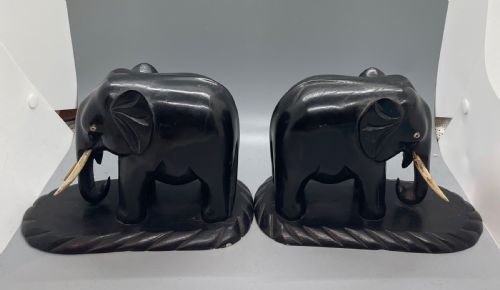


Ebony Elephant Carving
These heavy ebony elephant carving examples range from Victorian bookends to Anglo-Indian occasional tables, bringing dark woods and carved detail into a room.
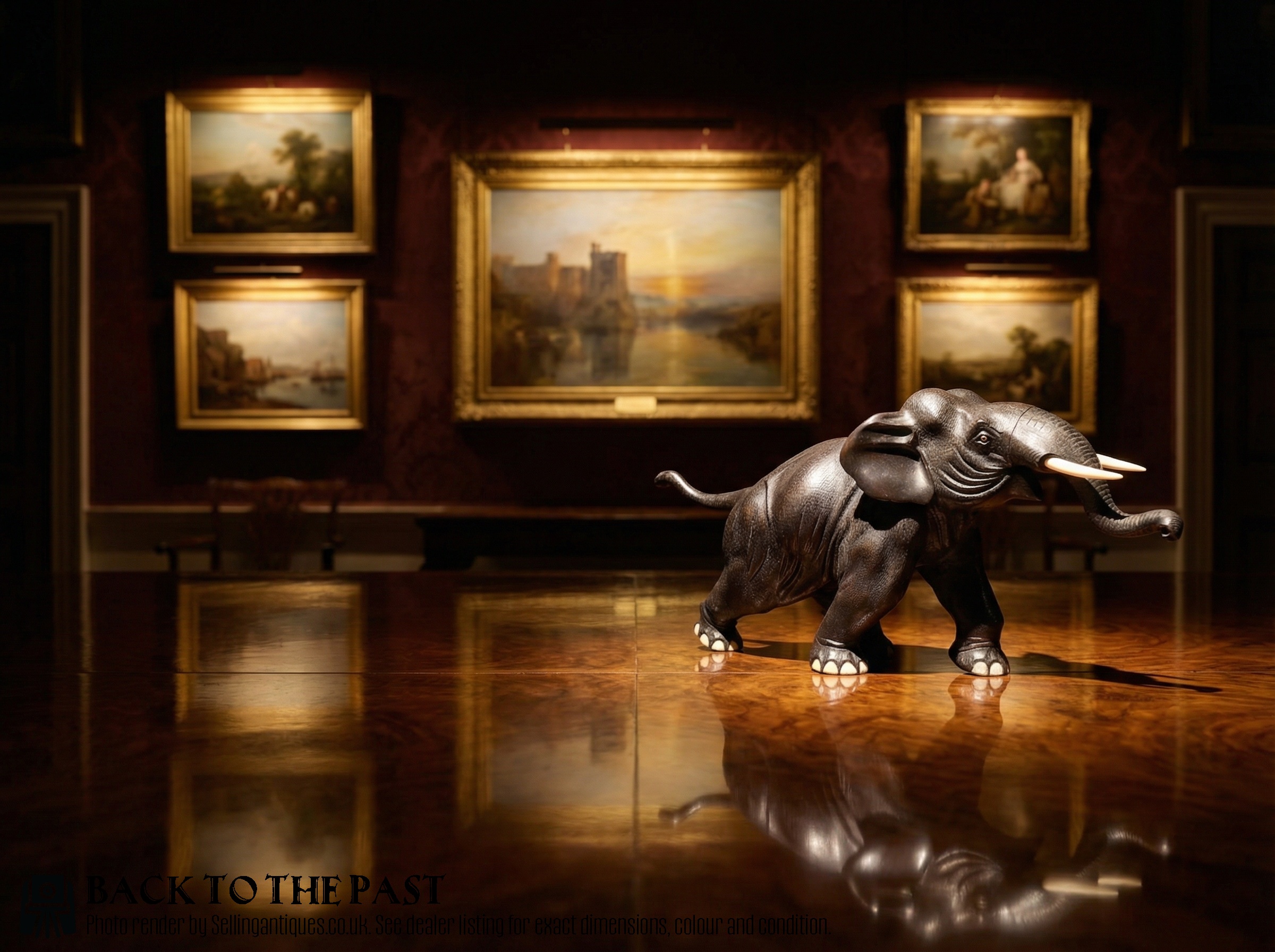
Ebony Elephant Carving
An ebony elephant carving typically takes the form of shelf bookends, decorative sculptures, or smaller occasional tables like tripod tables and coffee tables. These pieces span the Victorian era, the Indian Raj period, and the Art Deco years of the early twentieth century.
The versions most commonly met on this page include pairs of carved bookends and solid wood animal studies. Originating largely from British India and Ceylon, these objects showcase regional craftsmanship in dense tropical timber.
Materials and construction
Makers utilised dense timbers such as ebony, teak, coromandel wood, and walnut, often employing contrasting bone inlay for tusks, eyes, or decorative surface patterns. These dark woods were hand-carved to capture the natural musculature and skin folds of the animal.
Some larger items incorporate specialist regional woodworking traditions, such as the intricate Hoshiarpur technique seen in inlaid tripod tables. Smaller sculptures and bookends rely on straightforward subtractive carving from solid blocks of dark hardwood.
Judging quality in carved elephants
Quality rests in the anatomical accuracy of the carving and the crispness of the surface detail, distinguishing a lifelike study from a rigid or crude representation. The depth and precision of any bone inlay further separate standard examples from finer work.
The choice and condition of the timber dictate the overall character of the piece, with richly figured ebony and sound, unblemished coromandel or teak showing superior material selection. The presence of matching pairs, particularly in bookends, adds visual balance.
The Ebony Elephant Carving Glossary
- Ebony
- A dense, dark hardwood prized for its deep black or near-black heartwood and fine grain. It takes a high polish and resists wear.
- Anglo-Indian
- A style of furniture and decorative objects produced in India during the British Raj, combining British forms with traditional Indian craftsmanship.
- Bone inlay
- A decorative technique where small pieces of bone are set into recesses carved into the wood surface to create geometric or floral patterns.
- Coromandel wood
- A heavy, durable timber featuring contrasting dark brown and light yellow stripes, often used in fine nineteenth-century decorative pieces.
- Hoshiarpur
- A town in Punjab known for its intricate woodwork, particularly tables and boxes decorated with dense bone and shesham inlay.
Ebony Elephant Carving: Frequently Asked Questions
What periods do these carvings come from?
These pieces originate from the nineteenth century, the Victorian era, the Indian Raj period, and the early twentieth century up to the Art Deco nineteen-thirties.
They reflect colonial trade and travel, with distinct stylistic shifts from ornate Victorian and Anglo-Indian work to streamlined Deco forms.
How were these items used originally?
Bookends supported heavy volumes on study desks and library shelves, while decorative sculptures sat on mantelpieces or cabinets as displays of exotic travel.
Smaller tripod and coffee tables served functional roles in colonial and domestic drawing rooms for holding tea or decorative ornaments.
How do I care for ebony and hardwood?
Keep these items away from direct sunlight and rapid temperature fluctuations to prevent the dense timber from splitting or drying out.
Apply a minimal amount of appropriate furniture wax occasionally to maintain the natural lustre of the dark wood.
How do I distinguish regional styles?
Ceylonese and Indian pieces often feature intricate carving and specimen wood construction, sometimes incorporating bone inlay for contrast.
Art Deco examples tend to feature simplified, geometric lines in the base or associated furniture elements, reflecting 1930s design trends.