
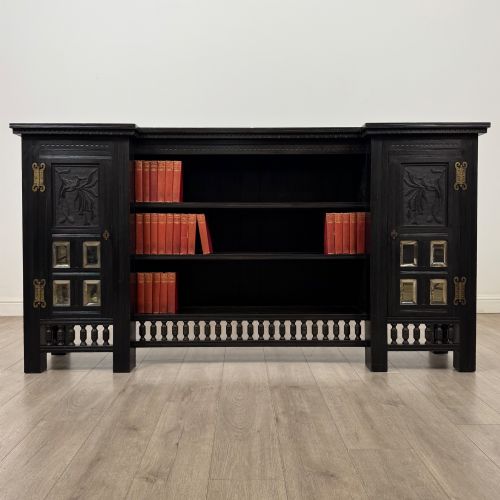
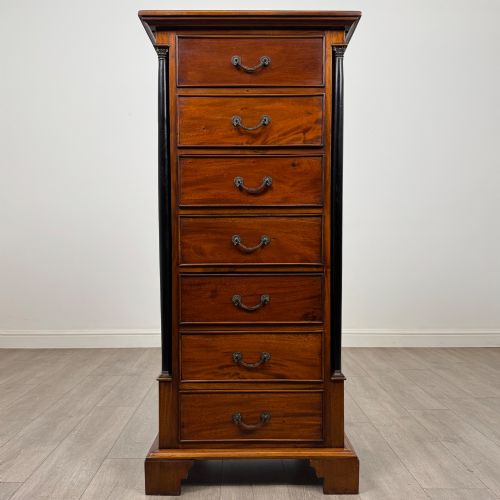
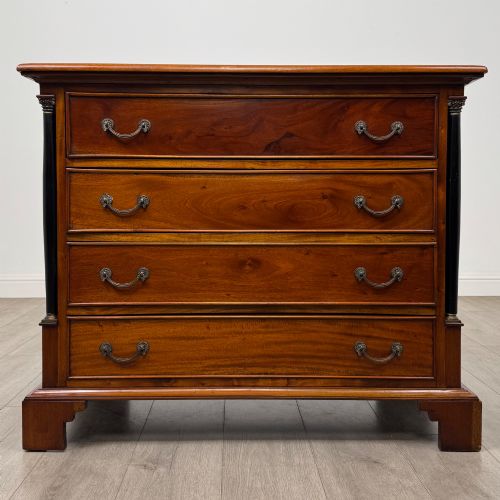


Ebonised Wood Storage Cabinet
These ebonised wood storage cabinets offer dark, striking surfaces and practical storage, drawing the eye in any room.
Ebonised Wood Storage Cabinet
An ebonised wood storage cabinet brings together functional storage and a dark, dramatic finish that anchors a room. When buyers search for an ebonised wood storage cabinet, they encounter forms ranging from Victorian sideboards and credenzas to 17th century table cabinets and French demi lune pieces.
The pieces on offer span several periods, most notably the Victorian era, alongside 19th-century works and earlier examples like the 17th-century Flemish ebony table cabinet. Forms vary widely from narrow chests of drawers and corner units to buffet cabinets and key cupboards.
Victorian and 19th-century examples dominate the selection, often combining ebonised surfaces with marquetry inlay, brass mounts, and glass panels. Buyers will find that these cabinets serve various domestic roles, functioning as sideboards, key cupboards, or small tabletop storage.
How they were made
Makers utilised woods such as ebonised wood, walnut, burr walnut, mahogany, softwood, and kingwood to construct these cabinets. Surfaces were frequently treated to achieve a deep, dark ebonised finish that mimics ebony.
Decoration relied on contrasting materials, incorporating brass, bone, and glass alongside intricate floral marquetry inlay. Construction techniques varied from simple softwood framing to elaborate two-part buffet builds and delicate tabletop cabinet joinery.
What varies in quality
Quality rests upon the precision of the ebonised finish and the crispness of any inlaid floral marquetry. Finer pieces display meticulous attention to detail in their brass mounts and glass fitting.
The choice of underlying timber, such as burr walnut or kingwood alongside the ebonised surfaces, elevates the visual depth of the cabinet. Structural integrity in drawers, doors, and two-part forms further separates standard utility pieces from finer examples.
The Ebonised Wood Storage Cabinet Glossary
- Ebonised
- Wood treated with a stain or finish to imitate true ebony, producing a dense black surface. This technique was widely favoured during the Victorian period.
- Marquetry
- Decorative veneer work arranged in intricate patterns or pictures using various woods and materials like bone. Floral designs often appear on credenzas and side cabinets.
- Credenza
- A sideboard or display cabinet originating in Italy and popular in Victorian dining rooms. These pieces often feature glass doors and elaborate inlay.
- Demi lune
- A half-moon shape used to describe furniture pieces such as small cabinets designed to sit flush against a wall. French makers frequently employed this curved form.
- Buffet cabinet
- A storage piece traditionally used for food service and dining storage, occasionally constructed in two distinct parts. They provide substantial interior space.
Ebonised Wood Storage Cabinet: Frequently Asked Questions
Where should I place an ebonised cabinet?
These dark cabinets work well as focal points in dining rooms, hallways, or living spaces. Their striking finish complements both neutral walls and rich colour schemes.
Ensure the cabinet is positioned away from direct sunlight to protect the ebonised finish and any delicate marquetry inlay from fading over time.
How do I care for ebonised wood?
Dust the surface regularly with a soft, dry cloth to prevent the buildup of particles. Avoid using harsh chemical sprays or silicone polishes, which can damage the dark finish.
Occasional application of a suitable wax helps maintain the lustre of the wood without altering its deep black tone.
Can I use a key cabinet for modern storage?
Key cupboards and table cabinets provide compact storage for small household items, trinkets, or everyday essentials. Their internal hooks and compartments adapt well to modern organisation needs.
Placing one on a desk or hall table combines historical character with practical utility.
What periods do these cabinets come from?
The selection spans multiple centuries, with a strong representation of Victorian pieces alongside 19th-century works. Earlier examples, such as 17th-century table cabinets, also appear.
Each period brings distinct construction methods and decorative styles, from Arts and Crafts simplicity to elaborate Flemish Baroque.