
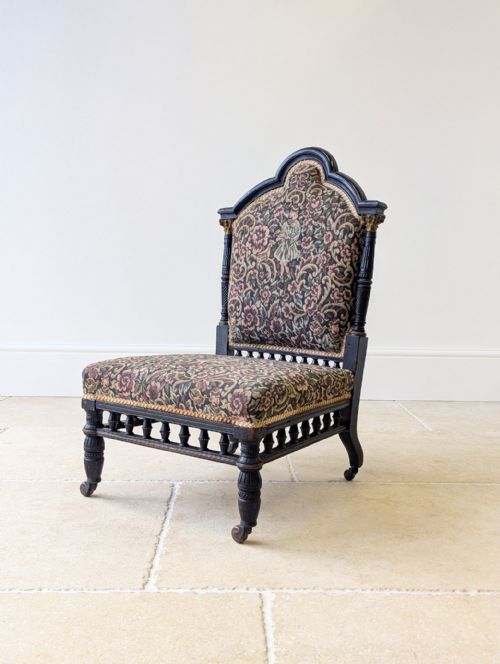


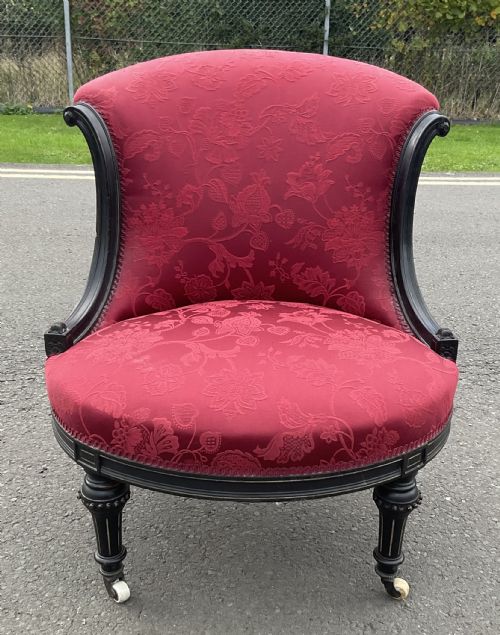


Ebonised Victorian Nursing Chair
An ebonised Victorian nursing chair offers low-slung seating and dark wood charm, making it a compact addition to a traditional bedroom or drawing room.
Ebonised Victorian Nursing Chair
The search phrase ebonised victorian nursing chair brings up low bedroom and salon seating typically fashioned from dark-finished wood during the nineteenth century. These items often appear alongside related low-slung forms such as slipper chairs, boudoir chairs, and occasional chairs.
Most examples date from the Victorian era and the Aesthetic Movement of the 1880s, whilst some extend into the Edwardian period. They frequently feature low seats designed for nineteenth-century domestic comfort.
Makers and workshops produced these chairs in various styles, including English Aesthetic, French Napoleon III, and late Victorian designs. Buyers encounter pairs as well as single pieces upholstered in velvet, damask, or cotton calico.
Materials and Construction
Craftsmen utilised wood treated with an ebonised finish to imitate expensive ebony, sometimes pairing the dark surfaces with gilt highlights or inlaid details. Frames were constructed using sturdy timbers to support upholstered bodies and turned legs.
Upholstery techniques involved traditional stuffing and buttoning finished in velvet, cotton calico, or damask fabrics. Brass fittings and ceramic castors occasionally appear on the lower framework of these seats.
Materials recorded across the inventory include ebonised wood, brass, velvet, cotton calico, damask, and ceramic.
Judging Quality and Finish
Superior pieces display crisp carving, subtle gilding, and precise ebonising that retains its depth across the wooden frame. The integration of decorative elements such as beadwork or cane seating distinguishes finer examples from plain utilitarian versions.
The integrity of the underlying wooden frame and the quality of the textile covering dictate the enduring appeal of each chair. Original upholstery methods and preserved surface patination elevate the standing of surviving items.
Maple and Co
The Ebonised Victorian Nursing Chair Glossary
- Ebonised wood
- Timber stained or painted black to imitate costly ebony wood. This finish was widely favored during the Victorian period for formal and aesthetic furniture.
- Nursing chair
- A low-seated chair traditionally used by women in the nineteenth century for infant care or dressing. The low stature provided practical convenience in domestic chambers.
- Aesthetic Movement
- A late nineteenth-century design style emphasising visual beauty and artistic expression over heavy historicism. Pieces from this movement often utilise clean lines and ebonised finishes.
- Button upholstery
- A tufted upholstery technique where buttons pull the fabric deep into the stuffing to form geometric patterns. This method secures the filling and creates a decorative texture.
- Slipper chair
- An upholstered bedroom chair characterised by very short legs designed to assist with putting on footwear. These low-slung seats share similarities with standard nursing chairs.
Ebonised Victorian Nursing Chair: Frequently Asked Questions
What is an ebonised Victorian nursing chair?
An ebonised Victorian nursing chair is a low-seated nineteenth-century seat featuring dark, ebony-finished wood and upholstered padding. These compact chairs were originally designed for bedroom or boudoir use.
They appear in various nineteenth-century styles, including Aesthetic Movement designs with gilt highlights, button upholstery, and turned wooden legs.
How were nursing chairs used originally?
Nineteenth-century households utilised these low seats in bedrooms and dressing rooms for tasks such as nursing infants or putting on shoes. Their reduced height made them practical for private domestic spaces.
Over time, these versatile pieces moved into drawing rooms and salons as decorative accent furniture.
How do I identify an Aesthetic Movement chair?
Aesthetic Movement chairs from the 1880s typically display ebonised surfaces, sometimes accented with gilt decoration, incised carving, or subtle inlay work. Their forms lean towards refined simplicity compared to heavier high-Victorian styles.
Many examples feature circular seats or slender turned wooden supports characteristic of this artistic period.
Can I use these chairs in a modern room?
These compact seats fit easily into contemporary bedrooms, hallways, or living spaces as occasional or accent chairs. Their low profile prevents them from dominating smaller rooms.
Matching the upholstery to existing interior colour schemes allows these historic pieces to blend seamlessly with modern furnishings.