

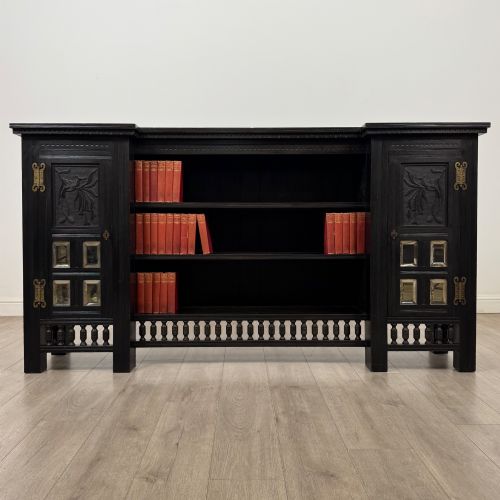
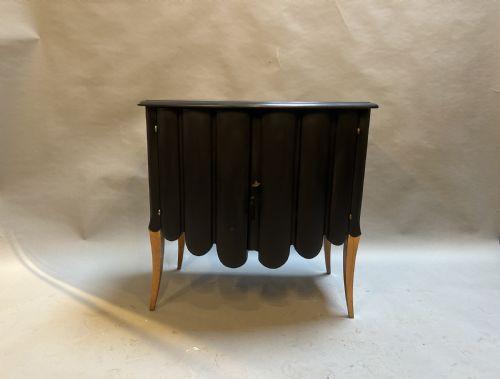
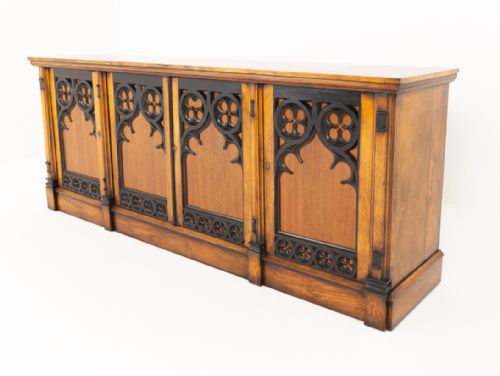


Ebonised Storage Sideboard
An ebonised storage sideboard brings deep dark timber and architectural presence to a room, offering practical storage disguised in period character.
Ebonised Storage Sideboard
An ebonised storage sideboard encompasses dark-finished cabinets, credenzas, and commodes designed to hold household items while anchoring a dining room or hall. The selections here span the Victorian era through the Art Deco period, offering both substantial proportions and smaller side cabinets.
The most frequent examples you will encounter combine ebonised wood surfaces with contrasting materials like burr walnut or marble tops. These pieces draw on styles ranging from Gothic Revival and French Rococo Revival to clean-lined Art Deco forms.
Makers and workshops from England, France, and Spain contributed to this category, creating functional furniture that ranges from English sideboards with floral marquetry to French commodes with parchment-covered drawers.
How they were made
Cabinet makers utilised dense hardwoods such as oak, walnut, and rosewood, often applying a black ebonised finish to imitate more costly ebony. This dark surface frequently served as a backdrop for boxwood inlay, brass mounts, and detailed floral marquetry.
Parchment and glass also appear in the construction of later Art Deco examples, adding tactile contrast to the wooden carcase. Marble tops provide a durable and weighty finish on nineteenth-century credenzas and cabinets.
Ebonised Storage Sideboard Retail Price Guide 2026
Typical asking prices for ebonised storage sideboard among the pieces listed under this phrase on Sellingantiques today, from the lower quarter to the upper quarter. They describe what is for sale here now, not the wider market.
The listings on this page span the Victorian era, the nineteenth century, and the 1930s Art Deco period, incorporating marble, brass, and parchment.
What varies in quality
The distinction between ordinary and exceptional pieces lies in the crispness of the carving, the precision of the boxwood inlay, and the integration of secondary timbers. Finer examples display meticulous marquetry and uncompromised structural integrity across doors, drawers, and plinths.
Quality also shows in the choice of auxiliary materials, such as heavy veined marble tops and cast brass mounts that fit the timber snugly without gaps. The depth and durability of the ebonised finish itself separates workshop standard work from superior cabinet making.
Gordovil Spain
The Ebonised Storage Sideboard Glossary
- Ebonised
- Wood treated to resemble ebony through staining or painting. This finish gained popularity in the nineteenth century for furniture mimicking luxury tropical hardwoods.
- Credenza
- A low dining room cabinet or sideboard, typically featuring doors and central shelving. Originating in Italy, it evolved into a decorative display piece in Victorian drawing rooms.
- Marquetry
- Decorative patterns formed by small pieces of veneer fitted into wood panels. Cabinet makers use contrasting timbers to create floral or geometric motifs.
- Commode
- A low French chest of drawers or cabinet with a wide body. These pieces often feature marble tops and decorative mounts.
- Demi-lune
- Half-moon shaped. This term describes side cabinets and console tables built with a curved front and flat back to sit flush against a wall.
Ebonised Storage Sideboard: Frequently Asked Questions
What is an ebonised storage sideboard?
An ebonised storage sideboard is a dark-finished cabinet or credenza designed for dining rooms and hallways to store tableware and household items while providing a display surface.
These pieces rely on deep stained wood, often paired with contrasting inlays, marble tops, or brass mounts to create a formal aesthetic.
How do I date an ebonised cabinet?
Dating relies on stylistic clues, such as the heavy carving of Victorian Gothic pieces versus the geometric simplicity of Art Deco commodes. Materials like parchment or Palisander rosewood often point toward twentieth-century French design.
Earlier nineteenth-century pieces typically feature burr walnut, boxwood inlay, and heavy marble tops supported by timber carcases.
Where should I place a sideboard?
These side cabinets suit dining rooms for storing serving dishes and cutlery, or living spaces as a low credenza for books and objects. Their flat tops also accommodate lamps and decorative pieces.
Because many examples feature finished backs or demi-lune shapes, they sit comfortably against main walls or in larger hallways.
How do I care for ebonised wood?
Ebonised surfaces require dusting with a soft, dry cloth to prevent the accumulation of grit that can scratch the dark finish. Avoid using harsh chemical sprays or excess water on the wood.
Conditioning the timber occasionally with appropriate furniture wax preserves the deep sheen and protects the underlying grain.