
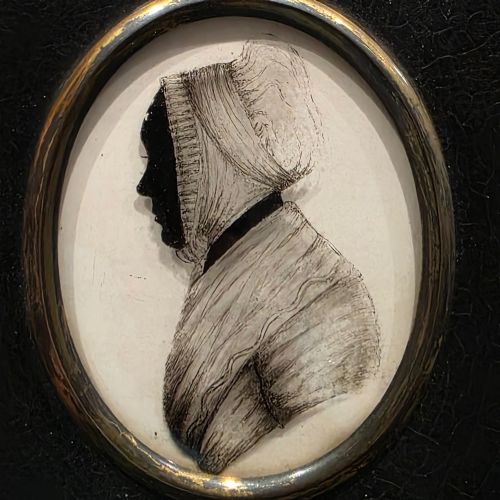


Ebonised Reverse Glass Painting
An ebonised reverse glass painting brings brilliant pigment and dark timber frames together to catch the light from any Georgian or Regency wall.
Ebonised Reverse Glass Painting
An ebonised reverse glass painting is a distinctive form of wall art where pigments, oil paint, or coloured mezzotints are applied directly to the rear of a glass sheet so the image appears correct when viewed through the front. The selection here spans portrait miniatures, silhouette depictions, and framed prints originating in the Georgian, Regency, and eighteenth-century periods.
Buyers seeking an ebonised reverse glass painting will encounter both British portraiture and Chinese export works within these listings. The forms range from small silhouette miniatures to larger domestic and royal subjects, all housed in wood frames treated with a dark, ebony-like finish.
The material combination brings together fragile glass surfaces, paper supports, and pigmented or gilded details enclosed in timber mouldings. These objects survive from the eighteenth and nineteenth centuries, retaining their original decorative purpose as interior wall ornaments.
How they were made
Makers constructed these works by applying oil paint, pigments, and gold leaf directly onto the reverse side of a glass plate. This demanding technique required artists to paint fine details and foreground elements first, as background layers were added last.
Mezzotint prints and paper elements were frequently transferred and fixed to the glass before being hand-coloured with pigments. The finished panels were then secured within wood frames, often finished with an ebonised coating to provide a dark, contrasting border.
Countess Spencer shares wall space here with a match boy, proving that eighteenth-century glass painting held room for both high society and street life.
What varies in quality
The finesse of the brushwork and the vibrancy of the remaining pigments distinguish the more accomplished examples from simpler decorative output. Portrait miniatures and mezzotints that retain their crisp detail and original gold leaf demonstrate superior artistic execution.
The condition of the fragile glass substrate and the integrity of the ebonised wood frame play a significant role in the overall character of each piece. Works that show minimal pigment flaking or disturbance to the underlying paper layers hold greater visual cohesion.
Fletcher·Sebastiaan Vrancx·W. Bishop
The Ebonised Reverse Glass Painting Glossary
- Reverse glass painting
- An artwork created by painting directly onto the back of a glass sheet so the final composition is viewed through the front. This method protects the pigment from atmospheric dirt.
- Ebonised
- Wood that has been treated or stained to imitate the dark appearance of ebony. This finish is typical of frames housing Georgian and Regency wall art.
- Mezzotint
- A printmaking process of the intaglio family where tones are created by roughening the metal plate with a rocker. These prints were often transferred to glass for hand-colouring.
- Silhouette miniature
- A small-scale portrait showing the outline of a figure filled in with a solid dark colour. These were frequently produced on glass during the Georgian period.
- Chinese export
- Goods manufactured in China specifically for Western markets and trade. These items often combined traditional Eastern techniques with European subject matter.
Ebonised Reverse Glass Painting: Frequently Asked Questions
What is an ebonised reverse glass painting?
An ebonised reverse glass painting is a piece of wall art created by applying paint, pigment, or prints to the back of a glass panel, viewed from the front. The dark timber frame surrounding the glass receives an ebonised finish to mimic ebony.
These works include portraits, silhouettes, and narrative scenes produced during the Georgian, Regency, and eighteenth-century periods. The technique protects the delicate pigments behind a smooth glass surface.
How do you clean reverse glass art?
Cleaning requires extreme caution because the paint sits on the inner surface of the glass rather than the outside. Wiping the front with a dry or barely damp cloth prevents moisture from seeping behind the glass.
Moisture can lift or damage the original pigments, oil paint, or paper elements applied to the reverse. The surrounding ebonised wood frame should be dusted gently without using liquid polishes.
Where were these paintings displayed?
Owners displayed these framed pieces on interior walls within Georgian and Regency homes as decorative portraits or conversation pieces. Their reflective glass surfaces added luminance to dimly lit rooms.
Smaller portrait miniatures and silhouettes were often hung in groups or placed in private chambers. Larger mezzotints and export works suited principal reception rooms.
How do you date these pieces?
Dating relies on the style of the costume, the subject matter, and the construction methods of the frame and glass. Eighteenth-century and Georgian examples often feature hand-painted silhouettes or mezzotints of known historical figures.
Material analysis of the wood backing, paper supports, and the type of glass also helps establish the period. Comparing the artistic technique with documented works provides further chronological context.