

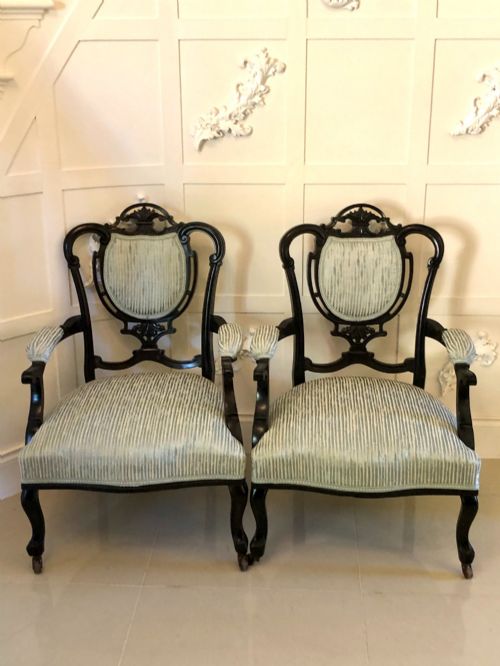
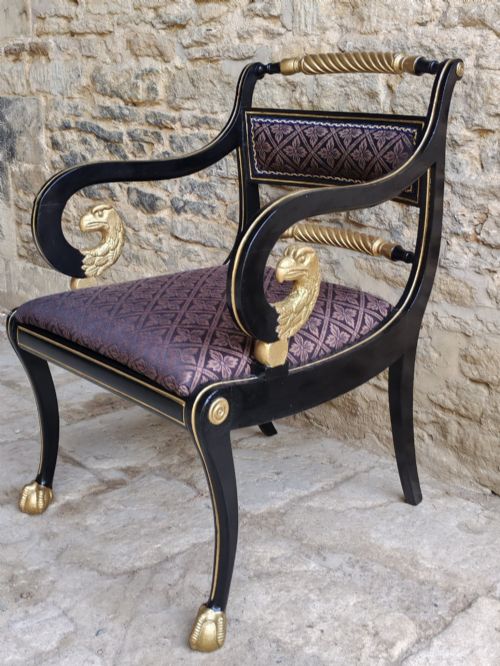
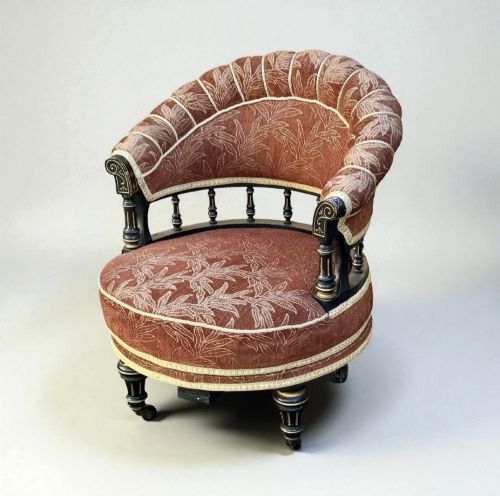


Ebonised Library Armchair
An ebonised library armchair brings striking dark timber and comfortable seating into a study, offering both period character and enduring utility.
Ebonised Library Armchair
An ebonised library armchair is a substantial seating form designed for reading and study, finished in a dark, polished black surface that mimics ebony. The examples on this page span the nineteenth century, encompassing Regency, Victorian, Aesthetic Movement, and Napoleon III styles.
The selection includes bergères with caned panels, revolving desk chairs, and reclining library armchairs upholstered in fabric, leather, or cane. These chairs originate from English and French workshops, utilising beech and hardwood carcasses beneath the signature dark finish.
Buyers will encounter both single armchairs and matched pairs, often enhanced with brass details, parcel gilt, or carving. Each piece reflects the functional requirements of nineteenth-century libraries combined with evolving decorative tastes.
How they were made
Cabinet makers constructed these frames primarily from beech and other hardwoods, applying a specialised dark stain or paint to achieve the dense black ebonised surface. Many examples incorporate intricate carving, turned elements, or parcel gilt accents to highlight the architectural lines of the frame.
Seating support varied according to the specific function of the chair, employing woven cane for light bergères or robust upholstery over springs for leather and fabric desk chairs. Brass fittings, such as castors and swivel mechanisms on revolving models, provided mobility and mechanical durability.
Ebonised Library Armchair Retail Price Guide 2026
Typical asking prices for ebonised library armchair among the pieces listed under this phrase on Sellingantiques today, from the lower quarter to the upper quarter. They describe what is for sale here now, not the wider market.
Some nineteenth-century readers apparently spun so fast at their desks that revolving library armchairs became a distinct manufacturing specialty.
What varies in quality
Quality rests upon the crispness of the timber carving and the depth of the ebonised finish, where finer pieces display a smooth, lustrous polish that reveals the underlying hardwood grain. Superior examples retain their original structural integrity, whether through intact caning or well-fitted upholstery frames.
Attribution to notable makers or distinct stylistic movements elevates an armchair, distinguishing standard commercial production from bespoke cabinet work. The integration of decorative elements like parcel gilt and brass mounts separates simpler seating from grander salon and library pieces.
Gillows
The Ebonised Library Armchair Glossary
- Ebonised wood
- Timber stained or finished to resemble expensive ebony. This technique was popular in nineteenth-century revival and aesthetic designs.
- Bergère
- An enclosed upholstered armchair with wooden sides, often filled with cane panels. It provides a comfortable seat for reading.
- Parcel gilt
- Wood or metal partially decorated with gold leaf. This highlights specific carved details against the dark ebonised background.
- Regency
- A British design period spanning the early nineteenth century. Furniture from this era draws inspiration from classical Greek and Roman forms.
- Aesthetic Movement
- A late nineteenth-century design style emphasising visual beauty over narrative content. It frequently utilised ebonised surfaces with gilt highlights.
Ebonised Library Armchair: Frequently Asked Questions
What is an ebonised library armchair?
An ebonised library armchair is a nineteenth-century seat finished in dark stained timber, built specifically for reading rooms and studies.
These chairs combine sturdy hardwood frames with comfortable upholstery, leather, or cane seating panels.
How do I identify a Regency library chair?
Regency library chairs date from the early nineteenth century and typically feature classical architectural lines influenced by antiquity.
Look for refined proportions, saber legs, and restrained decorative elements rather than heavy Victorian carving.
Were these chairs used at desks?
Many examples function as desk chairs, particularly revolving models designed for easy movement in a study.
Their adjustable mechanisms and sturdy frames suited the practical demands of nineteenth-century administrative work.
How do I care for ebonised wood?
Ebonised surfaces require gentle dusting with a soft cloth and protection from direct sunlight and excessive moisture.
Avoid harsh chemical polishes that can degrade the dark finish over time.