


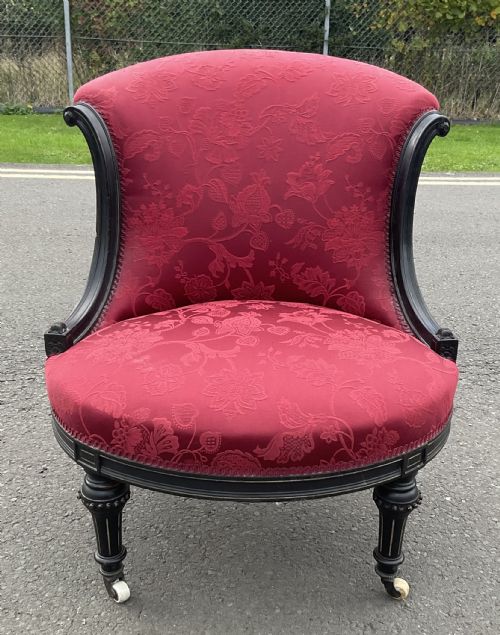

Ebonised Leg Nursing Chair
An ebonised leg nursing chair brings low seating and dark polished timber to the bedroom, offering the comfort and decorative grace collectors prize.
Ebonised Leg Nursing Chair
An ebonised leg nursing chair is a low-slung seat designed for the Victorian bedroom or drawing room, typically standing on turned wooden supports finished to resemble ebony. These pieces sit low to the floor, a proportion originally intended to make dressing or nursing easier in the nineteenth-century home.
The examples found here span the nineteenth century, including Victorian pieces alongside French Napoleon III and Aesthetic Movement variants. Alongside dedicated nursing chairs, the selection includes related low-profile forms such as slipper chairs, bedroom chairs, and compact armchairs.
Most pieces display the dark, polished timber finish that defines the group, often highlighted with gilt details or brass fittings. Their upholstery ranges from plain fabric to patterned damask and velvet, reflecting the diverse textile choices of the period.
How they were made
The frames are constructed from wood, subjected to ebonisation to achieve a dense, black finish that mimics costly tropical hardwood. Artisans frequently applied gold leaf and gilding directly to these dark surfaces to create high-contrast decorative effects characteristic of the Aesthetic Movement.
Upholstery forms a core part of their construction, employing traditional stuffing techniques beneath layers of fabric, damask, or velvet. Button upholstery appears on English drawing room examples, creating a tailored, padded surface supported by internal webbing and springs.
Legs are turned on a lathe, sometimes terminating in ceramic castors or brass hardware to aid mobility across heavy carpets. The structural joinery relies on traditional woodcraft methods hidden beneath the fabric covers and finished frames.
Ebonised Leg Nursing Chair Retail Price Guide 2026
Typical asking prices for ebonised leg nursing chair among the pieces listed under this phrase on Sellingantiques today, from the lower quarter to the upper quarter. They describe what is for sale here now, not the wider market.
Listings for this phrase feature nineteenth-century pieces spanning the Victorian era, French Napoleon III period, and Aesthetic Movement.
What varies in quality
Quality in these chairs rests upon the crispness of the ebonised finish and the condition of any underlying gilding. Superior examples retain their original surface treatment without excessive flaking, whereas lesser pieces show heavy over-painting that obscures the grain of the wood.
The integrity of the frame and the proportions of the low seat dictate the structural merit of each piece. Finely turned legs with sharp detailing indicate careful workshop production, contrasting with plain or worn supports lacking definition.
Upholstery style and fabric choice influence the overall character, with button-upholstered drawing room pieces representing a more elaborate standard of finish than stripped or bare frames awaiting re-covering.
The Ebonised Leg Nursing Chair Glossary
- Ebonised wood
- Timber treated with stain, paint, or chemical processes to turn it jet-black, imitating genuine ebony. This finish was widely utilised across Victorian and Aesthetic Movement furniture.
- Aesthetic Movement
- A late nineteenth-century design style emphasising decorative arts for their own beauty rather than narrative content. Pieces from this movement often feature ebonised surfaces and gilt highlights.
- Slipper chair
- A low-seated upholstered bedroom chair traditionally used by women while putting on shoes or slippers. These chairs share the low profile and compact dimensions of nursing seats.
- Damask
- A reversible figured fabric woven on a jacquard loom, frequently found on period upholstery. The pattern shows through contrasting matte and lustrous warp and weft threads.
- Button upholstery
- A technique where deep buttons are pulled through the padded back or seat to create a uniform pattern of tufts. This method secures the internal stuffing while adding tailored visual texture.
Ebonised Leg Nursing Chair: Frequently Asked Questions
What is an ebonised leg nursing chair?
An ebonised leg nursing chair is a low nineteenth-century seat featuring dark, polished wooden supports designed to resemble ebony. These chairs were traditionally used in bedrooms and drawing rooms for comfort and ease of dress.
The category encompasses various Victorian, French, and Aesthetic Movement forms, including slipper chairs and compact armchairs. Their defining traits are the low profile to the floor and the contrasting dark timber finish.
How do I identify an Aesthetic Movement chair?
Aesthetic Movement chairs from the late nineteenth century typically feature clean lines, ebonised wood surfaces, and subtle gilt ornamentation. They reflect a shift towards art furniture that prioritized visual harmony over heavy Victorian revival styles.
Many examples in this style also incorporate delicate turned legs and refined proportions. Makers of the period utilised these elements to create lighter, more stylized seating.
Are these chairs suitable for daily seating?
These chairs provide functional seating, though their low height differs from standard modern dining or desk chairs. Many period examples are sturdy enough for regular use in a living space or bedroom.
Some pieces listed require new upholstery before heavy daily use, as original nineteenth-century fabrics and internal stuffings can be delicate. Buyers often choose to re-cover frames to match contemporary interiors.
How do I tell French and English chairs apart?
French chairs from the period, such as Napoleon III slipper chairs, often feature slightly more exuberant curves and fluid framing intended for formal upholstery. English equivalents tend towards the straight lines and geometric restraint seen in Victorian Aesthetic pieces.
Both national traditions utilised ebonised woodwork, but the overall silhouette usually reveals the regional workshop origin. Examining the joinery and framing structure clarifies these stylistic distinctions.