
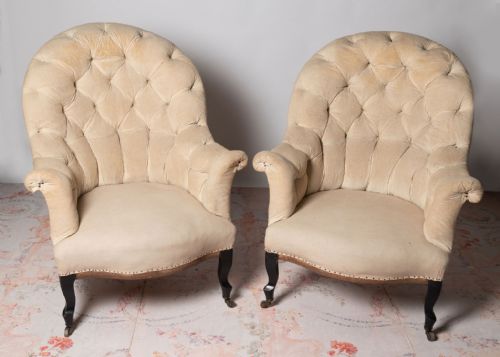
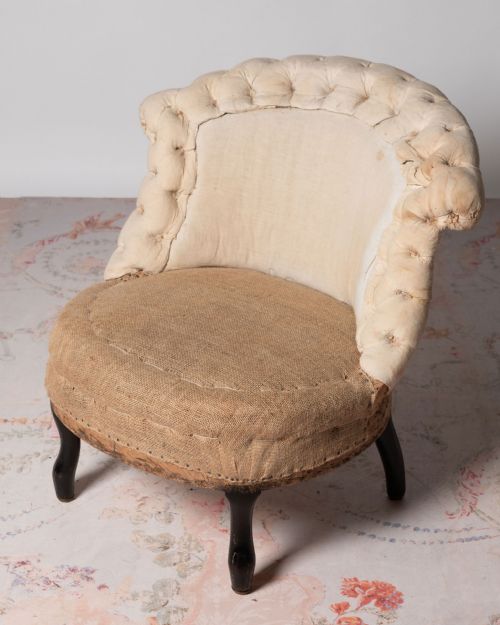


Cream Upholstered Boudoir Chair
These cream upholstered boudoir chair pieces offer compact, low-slung seating designed for the dressing room or bedroom, bringing French and Victorian elegance to intimate spaces.
Cream Upholstered Boudoir Chair
A cream upholstered boudoir chair brings together compact seating forms such as slipper chairs, low armchairs, and circular stools originally intended for dressing rooms and bedrooms. These pieces draw heavily on 19th-century French and Victorian designs, spanning Napoleon III, Louis XV style, and French Empire aesthetics.
Buyers encounter a mix of single chairs, matched pairs, and low chaises or stools dated from the 1850s through to the 1930s. The common thread across the selection is a low-slung profile paired with pale upholstery in calico, linen, or hessian over timber frames.
How they were made
Frames rely on sturdy timbers such as beech and ebonised wood, providing the structural skeleton for these compact seats. Woodwork is often painted or shaped into curvaceous forms, reflecting the French Chateau and Napoleon III styles of the period.
Traditional upholstery techniques utilise foundational layers of hessian, calico, and linen over supportive stuffing. Brass detailing occasionally appears on feet or mounts, adding metallic contrast to the wooden and fabric elements.
Listings feature beech and ebonised wood frames upholstered in calico, linen, and hessian across 19th-century French and Victorian periods.
What varies in quality
The sophistication of the timber carving and the purity of the stylistic revival dictate the standing of a piece. Finer examples display fluid lines in the woodwork, particularly on Napoleon III piecrust frames and Louis XVI style circular stools, whereas simpler versions rely on plain turned legs.
The integrity of the frame construction and the quality of the underlying upholstery materials separate standard items from superior ones. Original timber frames paired with dense, historically appropriate stuffing methods hold their form better than altered or heavily modernised pieces.
The Cream Upholstered Boudoir Chair Glossary
- Boudoir chair
- A small, low-slung chair traditionally placed in a private sitting room or dressing room. These seats prioritise comfort and intimate scale over formal upright posture.
- Slipper chair
- An armless bedroom chair with low legs, historically designed to make sitting down and putting on shoes easier. The low profile remains a defining characteristic in 19th-century examples.
- Napoleon III style
- A French design aesthetic spanning the mid to late 19th century, known for eclectic revivals of past royal styles combined with rich upholstery and ebonised finishes.
- Calico
- A plain-woven cotton fabric frequently used as an underlying layer or first cover in traditional upholstery work. It provides a stable base before decorative top fabrics are applied.
- Hessian
- A coarse woven fabric, often made from jute fibres, utilised inside traditional seating to support stuffing materials and maintain internal structure.
Cream Upholstered Boudoir Chair: Frequently Asked Questions
Where should I place a boudoir chair?
These compact seats suit bedrooms, dressing rooms, and smaller reading corners where standard armchairs prove too bulky. Their low profile ensures they do not overwhelm narrow spaces.
Pairs look particularly striking placed opposite a dressing table or framing a bedroom fireplace.
Are these chairs comfortable for daily sitting?
Most pieces were designed for resting while dressing or light reading rather than lounging for hours. The supportive upholstery and low height offer a comfortable, relaxed posture.
Victorian and French 19th-century examples vary in cushioning firmness depending on their original intended use.
How do I identify a Napoleon III chair?
Napoleon III pieces often feature ebonised wood frames, curvaceous silhouettes, and decorative painted finishes. They reflect the eclectic French taste of the mid to late 19th century.
Details like piecrust edging on chaises and subtle brass mounts help distinguish this period from earlier styles.
What fabrics are used on these chairs?
Listings show traditional foundational materials including calico, hessian, and linen beneath top upholstery. These textiles provide the durable base required for traditional sprung and stuffed frames.
Cream fabric tones dominate the selection, highlighting the woodwork and period lines.