

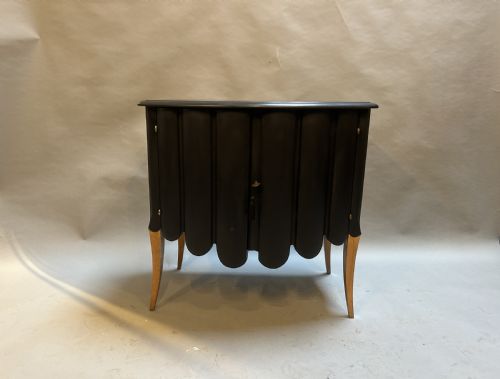
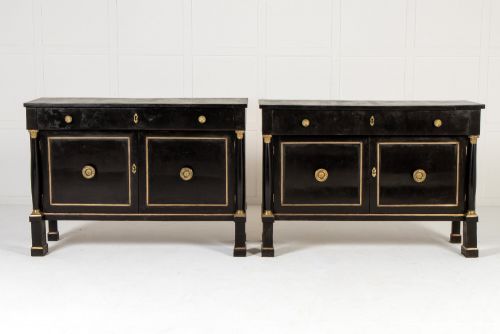
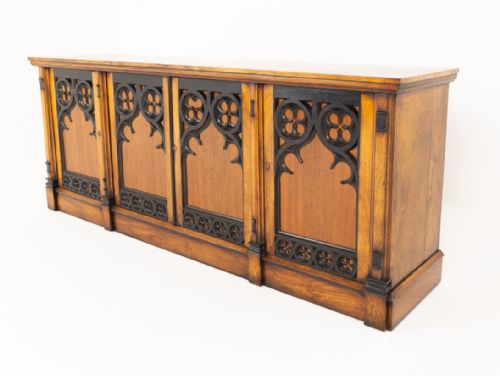


Ebonised Credenza Sideboard
An ebonised credenza sideboard brings dark, polished surfaces and striking brass mounts to a room, offering both display space and closed storage.
Ebonised Credenza Sideboard
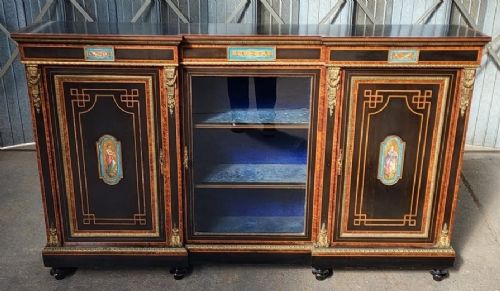
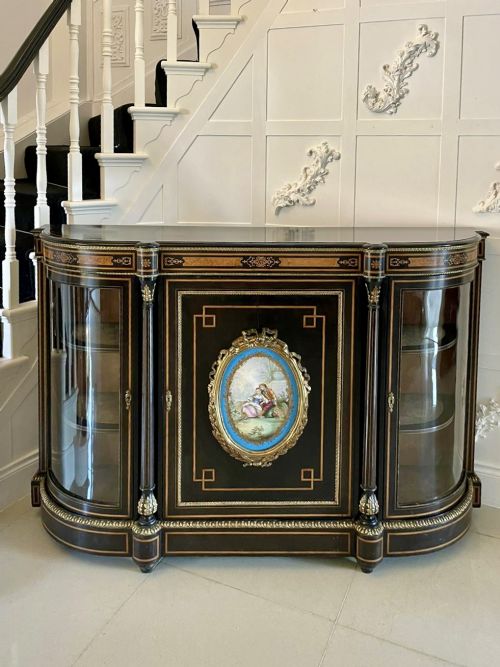
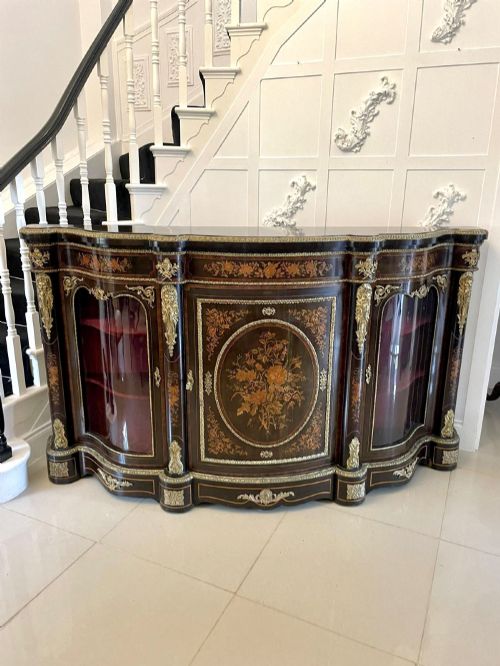
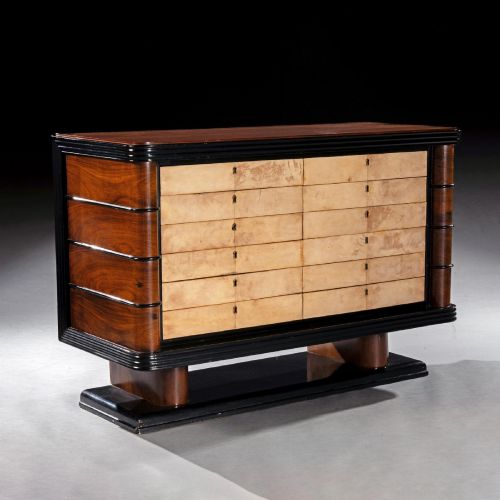
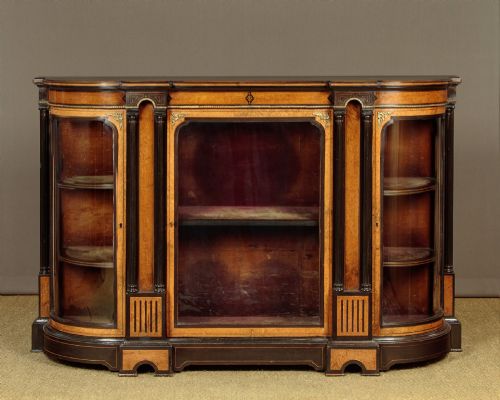
An ebonised credenza sideboard combines the low profile of a display cabinet with the substantial storage of a sideboard, typically featuring glazed central doors flanked by curved side cupboards. Buyers seeking an ebonised credenza sideboard will find numerous examples from the Victorian period alongside French Napoleon III and Aesthetic Movement pieces.
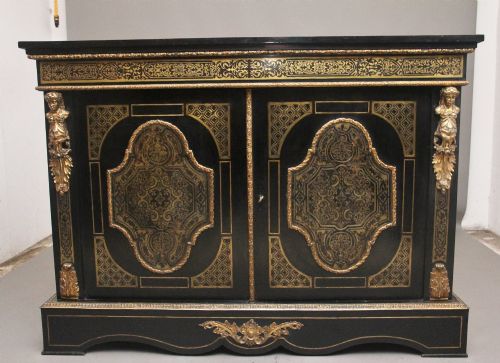
The form developed across the nineteenth century, drawing on English and continental cabinet-making traditions to serve formal dining rooms and parlours. Most pieces on this page utilise ebonised wood finishes combined with marquetry inlay, porcelain plaques, or gilt bronze mounts.
Materials and construction methods
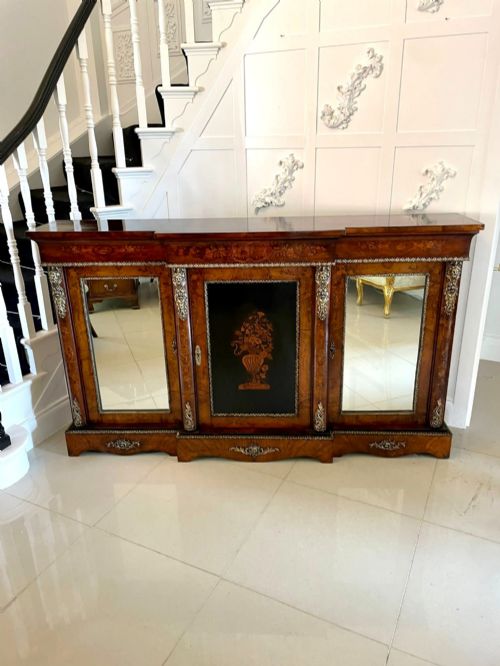
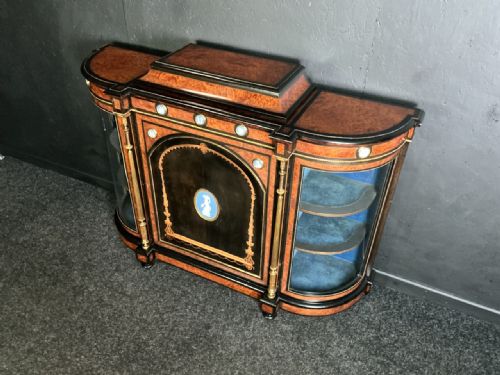
Makers achieved the characteristic dark finish by staining timber, often fruitwood or beech, to imitate solid ebony, frequently pairing these ebonised surfaces with contrasting veneers of amboyna, burr walnut, and rosewood. Ormolu mounts, brass inlay, and porcelain panels decorated the facades of finer pieces.
Glass doors with curved or serpentine frames required skilled glazing techniques, while marquetry involved precision cutting of contrasting wood veneers to form floral and geometric patterns across the doors and panels.
At least one apprentice tested their early woodworking skills by constructing a miniature cabinet with ebonised mouldings.
Variations in quality
Quality rests upon the precision of the cabinet-maker's joinery, particularly in the alignment of serpentine doors and the crispness of the applied ormolu mounts. Finer examples display meticulous floral marquetry and well-figured secondary timbers such as amboyna or burr walnut beneath the ebonised finish.
The integration of materials also defines the tier of a piece, where cast gilt bronze mounts and hand-painted porcelain plaques elevate a standard cabinet into an ambitious decorative statement.
Garnett & Sons·Gillow·Lamb of Manchester·Gordovil Spain
The Ebonised Credenza Sideboard Glossary
- Ebonised
- Wood treated with a dark stain or finish to simulate genuine ebony. This technique gained widespread popularity during the nineteenth century for furniture and decorative cabinets.
- Credenza
- A low dining room or parlour cabinet used for serving food or displaying china. They typically feature a combination of cupboards and central glass-fronted display space.
- Ormolu
- Gilt bronze mounts cast and chased to adorn furniture facades. These decorative elements frame doors and highlight structural curves.
- Boulle
- Marquetry technique utilising tortoiseshell and brass inlaid in ornate arabesque patterns. Named after the French cabinet-maker André-Charles Boulle.
- Marquetry
- Decorative patterns formed by fitting together thin veneers of wood and other materials onto a carcase. Floral motifs appear frequently on nineteenth-century cabinets.
- Serpentine
- A curved furniture front with a convex centre flanked by concave ends. This contour requires advanced woodworking skill to shape accurately.
Ebonised Credenza Sideboard: Frequently Asked Questions
Where were credenzas placed?
These cabinets stood against principal walls in Victorian dining rooms, drawing rooms, and reception spaces where hosts displayed porcelain and glassware.
Their low height ensured they did not obstruct paintings or mirrors hung above them.
How do I care for ebonised wood?
Dust surfaces regularly with a soft cloth and avoid placing pieces in direct sunlight or near heat sources, which can dry out the dark finish.
Apply specialist furniture wax sparingly to preserve the polished sheen without building up residue.
How can I identify an Aesthetic Movement piece?
Aesthetic Movement cabinets emphasise geometric simplicity, ebonised finishes, and Japanese-inspired brass hardware rather than heavy classical revival carving.
These pieces often reflect the design reforms promoted by late-nineteenth-century British artists and makers.