
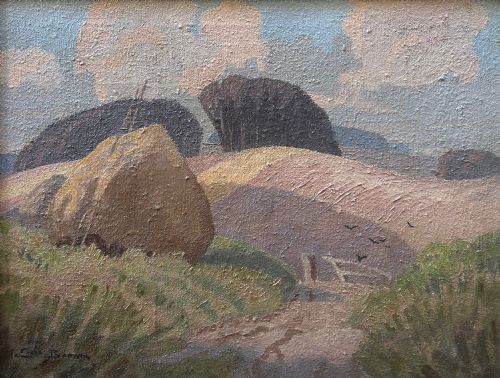


Earth Tone Rural Painting
Earth tone rural painting captures the quiet weight of British countryside life through muted palettes and pastoral scenes.
Earth Tone Rural Painting
An earth tone rural painting draws the viewer into fields, farmsteads, and riverbanks executed in subdued, natural pigments. When exploring earth tone rural painting, buyers encounter works spanning from the Victorian era through the early decades of the twentieth century.
The subjects centre on agricultural labour, livestock, cottages, and Yorkshire or northern landscapes. Painters of this calibre recorded ordinary rural existence with a focus on land and weather rather than grand historical narratives.
Most examples on this page date from the late nineteenth century to around nineteen thirty, reflecting the movements of British Impressionism, Post-Impressionism, and Victorian Realism.
Materials and technique
Artists worked primarily in oil paint upon canvas or wood panels, alongside watercolour pigment applied to paper. These mediums allowed creators to build up textured brushwork or translucent washes.
The palette relies heavily on ochres, umbers, siennas, and muted greens to evoke ploughed fields, hayricks, and overcast skies. Such pigments mirror the natural environment of the British countryside during harvest and winter months.
Several canvases record hardworking horses hauling timber and pulling ploughs through stubborn Yorkshire mud.
Judging quality
Quality rests upon the handling of light and the confidence of the brushwork within the landscape. A stronger piece demonstrates depth and atmosphere through considered tonal relationships rather than mere photographic detail.
The integration of figures, animals, or farm buildings into the wider environment separates a proficient composition from a rigid one. Works that capture movement in plough teams or the stillness of a riverbank display superior observation.
Oswald Garside·Ernest Higgins Rigg·Fred Lawson·Owen Bowen·James Orrock·James Hardy Junior·William Greaves·Frederick W Jackson·John Edward Bale·Ralph Hedley·William Manners·Adrian Jones·Henry Charles Fox·Thomas James Lloyd·Herbert Royle·Thomas Pyne·Frederick J Knowles·Fred Stead·John Abernethy Lynas-Gray·Edward Killingworth Johnson·Charles James Adams·John Percy Cooke·J V R Parsons
The Earth Tone Rural Painting Glossary
- Canvas
- A heavy woven fabric stretched across a wooden frame to serve as a support for oil paint. It provides a textured surface that holds thick brushstrokes effectively.
- Watercolour pigment
- Finely ground colour mixed with a water-soluble binder, applied to paper in transparent washes. It relies on the white of the paper to supply luminosity.
- British Impressionism
- A late nineteenth and early twentieth century painting style focusing on everyday subjects and natural light. Artists associated with this movement often worked outdoors to capture fleeting atmospheric conditions.
- Genre painting
- The depiction of scenes from everyday life, involving ordinary people engaged in familiar activities. In rural contexts, this includes farm work, reading, or domestic labour.
- Pastoral
- Relating to the countryside or rural life, particularly depicted in a romanticised or idealised manner. These scenes typically feature shepherds, farmsteads, and rolling fields.
Earth Tone Rural Painting: Frequently Asked Questions
What periods do these paintings cover?
The works span from the nineteenth century through the early twentieth century, encompassing Victorian, Edwardian, and post-impressionist periods. Most pieces originate between eighteen eighty and nineteen thirty.
Artists working during these decades documented rural transformation and traditional agricultural practices across Britain before mechanisation altered the landscape permanently.
How should I frame an antique watercolour?
Watercolours require framing behind glass with acid-free mounts to protect the paper and pigments from ultraviolet light and atmospheric moisture. Keeping the paper from direct contact with the glass prevents condensation damage.
Traditional wooden frames that complement the muted tones of the painting suit these pastoral subjects best without overpowering the delicate medium.
Where were these rural scenes painted?
Locations frequently include northern English regions such as Yorkshire, alongside Surrey, Sussex, and various Fenland areas. Painters travelled to rural communities to capture specific farms, rivers, and coastal villages.
Inscriptions on the reverse or within the titles often record the exact villages, bridges, or valleys where the artist set up their easel.
How do I care for an oil painting?
Oil paintings on canvas or wood need stable indoor humidity away from direct sunlight and extreme temperature fluctuations. Dust accumulates gently on textured brushwork over time.
Cleaning should be left to professional conservators to avoid disturbing the varnish layer or thinning the underlying oil pigments.