




Horse Cart Oil Artwork
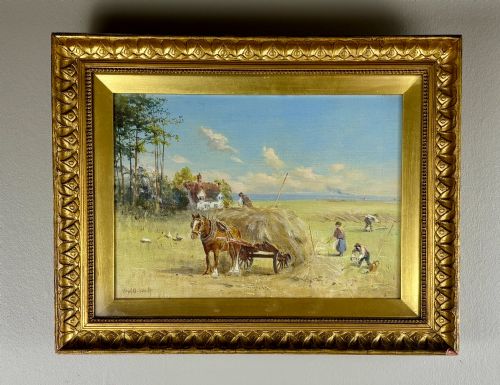
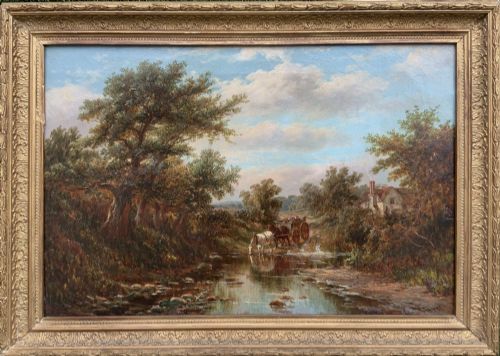
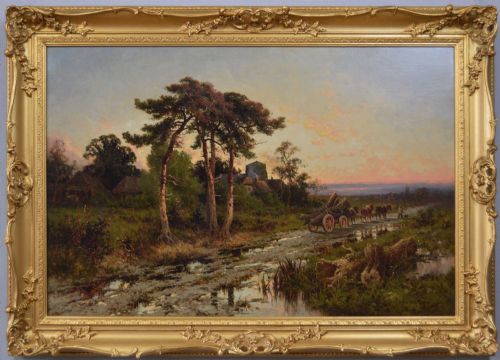
These horse cart oil artwork pieces capture rural labour and country life across canvas through the nineteenth and early twentieth centuries.
Horse Cart Oil Artwork
A horse cart oil artwork presents pastoral scenes, coastal harvests, and country tracks rendered in oil paint on canvas. These works range from small, intimate compositions to detailed landscape studies depicting rural transport and agricultural toil.
The selections span distinct periods from the mid nineteenth century through the 1930s, encompassing British Impressionism, French Impressionism, and various forms of Victorian realism. Buyers encounter rural scenes featuring hayricks, logging carts, and coastal kelp gathering.
Most pieces on this page originate from British and French artistic traditions, capturing everyday rural occupations with horses. The subjects document historical working methods before mechanisation altered the countryside.
Materials and methods
Artists painted these works using oil paint applied to stretched canvas surfaces, employing brushwork characteristic of impressionist and realist movements. The pigment application builds texture to represent landscape elements, figures, and working animals.
Many surviving canvases retain their original giltwood or wood frames, which complement the tonal range of the painted scenes. The combination of oil medium and canvas support has preserved the brushstrokes and colour fidelity across the decades.
Horses working overtime on canvas through everything from seaweed gathering to heavy logging.
Distinctions in quality
Quality rests upon the artist's ability to render light, movement, and anatomical accuracy in both figures and working horses. Superior compositions balance the focal cart against the wider landscape background with confident brushwork.
The handling of atmospheric effects, such as sunset coastal lighting or country track shadows, separates standard topographical records from accomplished artistic interpretations. Original framing in period giltwood further enhances the presentation of certain canvases.
Léon Joseph Voirin·Edward Brice Stanley Montefiore·Herbert Royle·Frederick William Jackson·George Smith·Henry H Parker·James Edwin Meadows
The Horse Cart Oil Artwork Glossary
- Canvas
- A heavy woven fabric stretched across a wooden frame to serve as the support for oil paintings. This material provides the traditional textured surface found across these historical works.
- Giltwood
- Wood carved and coated with a thin layer of gold leaf or gold paint to form decorative picture frames. It surrounds many period oil paintings to complement their visual depth.
- British Impressionism
- An artistic movement focusing on everyday subject matter and light through loose brushwork, prominent in British art from the late nineteenth century onward. It informs several country track and rural landscape scenes.
- Realism
- An artistic approach that depicts subject matter truthfully without artificiality, capturing ordinary people and rural labour like cart transport and coastal work. This style defines much of the nineteenth century output here.
- Oil paint
- A slow-drying paint made of particles of pigment suspended in a drying oil, typically linseed oil. It allows for rich colour blending and textured application on canvas.
Horse Cart Oil Artwork: Frequently Asked Questions
What periods do these paintings date from?
The available selection spans from the mid nineteenth century through the 1930s, capturing shifting artistic approaches to rural life.
Most pieces date between the 1860s and 1920s, reflecting Victorian realism and early twentieth century impressionist movements.
What materials make up these artworks?
Artists utilised oil paint on stretched canvas as the primary medium for every piece listed here.
Many works also retain period frames constructed from wood and finished with gilt leaf.
How were these scenes used historically?
These paintings served as fine art compositions for domestic display, capturing the agricultural and coastal industries of the period.
They recorded rural working life, including hay transport, logging, and kelp gathering, before mechanised vehicles replaced horses.
How do I distinguish different styles?
Realist works focus on precise detail and accurate depiction of daily rural labour and topography.
Impressionist pieces prioritise the play of light and atmospheric conditions, such as sunset coastal scenes or country tracks, using looser brushstrokes.