
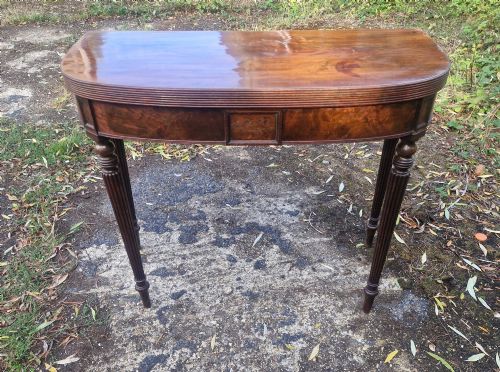
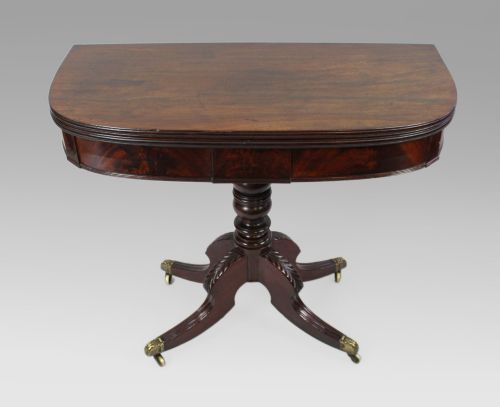

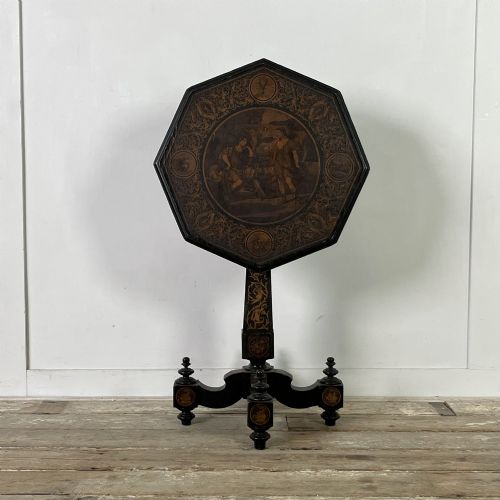


Early Regency Card Table
An early regency card table brings architectural dignity and ingenious folding tops to the drawing room, offering both a functional writing surface and a games board.
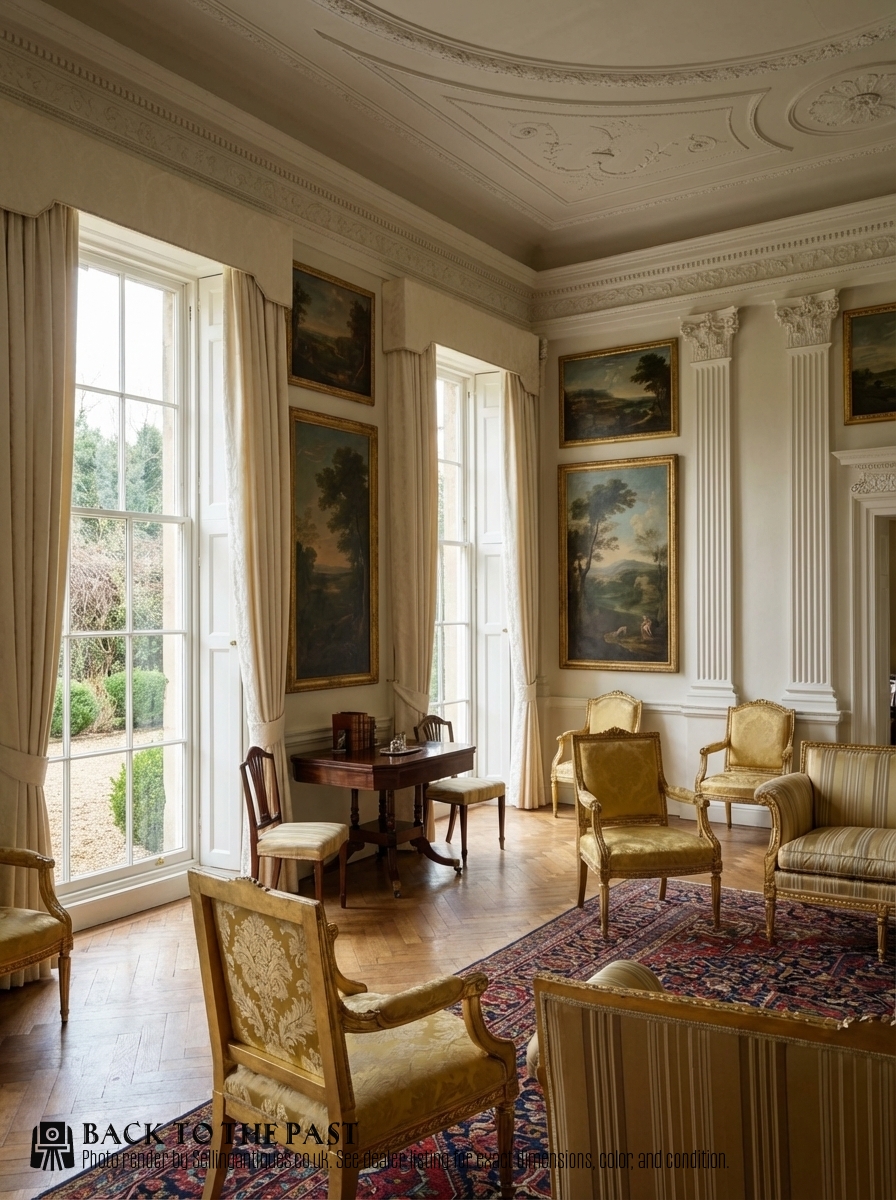
Early Regency Card Table
An early regency card table embodies the crisp lines and classical motifs characteristic of the early nineteenth century and the Georgian transition. When you search for this phrase, you will encounter diverse forms including card tables, tea tables, and games tables that bridge the Regency, George IV, and early Victorian periods.
The dominant survival on this page is executed in mahogany, often featuring a fold-over top designed to sit discreetly against a wall when not in use. Rosewood versions with sophisticated inlays also appear frequently alongside specimen wood and satinwood examples.
Makers and workshops of the era adopted distinctive supports such as lyre bases, sabre legs, and turned pillars. These pieces served polite society for card games, tea, and occasional writing, fulfilling multiple domestic duties within the principal rooms of a grand home.
Materials and Construction Methods
Cabinetmakers utilised rich timber reserves, selecting solid mahogany and rosewood as primary structural and decorative surfaces. Inlays of boxwood, ebony, and brass stringing provide sharp linear contrast against the dark background woods.
Specialist techniques included ink work and detailed specimen wood parquetry, seen on games tables likely originating from Ceylonese workshops. Folding mechanisms relied on precise hinge work and pivoting tops supported by lyre bases or carved pedestals.
Some tables double as sewing desks, proving that nineteenth-century aristocrats liked to gamble and mend their socks at the exact same piece of furniture.
Differentiating Quality in Cabinetwork
Quality rests upon the selection of timber veneers and the crispness of carved details such as acanthus leaves or reeded edges. Pieces with substantial brass inlay and well-figured rosewood show a higher degree of workshop ambition than plain mahogany versions.
Structural integrity of the fold-over mechanism and the stability of the central pillar or sabre legs dictate long-term durability. Superior examples display seamless alignment when closed and balanced proportions in their pedestal supports.
Gillows of Lancaster and London
The Early Regency Card Table Glossary
- Fold-over top
- A hinged table top that opens to double its surface area, revealing a baize-lined playing surface beneath. This ingenious mechanism allows the furniture to function as a side table when closed.
- Stringing
- A narrow strip of contrasting wood or brass inlaid into a channel on the table edge or frieze. It defines the geometric panels characteristic of the period.
- Sabre leg
- A curving, outwardly tapering support leg of classical derivation. It provides stable floor contact without heavy bulk.
- Lyre support
- A pedestal shaped like an ancient stringed instrument used beneath the central column. It is typical of the George IV and Regency eras.
- Specimen wood
- Timber selected for contrasting natural grain and colour, pieced together in geometric or pictorial patterns. Such tops demonstrate high decorative ambition.
Early Regency Card Table: Frequently Asked Questions
What is an early regency card table?
An early regency card table is a fold-over occasional table produced during the early nineteenth century, designed primarily for parlour games and tea.
These pieces feature hinged tops that rotate or fold out to reveal a baize-lined surface, supported by pillars, lyre bases, or sabre legs.
How were these tables used originally?
They functioned primarily as flexible furniture for polite society, serving as side tables against drawing room walls during the day.
In the evening, they opened up to accommodate card games, tea service, or writing, adapting quickly to the social demands of the household.
How do I care for rosewood and mahogany?
Protect the timber surfaces from direct sunlight and excessive temperature fluctuations to prevent the rosewood or mahogany veneers from drying out.
Apply a traditional beeswax polish sparingly and buff with a soft cloth to maintain the natural lustre of the polished wood.
How do I distinguish Regency from George IV?
Regency pieces often display refined classical restraint, delicate brass stringing, and slender sabre legs derived from ancient Greek and Roman models.
George IV examples tend towards heavier proportions, bolder carved details, and substantial architectural pedestals or lyre supports.