
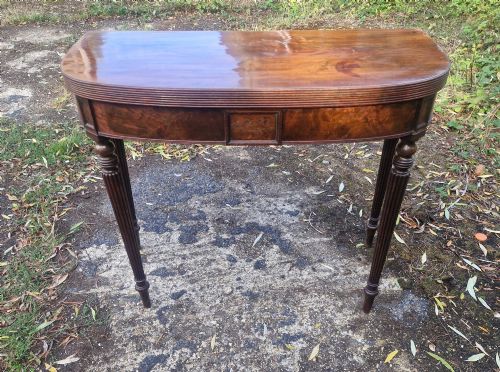
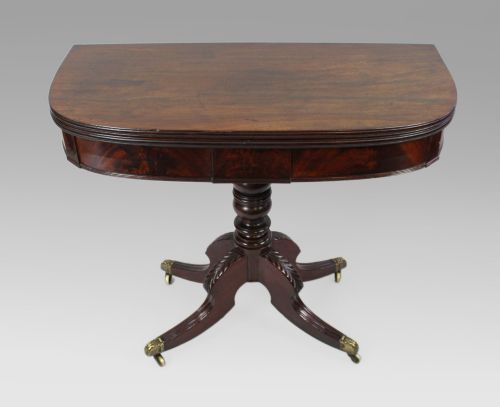

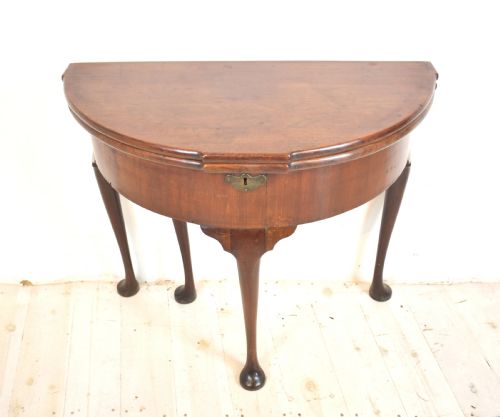
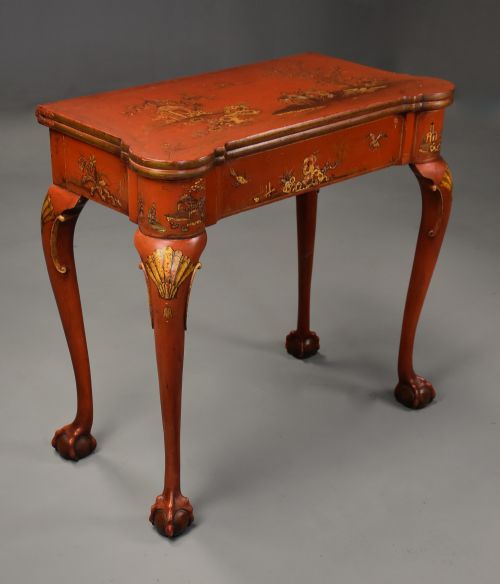

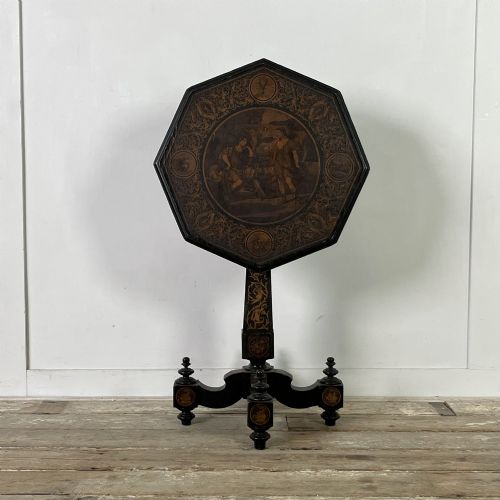


Early Georgian Card Table
An early georgian card table brings sociable card playing to life through rich mahogany and walnut surfaces.
Early Georgian Card Table
An early georgian card table serves as a folding games surface designed for eighteenth-century drawing rooms. These pieces appear in solid woods and veneered finishes, often featuring fold-over leaves that reveal baize-lined playing spaces.
The selection here encompasses eighteenth-century originals alongside later revivals from the nineteenth and twentieth centuries. Formats range from simple mahogany fold-over designs to elaborate red lacquered Chinoiserie games tables and figured walnut pieces.
Judging quality and finish
Quality rests in the selection of figured timber veneers and the crispness of any crossbanding or inlay work. Superior examples show careful matching of wood grain across the fold-over top and smooth operation of the pivoting leaves.
Construction integrity distinguishes better pieces, particularly where the frame meets the legs without movement. The depth of the timber polish and the preservation of original decorative surfaces also determine the standing of each table.
The listings span multiple centuries, uniting eighteenth-century originals with nineteenth-century Regency adaptations and twentieth-century revival pieces.
Gillows
The Early Georgian Card Table Glossary
- Crossbanding
- A border technique where thin strips of veneer are laid perpendicular to the grain of the main surface. This frames the top of the table with a contrasting wood border.
- Fold-over
- A hinged table top design that opens to double the surface area for playing cards or serving tea. The pivoting leaf rests on a swing leg or concertina frame.
- Chinoiserie
- European decorative style imitating Chinese artistic traditions using lacquer and gilt motifs. This appears on colourful twentieth-century interpretations of earlier forms.
- Baize
- A coarse woolen fabric used to line the interior playing surface of games tables. It provides a soft texture for card handling.
Early Georgian Card Table: Frequently Asked Questions
What was an early georgian card table used for?
These tables served primarily for evening card games such as whist, quadrille or ombre in fashionable households. When not in use for gaming, the closed top functioned as a standard side or console table.
The fold-over mechanism allowed families to quickly clear away domestic clutter or transform a parlour for social entertaining. Many double as tea tables depending on the interior layout.
How do I care for a mahogany card table?
Keep wooden surfaces away from direct sunlight and strong heat sources to prevent timber shrinkage and veneer lifting. Regular dusting with a dry lint-free cloth maintains the polish without chemical buildup.
Apply high-grade beeswax sparingly to nourish the timber grain when the finish appears dry. Avoid placing damp items directly onto the antique polish.
How do I identify an eighteenth-century original?
Examine the timber underneath and inside the frame for hand-cut joinery marks and period-appropriate secondary woods. Eighteenth-century pieces typically exhibit natural wear patterns and patination accumulated over generations of use.
Compare the hinge fixings and wood selection against documented examples from the same era. Later revival pieces often display machine-cut elements or different construction tolerances.
Can I use these tables for daily dining?
Most card tables feature relatively light folding structures not intended for heavy daily dining use. The pivoting leaves rely on supporting legs that can strain under heavy weight or downward pressure.
They suit occasional drinks, board games or display purposes rather than family meals. Treat the folding mechanism with care when opening and closing the top.