


Early Century Station Clock
An early century station clock brings functional public timekeeping into a private room, offering bold dials and robust mechanical character.
Early Century Station Clock
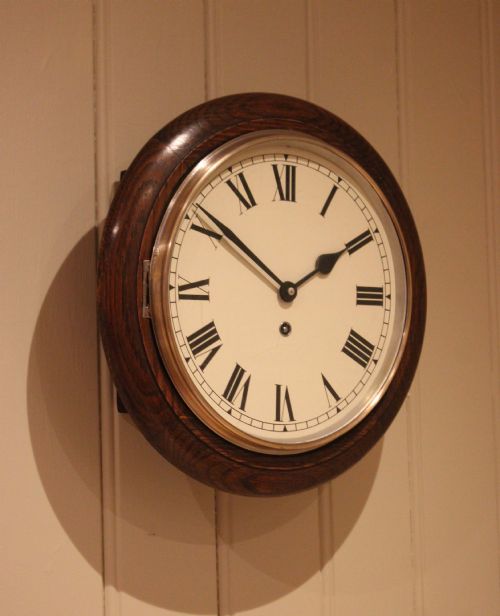
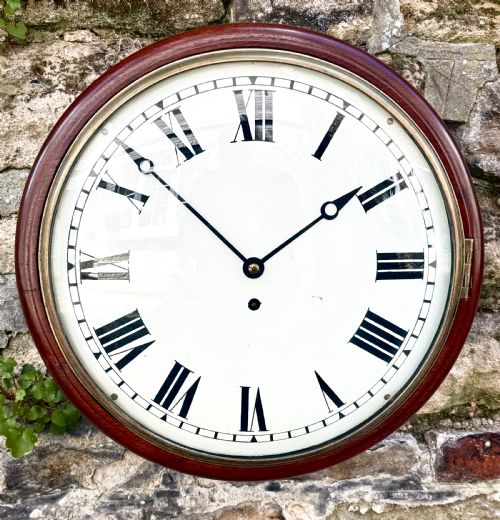
An early century station clock represents the large, legible timepieces once relied upon by travellers and workers in public transport hubs and municipal buildings. When searching for an early century station clock, buyers encounter wall-mounted pieces designed for maximum visibility from a distance, frequently housed in deep wooden surrounds.
The selections available here span from the nineteenth century through to the mid-twentieth century, capturing utilitarian designs alongside refined domestic adaptations. Many examples originate from British railway companies and municipal offices, bearing the straightforward layout characteristic of heavy-duty environments.
Most items on this page take the form of round wall clocks featuring prominent chapter rings and clear hands. Mahogany and oak cases predominate, paired with glass faces protecting paper, enamel, or wooden dials.
Materials and construction methods
Makers constructed these clocks using durable hardwoods such as mahogany and oak to withstand industrial environments and shifting atmospheric conditions. Brass components frequently form internal movements and bezels, offering resistance to wear while providing a bright contrast to darker timber surrounds.
Faces commonly utilise painted wood, enamel, or paper laid over backing boards, inscribed with bold numerals to ensure legibility across large platforms and waiting rooms. Heavy glass covers protect the delicate dial surfaces from dust and damage in busy public spaces.
Some clocks spent decades watching steam trains arrive late before finally retiring to someone's kitchen wall.
Assessing quality and authenticity
Superior examples derive their standing from the precision of their internal movements and the integrity of their original markers, such as specific railway company lettering. The weight and grain of the timber case, alongside the crispness of the painted or enamelled numerals, distinguish workshop standards.
The presence of documented railway provenance elevates a piece, linking it directly to named transport networks and specific stations. Refurbished or altered components can alter the character of an item, making untouched original dials and authentic mechanical systems the benchmarks for collectors.
Zenith·Camerer Cuss·Gents of Leicester·Osborn of Kingsbridge
The Early Century Station Clock Glossary
- Dial clock
- A wall-mounted timepiece featuring a prominent circular face and a simplified outer case. These typically housed reliable movements designed to keep accurate time in public buildings.
- Fusee movement
- A conical pulley mechanism that equalises the driving force of the mainspring as it winds down. This ensures consistent timekeeping accuracy throughout the running period.
- Convex dial
- A curved clock face that reduces glare from overhead lighting and windows. It allows passengers to read the time clearly from various angles across a platform.
- Chapter ring
- The circular band on a clock face bearing the hour and minute numerals. On public clocks, this ring is rendered in high-contrast tones for rapid reading.
- Bezel
- The metal rim that holds the protective glass front in place over the dial. It often hinges open to allow access for winding and hand adjustment.
Early Century Station Clock: Frequently Asked Questions
Where were station clocks originally used?
These clocks hung in prominent locations such as railway platforms, booking halls, and municipal offices where crowds needed reliable timekeeping.
Their large scale and clear numbering ensured visibility across bustling public spaces.
How do I wind a fusee wall clock?
Winding requires a dedicated key inserted into the small hole on the dial face, turned gently until resistance is met.
Care must be taken not to overwind the mechanism, which preserves the historical tension springs.
Are these clocks suitable for domestic living spaces?
Their strong visual presence makes them striking focal points in kitchens, hallways, and living rooms.
Consider the depth of the wooden case and the sound of the movement when selecting a room for placement.
How do I identify railway company markings?
Original pieces often feature painted initials or station names directly on the dial or timber case, denoting specific transit networks.
These authentic inscriptions provide a direct paper trail to the transport history of the item.