

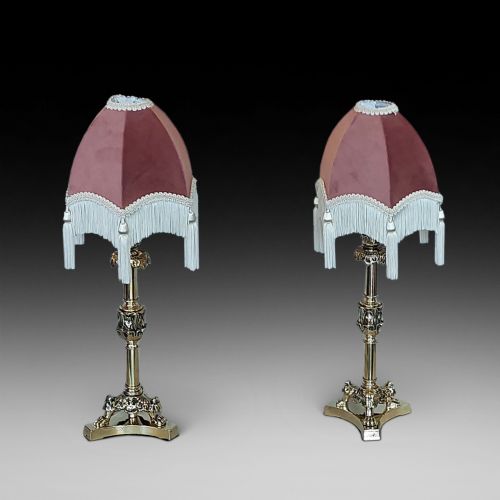


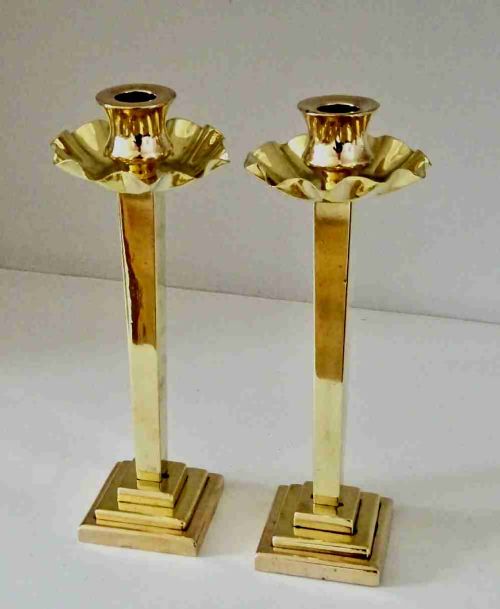


Early Brass Table Candlesticks
Early brass table candlesticks bring domestic illumination from the eighteenth and nineteenth centuries into modern rooms with solid metal weight.
Early Brass Table Candlesticks
Early brass table candlesticks span the eighteenth, nineteenth, and early twentieth centuries, encompassing Georgian, Regency, and Edwardian periods. Buyers searching for early brass table candlesticks encounter sturdy cast forms alongside later converted lamp fittings and multi-branch candelabra.
The selection ranges from early eighteenth-century octagonal and hexagonal section bases to Regency bronze and ormolu designs. Many pieces demonstrate utilitarian origins while others reflect elaborate French Empire or Baroque revival styling.
Materials and Construction
Foundry work relies on heavy brass, cast bronze, and ormolu, often combined with gilt metal accents or mahogany components. Metal is shaped through sand casting and turned on lathes to achieve clean profiles and stable weighted bases.
Makers occasionally introduced fabric elements or electrical wiring when older candlesticks were repurposed as table lamps in subsequent decades. Surface finishes vary from bright gilt bronze to patinated raw brass developed through centuries of handling.
Early Brass Table Candlesticks Retail Price Guide 2026
Typical asking prices for early brass table candlesticks among the pieces listed under this phrase on Sellingantiques today, from the lower quarter to the upper quarter. They describe what is for sale here now, not the wider market.
Listings feature brass, bronze, and ormolu pieces spanning the eighteenth century through the Edwardian period.
Assessing Quality and Execution
Superior examples display crisp casting detail and heavy gauge metal that provides reassuring stability at the base. Fine turning on the stem and sharp junctions on moulded octagonal or hexagonal sockets separate high-grade workshop production from simpler output.
Proportion and symmetry govern the visual success of each pair, particularly where adjustable arms or multi-branch components are involved. Original surface patination without aggressive cleaning preserves the historical integrity of the piece.
The Early Brass Table Candlesticks Glossary
- Ormolu
- Gilded bronze ornamentation applied to decorative metalwork and lighting. This finish provides a bright gold appearance that contrasted effectively with darker bronze elements.
- Candelabra
- A branched lighting fixture designed to hold multiple candles or bulbs simultaneously. These pieces often feature central standards with removable or adjustable arms.
- Cast Brass
- Metal poured into a mould to create complex three-dimensional shapes. This technique allows for heavier construction and sharper decorative details than sheet metal fabrication.
- Regency
- A British design style spanning the early nineteenth century characterised by classical revival motifs. Pieces from this period often incorporate bronze and ormolu finishes inspired by French taste.
Early Brass Table Candlesticks: Frequently Asked Questions
How do I date an old brass candlestick?
Dating relies on base shapes, manufacturing marks, and construction techniques visible at the underside and joints. Earlier pieces feature heavy cast sections and distinct casting seams.
Later nineteenth and twentieth-century examples often display sharper machine-turned finishes or adaptations for electricity.
Were these candlesticks converted to lamps?
Many surviving examples have been fitted with electrical wiring to function as table lamps in contemporary interiors. This conversion was often carried out during the twentieth century while retaining the original metal base.
Buyers find both unmodified candlesticks and period conversions within this category.
How should I clean polished brass?
Maintaining antique brass requires minimal intervention to protect the historical surface patina. Gentle dusting with a soft cloth prevents dust accumulation without stripping the metal's character.
Harsh chemical polishes should be avoided because they remove the aged appearance valued by collectors.
What is the difference between ormolu and brass?
Brass is an alloy of copper and zinc used extensively for durable domestic candlesticks and fittings. Ormolu refers specifically to gilded bronze where a thin layer of gold is applied to a bronze base.
Ormolu provides a richer golden lustre compared to plain or polished yellow brass.