
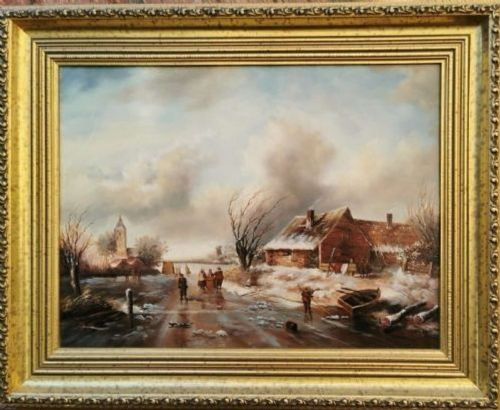
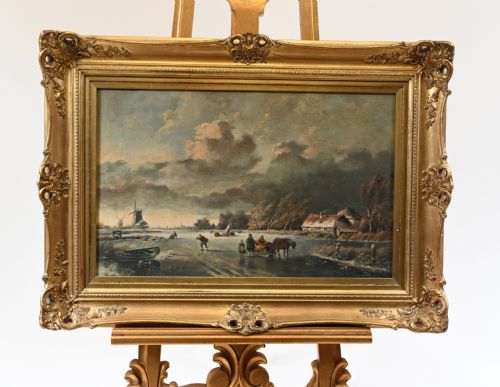


Dutch Winter Landscape Painting
A dutch winter landscape painting captures frozen canals and snow-dusted villages with atmospheric precision.
Dutch Winter Landscape Painting
A dutch winter landscape painting portrays the seasonal chill of the low countries through frozen rivers, snow-covered cottages, and ice skaters. These works frequently depict figures engaged in traditional winter activities like skating or collecting firewood near familiar landmarks such as windmills and castles.
Most examples found on this page draw from the nineteenth and twentieth centuries, reflecting both nineteenth century realism and mid-century interpretations. Painters utilise oil paint on canvas or wood panel to capture the pale winter light and muted atmospheric tones characteristic of these scenes.
The style spans traditional landscape compositions to specific depictions in the dutch golden age style and works associated with the hague school. Buyers encounter both signed works by known artists and unsigned atmospheric studies executed within these established regional traditions.
Materials and Technique
These works are executed in oil paint applied to prepared surfaces of canvas or wood panel. The medium allows artists to build up thick layers of pigment for snow and ice while maintaining translucent glazes for winter skies and frozen water.
Framing often involves decorative wooden gilt frames or giltwood surrounds that complement the traditional subject matter. Wood panels provide a rigid support favoured in earlier periods, whereas canvas becomes more common in nineteenth and twentieth century examples.
Dutch Winter Landscape Painting Retail Price Guide 2026
Typical asking prices for dutch winter landscape painting among the pieces listed under this phrase on Sellingantiques today, from the lower quarter to the upper quarter. They describe what is for sale here now, not the wider market.
Painted children skate perpetually on ice while sheep huddle near a barn.
Evaluating Quality and Execution
Quality rests upon the artist's handling of light and atmospheric perspective to convey the crisp chill of a winter day. Superior works capture the subtle shifts in tone across snow and ice rather than relying on flat or uniform washes of white.
The precision and vitality of the figures within the landscape distinguish finer examples. Whether depicting skaters on a frozen lake or shepherds near a barn, the integration of human activity into the seasonal scenery demonstrates the painter's skill.
T. Bergman·Pieter Cornelis Steenhouwer·Alexis De Leeuw·Ludwig Hermann·Louis Smets·Anthonij Anton Mauve·Jan Beerstraaten·H.W.G.Winter
The Dutch Winter Landscape Painting Glossary
- Canvas
- A woven fabric stretched across a wooden frame to serve as a painting surface. It provides a flexible support commonly used for oil paintings across the nineteenth and twentieth centuries.
- Wood Panel
- A rigid wooden board utilised as a support for oil paint. Panels are frequently found in earlier works and offer a smooth, stable surface for fine detail.
- Giltwood
- Carved wood decorated with gold leaf or gold paint. This material is typically found on the decorative frames enclosing traditional paintings.
- Hague School
- A group of nineteenth-century Dutch artists inspired by the realism of the French Barbizon school. Their work often employs subdued palettes to capture atmospheric landscape conditions.
Dutch Winter Landscape Painting: Frequently Asked Questions
What periods do these paintings come from?
The works span from the nineteenth century through to the mid-twentieth century, encompassing periods like nineteen hundred and nineteen sixty.
Creators draw upon earlier artistic traditions while employing the materials and canvas supports typical of their respective decades.
Are these paintings executed on canvas or wood?
Surviving examples utilise both stretched canvas and rigid wood panels as painting supports. The choice of material often relates to the period and the specific technique employed by the artist.
Panels frequently appear in works referencing traditional regional styles, while canvas is common across nineteenth and twentieth century pieces.
How should I display a giltwood frame?
These decorative frames require stable indoor conditions away from direct sunlight and sudden temperature fluctuations. Proper placement protects both the gilt finish and the oil painting contained within.
Ensure the wall fixings match the substantial weight of traditional wood and gilt surrounds.
What subjects typically appear in these scenes?
Common motifs include frozen rivers with figures skating, snow-laden cottages, windmills, and quays. Some compositions incorporate animals like sheep with a shepherd near a barn.
These elements combine to evoke the traditional atmosphere of a seasonal Dutch winter day.