


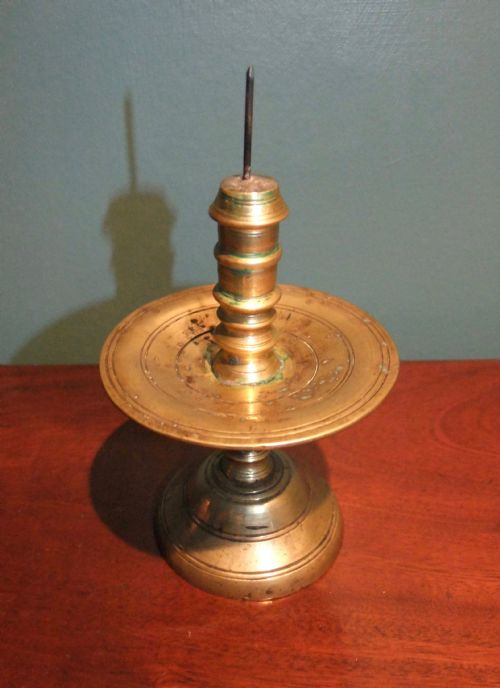

Dutch Brass Candlestick
These heavy Dutch brass candlestick examples bring centuries of domestic and church lighting straight to your table.
Dutch Brass Candlestick
A dutch brass candlestick combines sturdy utility with decorative presence across several distinct eras. You will encounter seventeenth-century Heemskerk types alongside twentieth-century Amsterdam School designs.
The inventory ranges from single seventeenth-century altar or domestic items to pairs of twentieth-century pricket candlesticks. Materials extend beyond brass to include iron, copper and patinated metal.
Materials and construction
Makers utilised cast and wrought brass, often pairing the metal with iron components for added weight and stability. Copper appears alongside brass in early twentieth-century examples.
Casting methods created the characteristic drip pans and knopped stems found on seventeenth-century pieces, while later workshops employed hammering and patination techniques.
Early seventeenth-century domestic lighting required servants to carry heavy brass sticks from room to room before tallow candles burned down to the drip pan.
Judging the work
Quality rests on the integrity of the original casting and the preservation of the surface patination. Heavier metal gauge and crisp detailing distinguish better examples from simpler production.
Proportion and balance dictate the strength of a piece, whether dealing with a seventeenth-century Heemskerk form or an early twentieth-century Amsterdam School design.
The Dutch Brass Candlestick Glossary
- Heemskerk candlestick
- A distinct seventeenth-century type featuring a multi-knopped stem and a wide drip pan placed midway down the shaft.
- Pricket candlestick
- A form that holds a candle upon a sharp metal spike rather than inside a socket.
- Amsterdam School
- An early twentieth-century architectural and design movement known for expressive brickwork and wrought metalwork.
- Drip pan
- A horizontal flange designed to catch melted wax before it reaches the table or floor.
Dutch Brass Candlestick: Frequently Asked Questions
What is a Heemskerk candlestick?
A Heemskerk candlestick is a seventeenth-century Dutch brass design recognised by its central drip pan and distinct multi-knopped stem. These pieces were built for heavy domestic use.
Their sturdy construction made them stable on wooden tables during a period when lighting relied entirely on open flame.
How do I date a brass candlestick?
Dating relies on comparing the form, casting method and material combinations against known seventeenth-century, eighteenth-century and twentieth-century examples. Seventeenth-century pieces often show specific Heemskerk or pin-pricket configurations.
Later twentieth-century pieces adopt Amsterdam School or Art Deco styling using patinated metal and wrought brass.
What is a pricket candlestick?
A pricket candlestick uses an upright metal spike to impale the base of the candle rather than sliding the candle into a socket. This style appears frequently on church lighting and early Dutch pieces.
Candles designed for prickets required a small hole at the base to sit securely on the spike.
Where were these candlesticks made?
These pieces originate from the Low Countries, encompassing the Netherlands and Flanders. Workshops in Amsterdam and surrounding regions produced both domestic items and large church pieces.
Brass founders and metalworkers utilised local casting traditions that persisted across multiple centuries.
Can I use antique candlesticks today?
You can use these pieces with standard candles provided the socket or pricket matches the candle diameter. Many collectors place them on dining tables or sideboards for ambient lighting.
Care should be taken with wax removal to preserve the antique brass surface and original patination.