


Drop Leaf Serving Table
A drop leaf serving table offers practical tiered service, folding neatly when not in use to save space in the dining room.
Drop Leaf Serving Table
A drop leaf serving table combines the utility of tiered serving furniture with hinged flaps that adjust the footprint of the piece. These items appear across several historic periods, spanning the Georgian era, the Edwardian period, and into the nineteen-twenties.
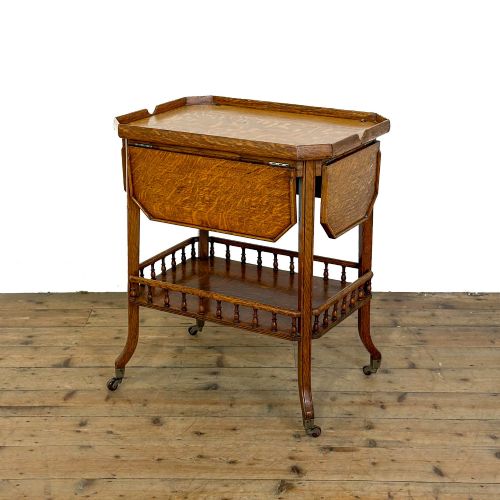
The objects on this page take various forms, including traditional dumb waiters with revolving circular or octagonal tiers, afternoon tea trolleys, and folding side tables. Buyers encounter forms ranging from two-tier occasional tables to multi-tiered serving pieces equipped with brass castors and metal hardware.
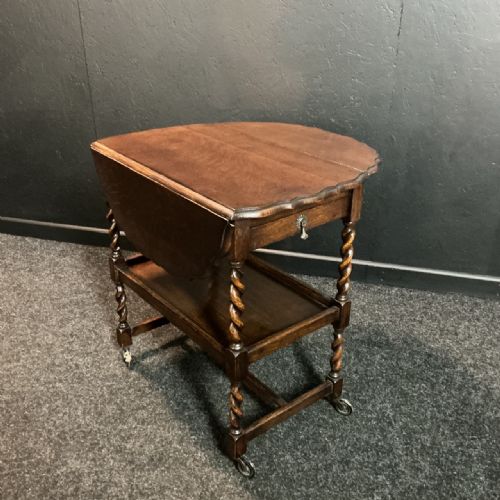
Georgian and George III iterations showcase mahogany construction, often featuring boxwood inlay or rectangular and circular drop-leaf tiers. Later Edwardian and nineteen-twenties examples lean towards oak, incorporating barley twist supports and serving trolley designs suited to domestic hospitality.
How they were made
Cabinetmakers utilised dense timbers such as mahogany and oak to construct the main tiers and folding leaves of these serving tables. Boxwood inlay provides decorative contrast on select surfaces, while brass and iron components ensure smooth mobility and mechanical support for the drop leaves.
Joinery techniques focus on stability across multiple levels, employing solid wood panels and hinged mechanisms that allow leaves to drop cleanly against the central pillar or frame. Turning and carving shape the upright supports, from plain columns to decorative barley twist profiles.
Listings span the eighteenth century, Georgian period, Edwardian era, and nineteen-twenties, constructed primarily in mahogany and oak.
What varies in quality
The distinction between standard and superior examples rests upon timber selection, grain figure, and the crispness of any inlay work. Mahogany items from the Georgian period often display finer joinery and more refined turning than later revival pieces.
Mechanical execution in the folding leaves and tiers dictates the tactile success of the piece. Well-fitted brass hinges and stable column attachments separate high-tier examples from more utilitarian trolleys.
The Drop Leaf Serving Table Glossary
- Drop-leaf
- A table or tier with a hinged section that folds down to reduce the overall surface area when not required.
- Dumb waiter
- A tiered serving stand designed to hold food or drinks without the immediate presence of domestic staff.
- Barley twist
- A spiral turning technique applied to wooden table legs and vertical supports during the revival periods.
- Boxwood inlay
- Contrasting light wood inserted into recesses on the primary timber surface to create linear or geometric decoration.
- Castor
- A small wheel fitted to the base of table legs to permit easy movement across the floor.
Drop Leaf Serving Table: Frequently Asked Questions
What is a drop leaf serving table used for?
These tables provide supplementary surface space for serving food and beverages during meals or social gatherings. The adjustable leaves allow the furniture to sit compactly against a wall when extra room is needed.
Historically, multi-tiered dumb waiters held dishes between courses to reduce reliance on servants. Modern interiors utilise them as mobile drinks trolleys or occasional side tables.
How do I identify a Georgian drop leaf serving table?
Georgian and George III pieces typically feature dense mahogany construction, sometimes enhanced with subtle boxwood stringing or inlay. The silhouettes rely on proportion and traditional column supports rather than heavy ornamentation.
Earlier examples often incorporate circular or octagonal folding tiers designed to revolve or fold flat. Oak variants with barley twist turns generally point towards later Edwardian or nineteen-twenties production.
How do the folding leaves operate?
Hinged flaps drop downward from the main tier, supported by pivoting wooden brackets or swing legs. This mechanism allows the user to expand or contract the surface area instantly.
When inspecting a folding mechanism, look for smooth movement in the brass or iron joints. The drop leaves should hang evenly and lock securely into the horizontal position.
Can I use these tables on carpet?
Many of these serving pieces are fitted with metal or brass castors designed for easy movement across wooden floors. Placing older items on thick carpets requires care to avoid straining the leg joints during transit.
For frequent movement on carpet, ensure the castors rotate freely and remain securely fastened to the base of the table.