




Domed Tea Box
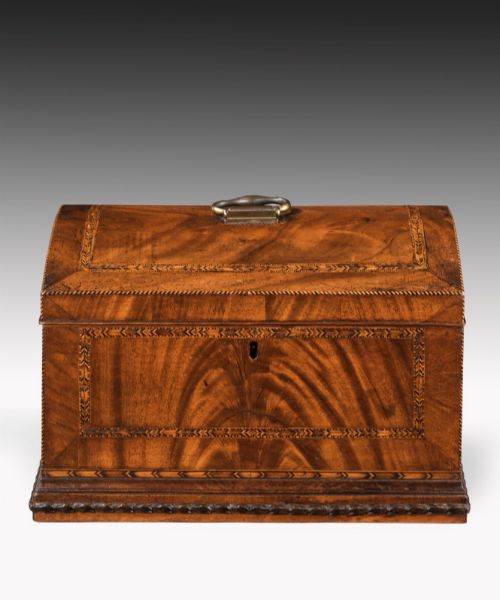
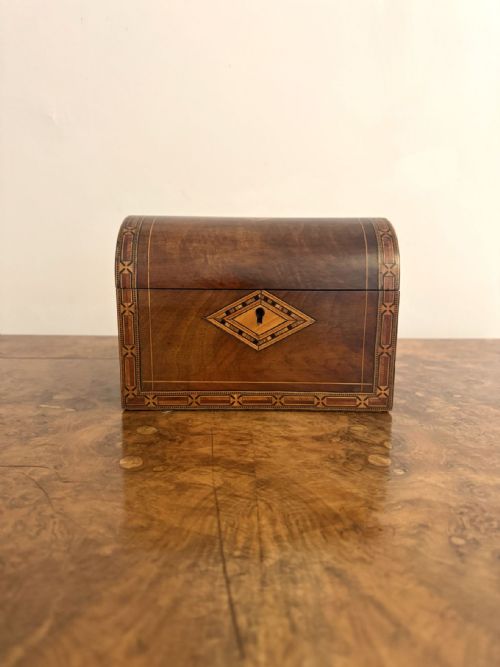
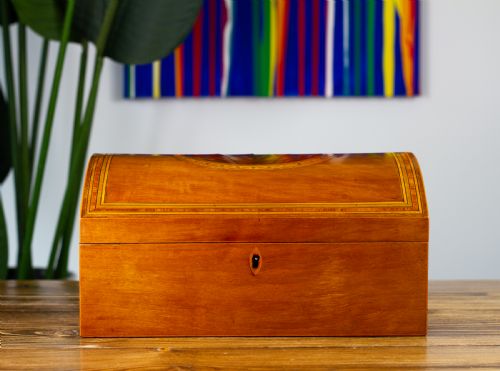
These pieces are domed tea box examples, built to store and protect precious leaves in earlier centuries.
Domed Tea Box
When you search for a domed tea box, you are looking at lidded containers designed to keep dry leaves secure and aromatic. These items appear across Georgian, Regency, and Victorian periods, often taking the form of tea caddies and decorative caskets. The forms range from simple geometric shapes to elaborate architectural interpretations.
On this page, you are most likely to meet mahogany, burr walnut, and coromandel wood specimens with curved lids. Many examples incorporate boxwood stringing, brass mounts, or Tunbridge inlay to accent the timber grain. The origins span English workshops and French cabinet makers of the nineteenth century.
How they were made
Cabinet makers built these containers using dense hardwoods like mahogany, rosewood, and satinwood, often applying burr walnut or coromandel veneers to the exterior surfaces. Boxwood inlay and bone escutcheons provided contrast and detail to the primary timber.
Metal components such as brass mounts, handles, and locks were fitted to secure the contents and assist with handling. Joinery relied on precise cutting and gluing to shape the characteristic curved lids without splitting the wood.
Many of these miniature architectural domes survived because their original keys stayed with them through the centuries.
What varies in quality
The choice of primary timber and decorative veneer sets the baseline for a piece, with figured burr walnut and coromandel sitting above plain mahogany. Finely executed Tunbridge inlay and precise brass mounting separate superior examples from standard production.
The integrity of the curved lid construction and the survival of original interior fittings indicate the care taken by the original maker. Attention to detail in the boxwood stringing and the crispness of the exterior shaping distinguish the finer items.
The Domed Tea Box Glossary
- Domed tea box
- A lidded container featuring a rounded top, built to hold loose tea leaves safely. This form protects the contents from light and moisture.
- Tunbridge inlay
- A mosaic woodwork technique creating detailed geometric or pictorial designs from tiny pieces of naturally coloured wood. It is commonly found on nineteenth-century surfaces.
- Escutcheon
- A protective plate surrounding a keyhole, frequently made of brass or bone on these containers. It prevents the wood around the lock from splitting through repeated use.
- Stringing
- A narrow strip of contrasting wood inlaid flush into the surface to create a decorative border. Boxwood is frequently used for this purpose.
- Coromandel wood
- A dense, heavily figured timber from Asia featuring dark brown and black stripes. Cabinet makers utilised it for high-status boxes during the Victorian era.
Domed Tea Box: Frequently Asked Questions
What is a domed tea box?
A domed tea box is a lidded wooden container designed to store dry tea leaves safely away from air and light. These items were essential household objects when tea was an expensive commodity.
Peculiar to the Georgian and Victorian eras, these caskets often featured internal compartments to separate different varieties of tea leaf.
How were domed tea boxes used?
They were kept in the drawing room or dining room by the head of the household to dispense tea for guests. The key was retained by the owner to control access to the valuable leaves inside.
Inside, individual lidded canisters or foil-lined compartments kept the black and green teas fresh and dry.
How do I date a domed tea box?
Dating relies on identifying the primary timbers, decorative styles, and construction methods used by the cabinet maker. Georgian examples often showcase solid mahogany, whereas Victorian versions frequently employ burr walnut or coromandel veneers.
Hardware such as brass hinges, locks, and escutcheon plates also provides physical clues to the manufacturing period.
How do I care for wooden tea boxes?
Keep them away from direct sunlight and sources of direct heat to prevent the timber veneers from shrinking and cracking. Maintain a stable indoor humidity where possible.
Apply a minimal amount of appropriate furniture wax occasionally to nourish the wood and preserve the finish without building up heavy residues.