
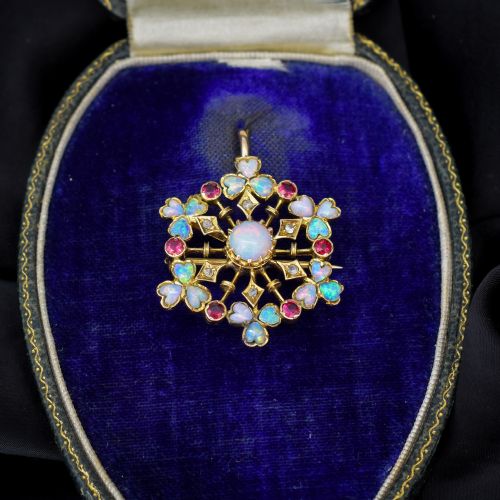


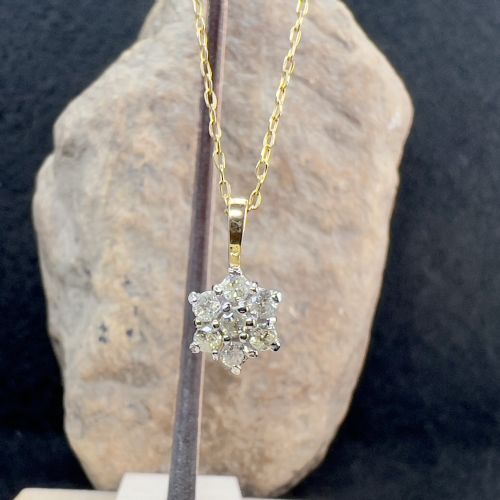


Diamond Flower Cluster Pendant
These diamond flower cluster pendant pieces group central floral arrangements of old cut stones in silver and gold mounts.
Diamond Flower Cluster Pendant
A diamond flower cluster pendant brings together petal formations centred around sparkling stones, created to catch candlelight or daylight with equal charm. These items span Victorian periods through to the mid twentieth century, encompassing traditional and contemporary interpretations of floral motifs.
Most examples found here combine multi carat diamond sets with coloured gems such as rubies, sapphires, or opals, mounted flexibly so they function as both pendants and brooches. The forms range from compact late Victorian clusters to larger starburst designs originating from the eighteen eighties and eighteen nineties.
Buyers seeking a diamond flower cluster pendant encounter pieces fashioned in nine carat, fifteen carat, and eighteen carat gold, frequently backed in silver to enhance the brilliance of the stones. The variety covers nineteen fifties ruby combinations alongside antique French pearl and rose cut diamond expressions.
How they were made
Maker workshops utilised combination settings of silver mounted over gold, a traditional method that kept white metals facing forwards to showcase diamonds whilst gold provided structural strength at the reverse. Stones were hand cut, encompassing old cuts and rose cuts, bedded closely together to mimic natural floral geometry.
Enamelling and high carat gold casting techniques shaped the foundational frames, particularly during the Victorian eras, where intricate wirework and cluster soldering formed the petals. Mounts accommodated multiple stone types simultaneously, integrating rubies, sapphires, and opals directly into the cluster arrangement.
The listings show materials spanning diamond, ruby, sapphire, opal, silver, and gold across Victorian and mid twentieth century periods.
What varies in quality
Quality separates pieces by the uniformity of stone matching and the precision of the cluster geometry, where hand cut facets align to create a cohesive floral silhouette. Superior examples maintain original silver on gold fabrication integrity without structural alterations or replacement stones.
The sophistication of the mounting work defines the upper tier, visible in the fineness of the claw or collet settings holding each diamond and coloured gem. Weight distribution and the crispness of petal contours separate standard production from finer artisan workshops.
The Diamond Flower Cluster Pendant Glossary
- Cluster
- A stone setting arrangement where multiple smaller gems surround a larger central stone to form a unified shape, resembling a flower.
- Old cut
- A hand faceted diamond shape typical of nineteenth century jewellery, featuring a smaller table, higher crown, and open culet.
- Rose cut
- A vintage diamond cut with a flat base and a domed crown consisting of triangular facets arranged in a symmetrical pattern.
- Convertible pendant
- A jewellery piece fitted with a removable pin mechanism allowing it to function as either a brooch or a necklace pendant.
Diamond Flower Cluster Pendant: Frequently Asked Questions
How do I wear a convertible pendant?
These items feature integrated folding loops and pin mechanisms on the reverse, allowing the piece to shift between a brooch fastened to clothing and a pendant suspended from a chain.
Securing the safety catch correctly ensures stability when worn as a brooch, whilst threading a suitable chain through the bail transforms the piece for neck wear.
What periods do these pendants cover?
The selection spans from mid nineteenth century Victorian creations through to the nineteen fifties and nineteen sixties, showing shifts in mounting styles.
Earlier examples from the eighteen eighties often utilise silver backed gold settings, whereas mid century pieces frequently employ nine carat yellow gold.
How should I clean antique diamond jewellery?
Cleaning requires gentle brushing with warm soapy water using a soft bristled brush, taking care around foiled or closed back settings found in period pieces.
Harsh chemical immersion and ultrasonic cleaners risk damaging older metals, pearls, and softer coloured stones like opals embedded within the cluster.
What metals are used in these mountings?
Craftsmen utilised various gold purities including nine carat, fifteen carat, and eighteen carat, alongside silver soldered to the front faces.
Silver was traditionally placed over gold to keep the metal appearing bright white against the diamonds whilst maintaining the durability of gold underneath.