


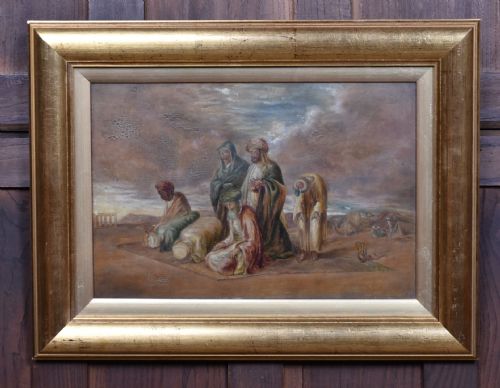


Desert Landscape Painting
These desert landscape painting examples capture arid expanses and distant horizons, offering collectors a window into distant travels and historical vistas.
Desert Landscape Painting
A desert landscape painting presents scenes of arid terrain, featuring subjects such as camels, Bedouin figures, river tributaries, and ancient monuments like the pyramids.
The works span multiple periods, ranging from 19th-century Victorian Orientalism and Edwardian pieces to mid-20th-century realism and modern interpretations.
Compositions often appear on paper, canvas, or board, utilising watercolours, gouache, or oil paint to render the bright light and vast expanses of foreign regions.
Materials and methods
Artists record these arid scenes using oil paint applied to canvas or wood panels, building up rich textures and deep tones for dramatic skies and sandy expanses.
Watercolour and gouache on paper offer a lighter touch, capturing the translucent heat haze and swift atmospheric shifts observed during travels abroad.
Several camels manage to look remarkably unimpressed while posing against vast stretches of sand and ancient monuments.
Judging quality and execution
Quality rests in the handling of light and atmosphere, where skilled brushwork distinguishes a flat depiction from one possessing genuine depth and heat.
Condition matters significantly, particularly with works on paper or board where exposure to light can alter pigments over decades.
Edwin Lord Weeks·Anne Dorrien Smith·Nora Cundell·Cecil Rochfort Doyly John·William James Muller·Yves Brayer·Hugo Vogel·Abdul Kadir Al Rassam·Earl Haig·Frank Holme
The Desert Landscape Painting Glossary
- Orientalism
- Artistic style depicting scenes and people of the Middle East and North Africa. It gained popularity among European and American artists during the nineteenth century.
- Gouche
- An opaque water-based paint that dries to a matte finish. It allows artists to combine the fluid application of watercolour with solid, opaque highlights.
- Gouache
- An opaque water-based paint that dries to a matte finish. It allows artists to combine the fluid application of watercolour with solid, opaque highlights.
- Post-Impressionism
- Art movement following Impressionism that extended its boundaries while retaining its use of vivid colours. Works from this style emphasise symbolic content and distinct brushstrokes.
- Canvas
- Heavy woven fabric used as a surface for oil paintings. It is typically stretched over a wooden frame before application of paint.
Desert Landscape Painting: Frequently Asked Questions
What subjects appear in these paintings?
The works depict arid terrain, camels, Bedouin tribesmen, river tributaries, and ancient monuments such as the pyramids.
Scenes frequently capture specific regions including Arizona, Egypt, Jerusalem, and the Suez Canal.
Which materials do artists use?
Artists employ oil paint on canvas or wood, as well as watercolour and gouache on paper or board.
These varied mediums allow for both detailed atmospheric watercolours and heavily textured oil compositions.
How do I date these artworks?
Dating relies on recorded periods such as the nineteenth century, Edwardian era, or mid-twentieth century dates noted in the listings.
Signatures, artist life dates, and stylistic movements like Orientalism or Post-Impressionism also provide chronological context.
Where should I hang these paintings?
These works suit spaces with controlled lighting to protect sensitive watercolours and gouaches from fading.
Framed oil paintings on canvas adapt well to most interior rooms away from direct heat sources.