

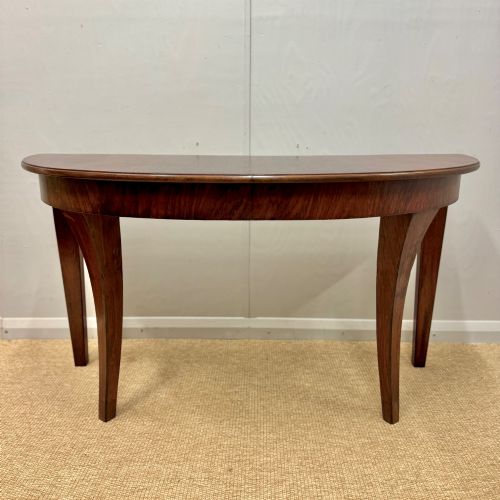

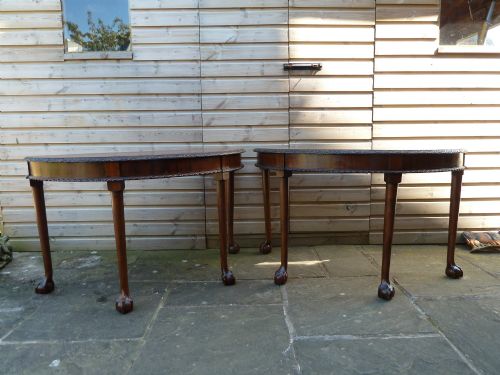


Demilune Wall Table
A demilune wall table brings a graceful semicircular form to an entrance hall or reception room while conserving floor space.
Demilune Wall Table
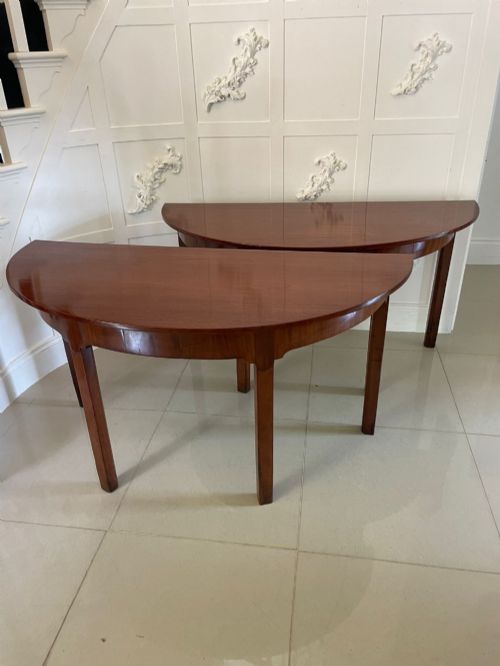
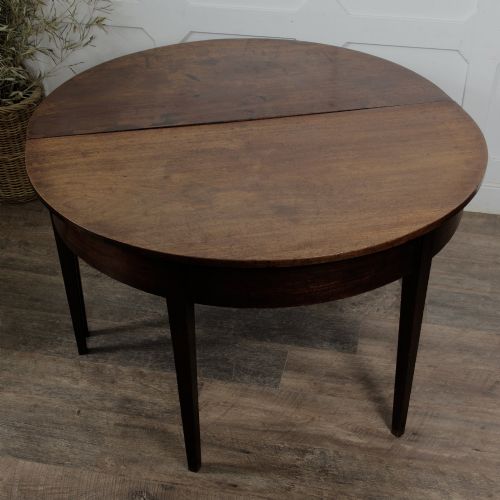
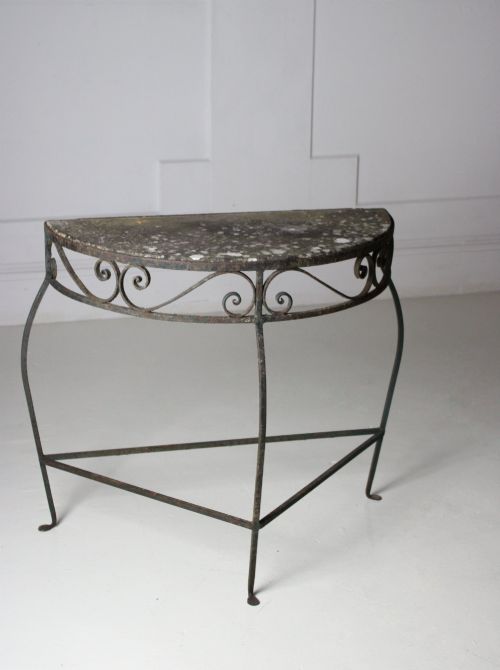
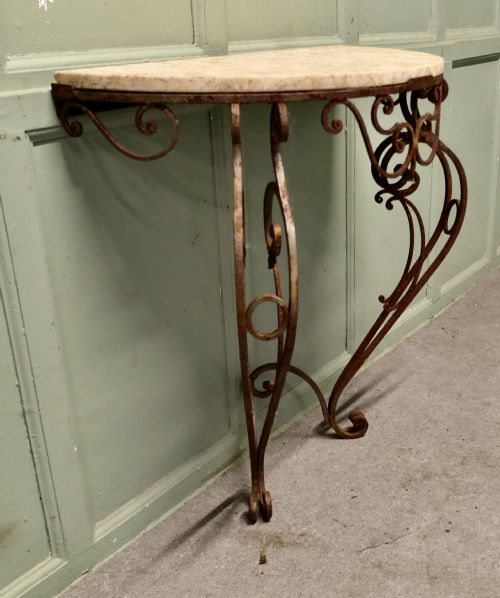
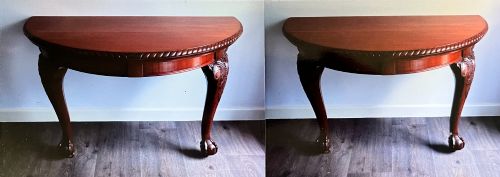
A demilune wall table is a semicircular item designed to stand flush against a wall, frequently functioning as a console, pier, or hall table. When you examine the pieces gathered here, you encounter forms ranging from George III mahogany consoles to Edwardian inlaid examples and rustic iron frames.
The selection spans several centuries, including 18th-century pieces, Georgian designs, and Victorian interpretations up to the 1930s. Tables appear singly or as pairs, offering symmetrical options for flanking a doorway or a matching wall mirror.
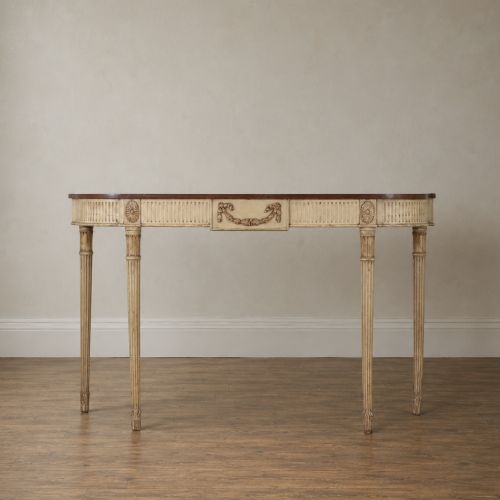
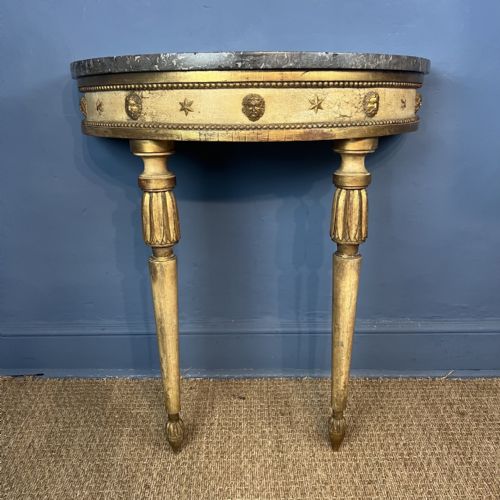
Origins vary across English, French, Italian, and Swedish workshops, introducing regional characteristics like cream paint, parcel gilding, or folk detailing. Buyers select these half-round tables to furnish narrow spaces where a full-depth circular or rectangular table protrudes too far.
Materials and construction methods
Cabinetmakers constructed these tables using timbers such as mahogany, walnut, satinwood, and rosewood, frequently employing crossbanding and marquetry inlays to decorate the semicircular tops. Many examples incorporate figured veneers or bleached finishes to highlight the grain of the wood.
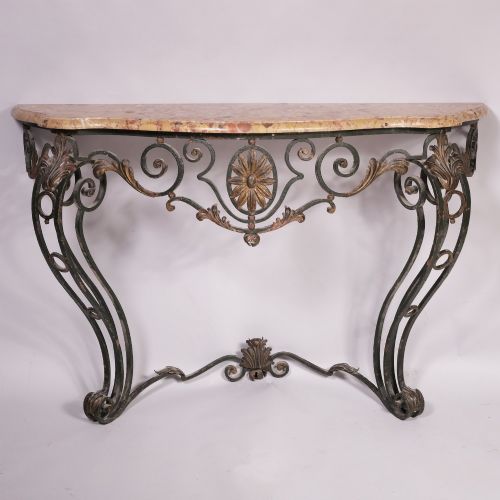
Pioneering makers also utilised stone and metal, pairing heavy marble tops with wrought iron bases, giltwood frames, or gesso ornamentation. Painted and parcel-gilt surfaces appear on continental pieces, utilising cream or polychrome pigments applied over wood.
Several tables arrive in matched pairs, proving that even semicircular furniture refuses to go anywhere alone.
Distinctions in construction and material quality
Quality separates through the selection of timber and the precision of decorative techniques such as marquetry inlay and crossbanding. Tables featuring solid marble slabs and finely carved giltwood or gesso sit at a different level of craftsmanship compared to simpler utility pieces.
The refinement of the legs and the integrity of the frame dictate the standing of a table, with balanced proportions and matching pairs commanding greater attention. Regional execution also plays a part, distinguishing sophisticated metropolitan furniture from provincial folk-made variants.
Edward and Roberts
The Demilune Wall Table Glossary
- Demilune
- A half-moon or semicircular shape used for table tops and furniture designed to stand against a wall.
- Console table
- A table supported by wall brackets or console legs, designed to fit flush against a vertical surface.
- Pier table
- A table specifically built to sit against the wall space between two windows, frequently accompanied by a matching mirror.
- Marquetry
- Decorative veneer work formed by fitted pieces of various woods, shells, or ivory to create pictorial designs on a surface.
- Giltwood
- Wood that has been coated with gold leaf or a gold-coloured metallic finish for decorative effect.
- Crossbanding
- A strip of veneer running border-to-border along the edge of a table top, with the grain running perpendicular to the centre.
Demilune Wall Table: Frequently Asked Questions
Where should I place a demilune wall table?
These tables suit narrow entrance halls, corridors, and reception rooms where floor space is limited. Their flat straight edge pushes directly against the wall while the curved front softens the circulation route.
Pairs function well beneath large wall mirrors or flanking a doorway to create a formal symmetrical arrangement.
What is the difference between a console and a pier table?
A console table relies on wall support or bracket legs, whereas a pier table is traditionally designed for the wall pier between windows.
In modern usage, the terms often overlap, but both describe narrow tables built to occupy minimal depth against a room boundary.
How do I identify a Georgian demilune table?
Georgian examples often feature figured mahogany, subtle inlay work, and restrained proportions typical of late 18th-century design. Look for craftsmanship markers like hand-cut joints and timber selection.
Many bear the characteristic straight tapered legs or carved details associated with the period.
Are these tables sturdy enough for daily use?
Most wall tables rely on proximity to a vertical surface for ultimate stability, though freestanding console designs exist. Marble-topped variants offer durable surfaces for everyday hallway items.
Heavier tops add inherent stability to the base structure beneath.