
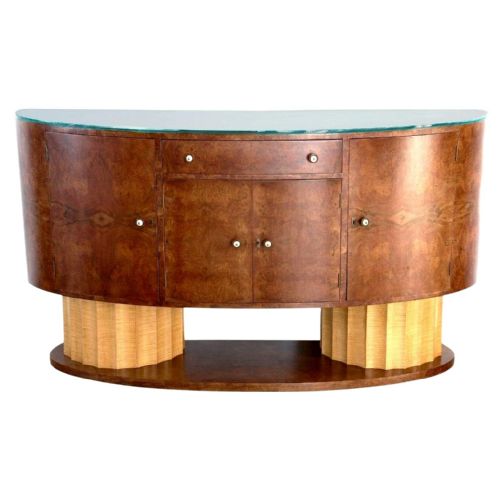

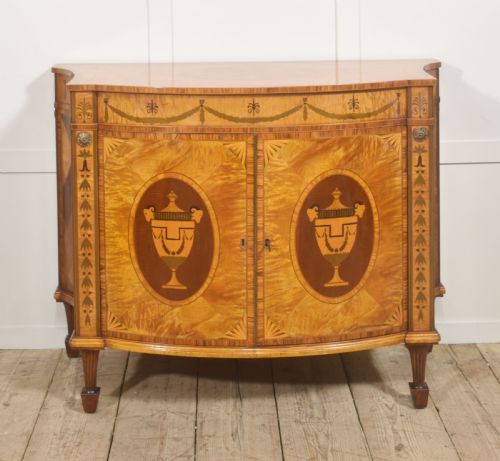


Demi Lune Sideboard Cabinet
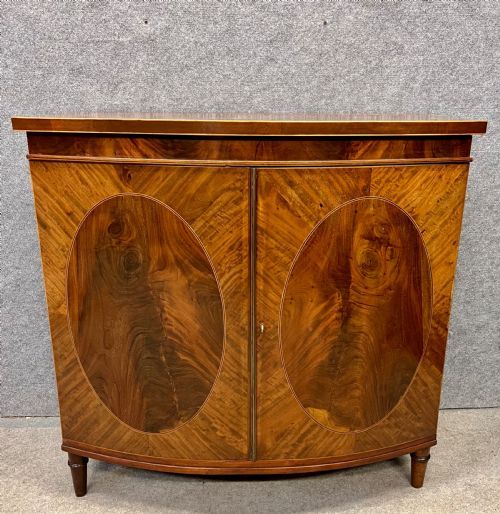
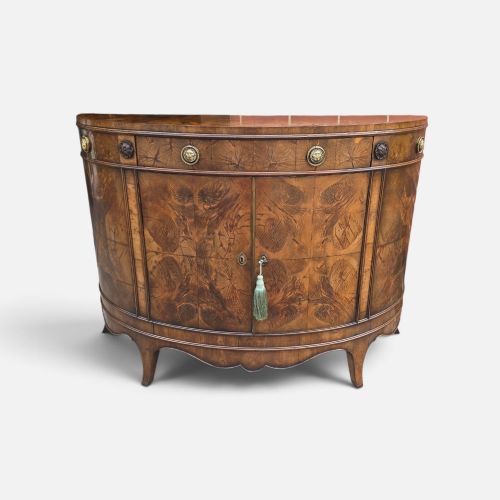
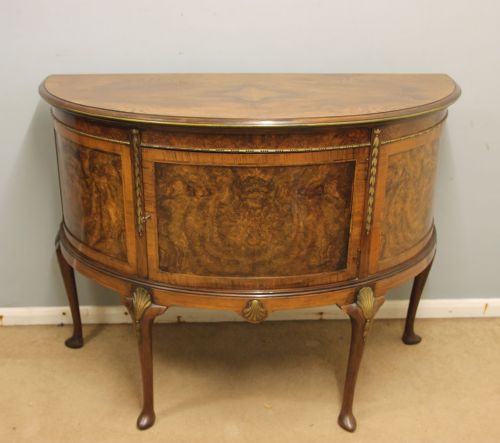
These demi lune sideboard cabinet pieces offer a graceful curved profile and compact footprint that suits period drawing rooms.
Demi Lune Sideboard Cabinet
A demi lune sideboard cabinet provides a semi-circular surface designed to fit snugly against a wall while offering discreet storage within a hallway, drawing room, or dining space. These items span various eras, with examples appearing from the 18th century through the Edwardian period and into the 1930s.
The version most commonly encountered on this page combines a flat back edge with a curved front, frequently realised in satinwood, mahogany, or walnut. Makers often incorporated doors or tambour fronts opening to reveal shelved interiors tailored for storage or drinks.
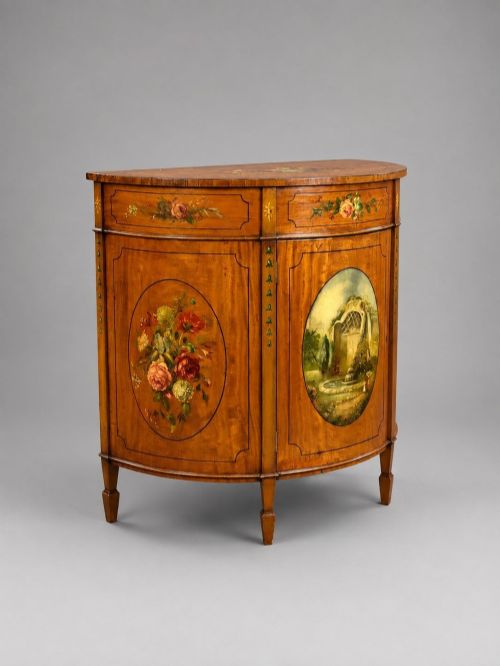
Makers drew upon George III, Sheraton Revival, Neoclassical, and French Louis XVI vocabulary, applying marquetry, paint, or fine wood veneers to the curved facade. Such pieces function equally well as commodes, side cabinets, or compact sideboards depending on their internal layout and proportions.
Materials and construction methods
Cabinetmakers constructed the curved carcase using timber frameworks overlaid with figured veneers such as satinwood, mahogany, walnut, burr elm, and burr yew wood. Boxwood and brass frequently formed stringing and mounts to define the semi-circular edge.
Surface decoration involved intricate marquetry inlay or hand-painted classical panels, often finished with polished marble tops on specific examples. Tambour fronts and hinged doors required precise joinery to follow the demanding radius of the demi lune shape.
Listings feature satinwood, mahogany, walnut, and paint, spanning periods from the 18th century through Edwardian times to Art Deco.
Assessing quality in curved cabinetry
Quality rests upon the precision of the curved joinery and the selection of figured timber veneers across the sweeping facade. Superior examples display seamless grain matching and meticulously fitted doors or tambour mechanisms that operate smoothly along the radius.
The refinement of the decorative scheme separates standard pieces from exceptional ones, particularly where hand-painted classical panels, fine marquetry inlay, and original brass fittings remain intact and well preserved.
Hille·Pietro Ferrario
The Demi Lune Sideboard Cabinet Glossary
- Demi lune
- Half-moon shape describing furniture built with a flat back for a wall and a curved front. This profile defined many 18th-century commodes and later revival side cabinets.
- Marquetry
- The art of applying pieces of veneer to a structure to form decorative patterns and pictures. Craftsmen utilised contrasting timbers like satinwood and boxwood to achieve detailed motifs.
- Commode
- A low chest of drawers or cabinet originating in France. In this context, the term often applies interchangeably with a demi lune side cabinet.
- Tambour
- A flexible shutter made of narrow strips of wood glued to canvas, allowing a curved cabinet door to slide open around a radius. This technique appeared on late 18th-century storage pieces.
- Stringing
- A thin inlay of contrasting wood used to outline drawers, panels, and table edges. It provided a delicate border on satinwood and mahogany surfaces.
Demi Lune Sideboard Cabinet: Frequently Asked Questions
How were these cabinets used originally?
Historically, these items served in dining rooms and grand halls for storing glassware, serving accessories, or documentation. Their curved profiles allowed servants to maneuver around them easily in restricted spaces.
Over time, later iterations also functioned as specialised drinks cabinets or decorative commodes in drawing rooms.
How do I identify a Sheraton Revival piece?
Sheraton Revival examples date primarily from the late 19th and early 20th centuries, drawing inspiration from late 18th-century neoclassical designs. They frequently feature painted satinwood, classical panels, and delicate boxwood stringing.
The lighter timbers and refined proportions distinguish them from heavier Victorian furniture styles.
Where should I place a demi lune cabinet?
These cabinets suit entrance halls, narrow landings, or dining room walls where a standard rectangular sideboard would project too far into the floor space. Their curved fronts soften the geometry of a room.
Pair them with a hanging mirror or artwork that matches the width of the flat back edge.
What woods were commonly used?
Mahogany, walnut, and satinwood dominate the construction of these cabinets, often enhanced by burr elm or burr yew wood veneers. Cabinetmakers selected these timbers for their rich grain patterns.
Inlays of boxwood and accents of brass added contrast to the primary wood surfaces.