




Deep Chest of Drawers
A deep chest of drawers gives you substantial bedroom storage with generous capacity, combining sturdy utility and period character.
Deep Chest of Drawers
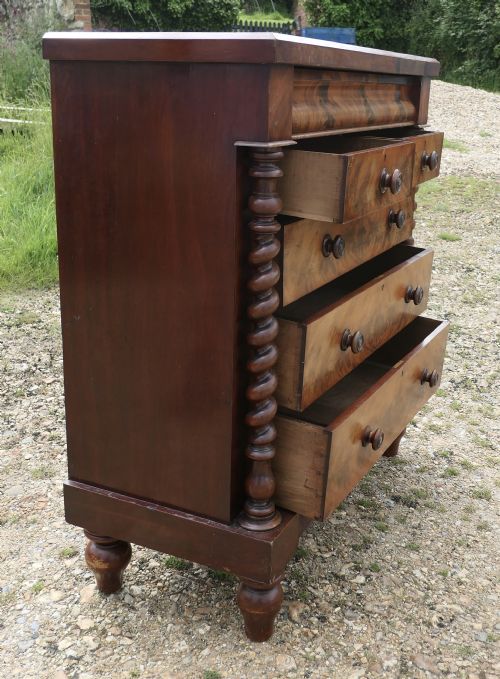
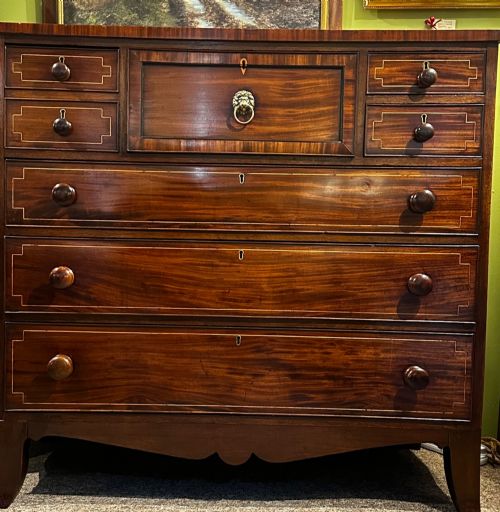
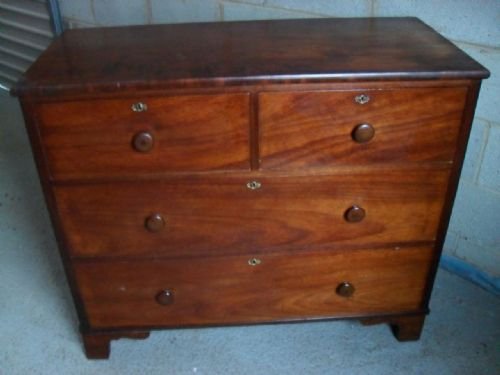
When you search for a deep chest of drawers, you encounter solid storage pieces designed to hold bulky garments and linens. The examples seen here belong predominantly to the Victorian and Regency periods, with occasional pieces from the 17th, 19th, and 20th centuries.
You are most likely to meet large mahogany or waxed pine variations on this page, often featuring configurations like two small drawers over two deep drawers, or tall formats with multiple deep tiers. Scotch chests and bow fronted examples also appear regularly among the listings.
These items originate primarily from domestic bedroom settings where extra depth was required for heavy woollens and blankets. The forms range from wide proportioned carcases to narrower vertical towers suited for compact spaces.
Materials and construction
Cabinetmakers built these carcases using hardwoods such as mahogany and walnut, alongside softer woods like pine, frequently applying flame mahogany veneer to primary display surfaces for striking visual grain patterns. Boxwood stringing and brass details appear for decorative contrast.
Drawers utilise wood, turned, bun, white ceramic, or wooden knob handles, supported by internal framing designed to bear heavy loads. Finish treatments include wax applications that highlight the natural grain of the timber.
Some lower drawers are deep enough to moonlight as blanket chests, solving the eternal mystery of where the spare quilts go.
Assessing quality
Quality in a deep chest of drawers rests upon the choice of timber and the handling of veneers, where select flame mahogany or well-figured walnut distinguishes finer carcases from standard pine utility pieces. The crispness of moulded edges and the integration of plinth bases further set apart superior examples.
The precision of drawer construction determines daily utility, where smooth running actions and well-fitted internal components separate robustly engineered furniture from simpler builds. Surface finishing, whether through consistent waxing or preserved patination, signals the care taken during manufacture.
The Deep Chest of Drawers Glossary
- Scotch chest
- A regional nineteenth-century form typically featuring a central deep drawer flanked by smaller bonnet drawers above a bank of larger drawers.
- Flame mahogany
- A veneer sliced from timber where the branch meets the trunk, producing a distinctive flickering flame pattern.
- Bow front
- A convex curved front facade that softens the rectangular geometry of the chest carcase.
- Plinth base
- A heavy solid platform base supporting the lower section of the chest in place of standard feet.
- Boxwood
- A dense pale wood utilised for fine inlay stringing and decorative contrast on drawer fronts and borders.
Deep Chest of Drawers: Frequently Asked Questions
What is a deep chest of drawers used for?
These pieces provide heavy-duty bedroom storage designed for bulky blankets, heavy winter garments, and large volumes of folded linens that standard shallow drawers cannot accommodate.
The generous depth of the lower drawers allows for substantial stacking capacity while maintaining a formal presence in a bedroom or dressing room.
How do I date a Victorian mahogany chest?
Dating relies on observing construction methods, timber choices, and hardware styles such as turned wooden knobs or bun feet typical of the mid to late nineteenth century.
Secondary woods inside the drawer linings and the presence of hand-cut dovetails offer further physical clues to the exact manufacturing decade.
Where do Scotch chests come from?
Scotch chests originate from nineteenth-century Scottish workshops, identifiable by their specific architectural proportions and distinctive top drawer arrangements.
They often combine deep central storage compartments with smaller upper drawers framed by bold mouldings.
How do I care for a waxed pine chest?
Maintenance involves applying a quality natural beeswax periodically to nourish the softwood and maintain a soft protective sheen against moisture.
Keep the timber away from direct heat sources and dramatic temperature swings to prevent the pine from splitting or warping over time.