
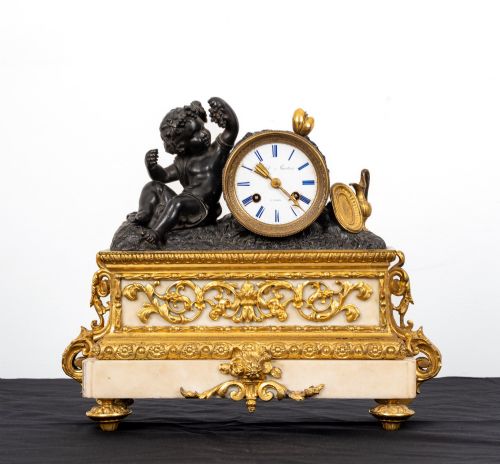
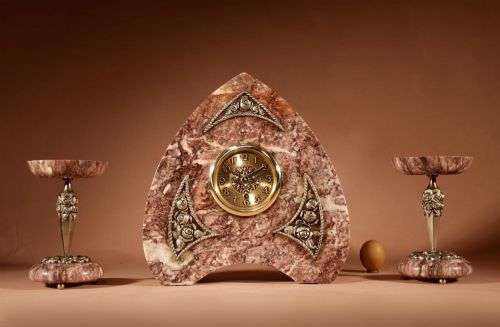


Decorative Marble Mantel Clock
A decorative marble mantel clock brings substantial weight and classical poise to a room, driven by heavy stone cases and ornate metal mounts.
Decorative Marble Mantel Clock
A decorative marble mantel clock is a substantial domestic timekeeper housed in a heavy stone case, frequently paired with matching garnitures to ornament a fireplace or sideboard. These objects combine timekeeping with architectural or figural sculpture, relying on dense mineral bodies for their physical presence.
The versions most commonly met on this page span the Victorian era and the nineteenth century, alongside later Art Deco and Art Nouveau interpretations. French workshops dominate the selection, producing works in styles ranging from Louis XIV and Empire revivals to classical portico designs.
Makers integrated various hardstones with cast metals, mounting bronze, ormolu, and brass upon black, green, pink, or rouge marble structures. Certain examples incorporate figurative elements, ranging from classical figures to animals such as elephants, or feature specialised movements like silk suspensions.
What varies in quality
The distinction between tiers of a decorative marble mantel clock rests upon the crispness of the bronze chasing and the weight and type of the marble used. Finely cast ormolu mounts with deep, hand-finished detail separate superior workshop output from simpler, mass-produced metal elements.
The integration of the movement with the case, the presence of matching garniture sets, and the complexity of the stone architecture - such as multi-coloured marble inlays or portico columns - determine the standing of an individual piece within the historical range.
Siffel & Cartier·Charpentier Foundry·Thos Agnew & Sons
The Decorative Marble Mantel Clock Glossary
- Ormolu
- Gilded bronze produced by applying a mercury-gilding amalgam to a cast bronze base. This technique creates a durable, warm metallic lustre characteristic of French mantel clocks.
- Garniture
- A set of ornamental objects designed to match a clock and be displayed alongside it on a mantelpiece. These usually comprise side vases or candelabra executed in corresponding materials.
- Portico clock
- A mantel clock styled after classical architecture, featuring a dial suspended within a frame supported by columns. Pink and white marble examples are typical of the nineteenth century.
- Silk suspension
- An early method of hanging the pendulum from a fine loop of silk thread rather than a metal spring. This fragile mechanism is associated with earlier nineteenth-century French movements.
Decorative Marble Mantel Clock: Frequently Asked Questions
What is a clock garniture?
A clock garniture is a matching set of decorative objects, typically urns, vases, or candelabra, designed to sit on either side of the mantel clock.
These matched sets create a balanced, symmetrical display across a fireplace mantel or sideboard in period interiors.
How do I care for marble clock cases?
Marble clock cases require only gentle dusting with a soft, dry cloth to maintain their polished surface.
Avoid using water, chemical cleaners, or abrasive polishes, as these can damage the stone surface and tarnish adjacent metal mounts.
Are these clocks heavy?
Yes, these clocks possess substantial weight due to the solid marble, onyx, or slate used in their construction.
Buyers must ensure that any shelf or mantelpiece supporting the clock is structurally sound and level enough to bear the load.
How do I date a marble clock?
Dating relies on stylistic clues, such as classical revival motifs indicating the nineteenth century, or geometric lines pointing to the 1920s.
Examining the movement backplate and the casting style of the bronze mounts also provides clear indicators of the period of manufacture.