
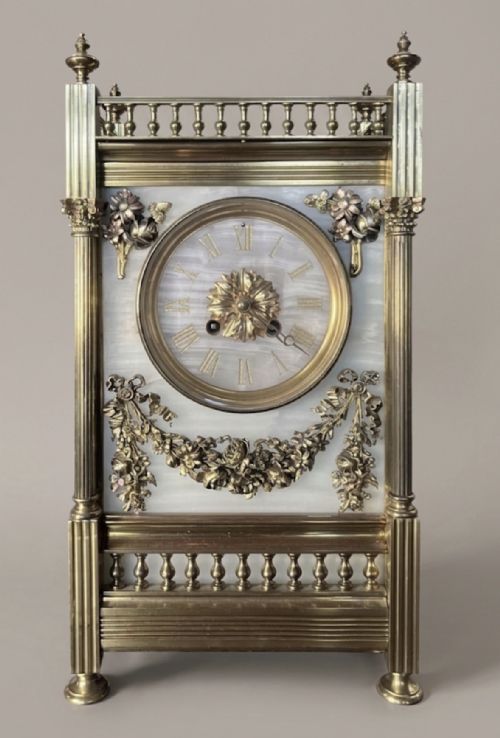


French Alabaster Mantel Clock
A french alabaster mantel clock brings a luminous, classical presence to a room, combining soft stone with rich metal mounts.
French Alabaster Mantel Clock
A french alabaster mantel clock sits among the most refined timepieces of the nineteenth century, bridging decorative sculpture and functional engineering. When buyers search for a french alabaster mantel clock, they encounter forms ranging from simple portico designs to elaborate clock garnitures complete with candelabras.
The pieces appearing on this page span the Victorian era, the late nineteenth century, and early twentieth-century movements like Art Deco. Most examples combine carved alabaster or white marble bodies with contrasting brass, gilt bronze, or ormolu mounts.
Originating predominantly from French workshops, these clocks often feature enamel dials and eight-day movements. Buyers frequently find matching side pieces or glass domes accompanying the main clock.
Markers of distinction
The fineness of the stone carving dictates much of the visual appeal, separating simple geometric housings from deeply sculpted figural cases. Crisp details in the cast bronze or ormolu mounts indicate skilled chasing and high workshop standards.
The integrity of the movement and the presence of original components, such as matching garniture pieces or glass domes, elevate certain examples above standard domestic timepieces.
Cupid figures and swinging cherubs occasionally lean out from the marble columns to check the hour.
James Ritchie and Son·Farcot
The French Alabaster Mantel Clock Glossary
- Alabaster
- A fine-grained, translucent stone used for the bodies of nineteenth-century clock cases. Its softness allowed for delicate architectural and figural carving.
- Ormolu
- Gilded bronze produced through a mercury amalgamation technique, providing a rich golden finish to metal mounts. It creates a striking contrast against white stone.
- Portico clock
- A distinct clock style featuring two supporting columns framing a central hanging pendulum. This architectural form draws heavily on neoclassical design principles.
- Clock garniture
- A matching set consisting of a central clock flanked by decorative accessories such as candelabras or urns. These sets provided symmetry for nineteenth-century mantelpieces.
- Fusee
- A conical pulley used in clock movements to maintain even driving force as the mainspring unwinds. It represents a higher standard of clockmaking precision.
French Alabaster Mantel Clock: Frequently Asked Questions
How do I wind an eight day clock?
Insert the winding key into the dial holes and turn gently until resistance is felt. Take care not to overwind the mainspring.
Most nineteenth-century movements require this attention weekly to keep accurate time.
Can these clocks be cleaned safely?
Dust alabaster gently with a dry, soft cloth, avoiding water or chemical cleaners that dissolve the soft stone. Metal mounts require similarly dry maintenance to protect gilt surfaces.
Harsh polishing compounds will damage the patination built up over decades.
Why does my clock have a glass dome?
Glass domes protected delicate ormolu mounts and soft alabaster from household dust and soot in nineteenth-century coal-heated homes. They also stabilized the environment around exposed pendulums.
Original domes add significant authenticity to a surviving piece.
What is a clock garniture?
A garniture comprises a central mantel clock accompanied by matching decorative side pieces like candelabras or urns. Victorian interiors used these sets to create balanced mantelpiece displays.
Finding a complete matching set remains uncommon.