
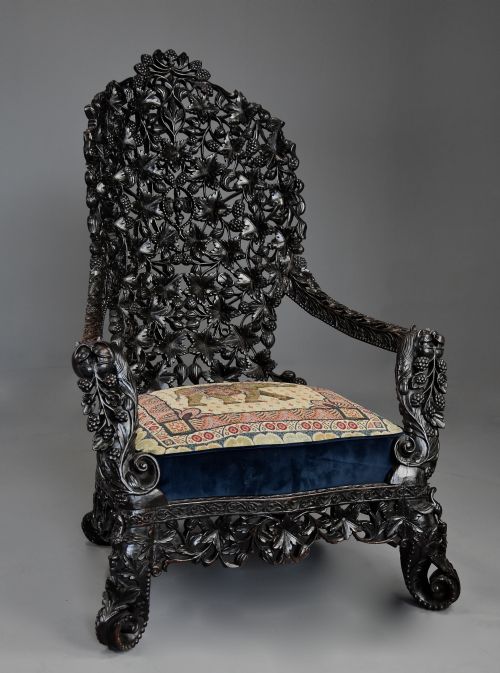


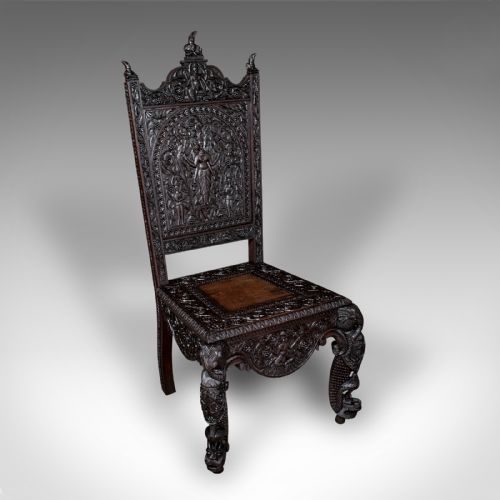
Dark Wood Ornate Chair
These dark wood ornate chair selections bring together centuries of dense carving, global trade routes and domestic seating.
Dark Wood Ornate Chair
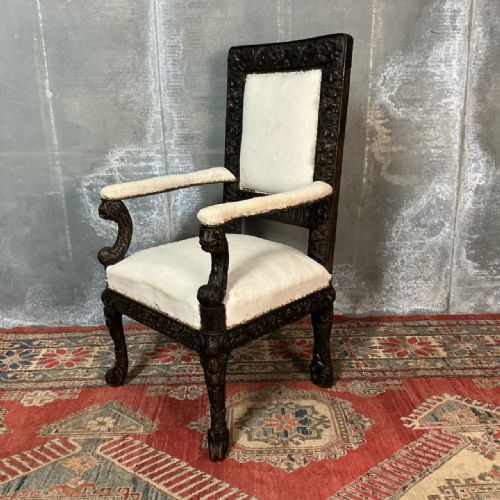
A dark wood ornate chair brings together dense timber carving and functional domestic seating, drawing from periods ranging across the eighteenth, nineteenth and early twentieth centuries. When searching for a dark wood ornate chair, buyers most frequently encounter Victorian interpretations alongside continental revival pieces and colonial workshop production.
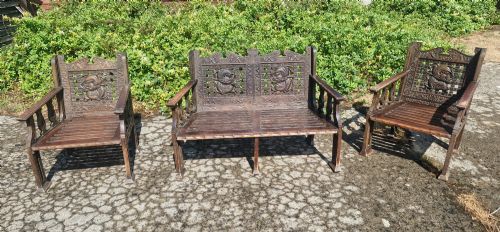
The assortment on this page spans dining chairs, hall chairs, armchairs and occasional seating suites in regional timber. Makers deployed heavy relief work across oak, walnut, mahogany, padauk and teak to satisfy domestic and institutional demand.
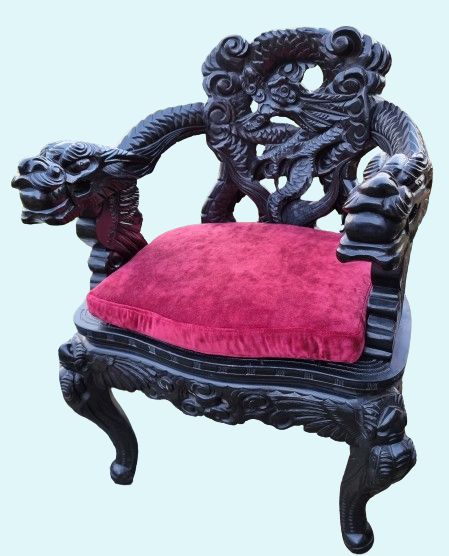
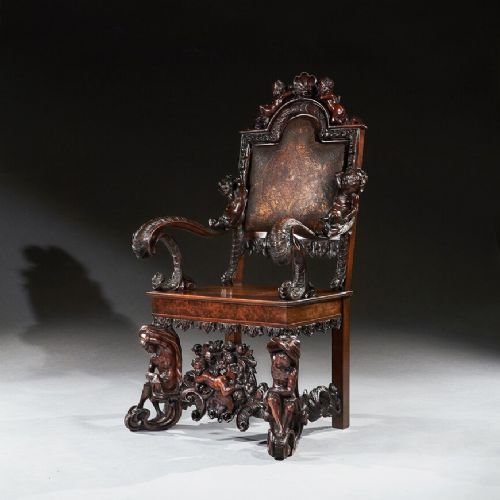
Origins stretch from British workshops to Italian revival centres, French studios, Swiss makers and Asian export hubs including Burmese and Indian carvers. Forms shift from upright high-back side chairs to deep-set armchairs and structural hall benches.
Materials and technique
Construction relies upon dense hardwoods such as oak, walnut, mahogany, teak and padauk, selected for structural stability under heavy manual carving. Artisans executed deep relief work by hand, shaping foliage, figures, animals and geometric motifs directly into the timber frame.
Joinery combines traditional tenon and mortise framing with turned supports and applied mouldings. Upholstered variants incorporate textiles, fabric, velvet and brass elements fixed to padded seats and backs.
One chair bears a carved back showing a dancing bear from the Black Forest manner.
Assessment of quality
Depth and crispness of the hand carving distinguish standard production from exceptional pieces, where carvers maintained clean undercut details and symmetrical balance across complex figurative scenes. Timber selection also dictates the grade, as dense grain figures in walnut, oak and padauk hold structural integrity and sharper relief lines over decades of use.
Construction methods reveal the hand of the maker through tight joinery, absence of modern fasteners and proportioned framing that supports the heavy ornamentation without warping.
Andrea Brustolon
The Dark Wood Ornate Chair Glossary
- Hall Chair
- A rigid wooden seat designed for an entrance hall or corridor, frequently featuring a high carved back bearing heraldic or decorative motifs. These pieces prioritized display over prolonged sitting.
- Sgabello
- A portable wooden Renaissance chair with a high back and trestle supports instead of traditional legs. The form originated in Italy and emphasises flat carved panels.
- Padauk
- A dense, durable tropical hardwood with a reddish-brown tone utilised by colonial and export workshops. It accepts intricate hand carving without splintering.
- Marquetry
- The art of applying small pieces of veneer to a wooden structure to form decorative patterns. Artisans utilised contrasting timber shades to create pictorial designs.
Dark Wood Ornate Chair: Frequently Asked Questions
What is a dark wood ornate chair used for?
These chairs served as functional seating while signalling social status, taste and cultural awareness in domestic interiors, parlours and entrance halls.
Today, buyers place them as accent pieces in living rooms or studies where their heavy carving contributes visual weight and historical character.
How do I care for antique carved wood?
Maintain stable indoor humidity levels and keep wooden frames away from direct heat sources to prevent timber splitting and shrinkage.
Dust intricate relief carvings regularly with a soft dry brush and apply occasional natural wax to preserve the finish.
How can I tell an 19th-century chair apart?
Nineteenth-century seating often draws from earlier revivals like Baroque, Renaissance or Chippendale styles while utilising machine-assisted preparation combined with manual finishing.
Examine the underside and joints for tool marks, timber ageing and construction methods consistent with Victorian production standards.
Where were colonial ornate chairs made?
Colonial workshops operated across regions such as India, Ceylon and Burma, utilising local dense hardwoods like padauk and teak.
Local artisans combined traditional European seating forms with intricate indigenous carving traditions and regional iconography.