


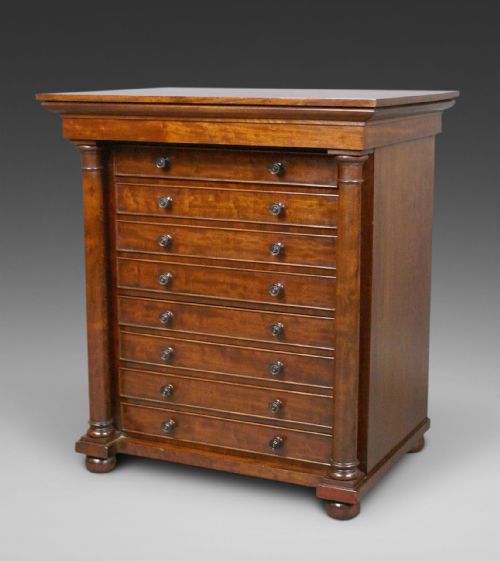


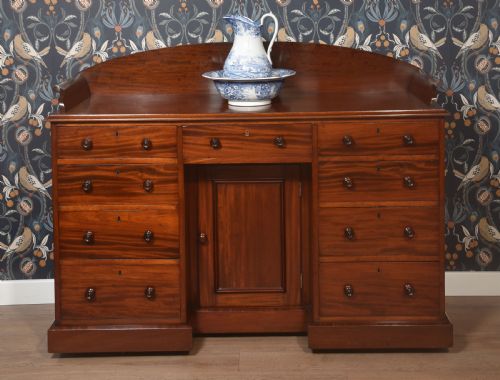
Dark Mahogany Storage Desk
These dark mahogany storage desk pieces offer practical storage and rich timber warmth, drawing you straight to the honest craftsmanship of past centuries.
Dark Mahogany Storage Desk
A dark mahogany storage desk brings together deep timber tones and functional compartments for everyday use. When searching for a dark mahogany storage desk, you will most frequently encounter compact writing bureaux, sideboards, and tabletop cabinets spanning periods from the Georgian era through to the Victorian age.
The selection ranges from large bow-fronted sideboards down to miniature chests of drawers and waterfall desk tidies. These items served traditional domestic needs, from storing household linens and papers to housing valuable collections.
How they were made
Cabinet makers relied primarily on solid mahogany and mahogany veneers, often accentuating drawer edges and borders with fine boxwood stringing. Timber selection focused on rich grain patterns that deepened in colour over decades of polishing.
Hardware details such as cast brass drop handles were fitted securely to drawers and doors to handle daily operation. Secondary timbers like oak appeared in internal drawer construction, while bone occasionally served for escutcheons and small decorative inlay points.
Dark Mahogany Storage Desk Retail Price Guide 2026
Typical asking prices for dark mahogany storage desk among the pieces listed under this phrase on Sellingantiques today, from the lower quarter to the upper quarter. They describe what is for sale here now, not the wider market.
The listings span multiple centuries, including Georgian, Regency, and Victorian eras, utilising mahogany alongside brass, boxwood, and bone.
What varies in quality
The distinction between standard examples and finer pieces lies in the crispness of the timber carving and the subtlety of the decorative stringing. Master craftsmen invested greater time in selecting figured mahogany veneers and ensuring seamless joinery across complex forms like bow-fronted carcasses.
Proportion and balance dictate the architectural success of each piece, separating straightforward utilitarian items from those commissioned for formal reception rooms. Original hardware and undisturbed surface patination further elevate the standing of an individual storage item.
The Dark Mahogany Storage Desk Glossary
- Mahogany
- A durable hardwood prized for its rich reddish-brown colour and stability. It forms the primary structural and visual base for these storage pieces.
- Boxwood stringing
- A narrow inlay of pale contrasting wood used to outline drawer fronts and panels. This technique adds linear definition to dark timber surfaces.
- Cellarette
- A fitted container or table designed to hold wine bottles securely. These pieces often feature internal partitioning tailored for liquid storage.
- Escutcheon
- A small protective plate surrounding a keyhole, frequently fashioned from brass or bone. It prevents the surrounding wood from wearing down through repeated use.
Dark Mahogany Storage Desk: Frequently Asked Questions
How do I care for mahogany?
Keep mahogany furniture away from direct sunlight and sudden temperature shifts to prevent the timber from drying out. Regular dusting with a soft, dry cloth preserves the natural lustre.
Apply a traditional wax polish sparingly when the wood appears dry, buffing gently to maintain the soft sheen built up over generations.
Where were these pieces used?
These storage forms found places throughout the home, from formal dining rooms and libraries to private dressing rooms and studies. Larger sideboards managed tableware, while tabletop cabinets and miniature chests organised documents and personal trinkets.
Housekeepers and writers relied on these compartments to keep papers and household necessities orderly and secure.
How can I tell Georgian from Victorian?
Georgian pieces, dating through the eighteenth and early nineteenth centuries, generally display restrained classical proportions and refined stringing details. Cabinetmakers of this era favoured elegant structural lines and understated brass hardware.
Victorian pieces often present heavier proportions and more robust construction to suit changing domestic tastes. Decoration during the later period became more varied, incorporating turned elements and more pronounced functional storage forms.